
 United States
 United Kingdom
 Canada
 Australia
 New Zealand
 Ireland
Smart cameras can expose homes and relay cyberattacks, Japanese report warns
A cybersecurity demonstration shows how internet-connected devices can be found online, followed by practical steps for securing household appliances.
 JapanStory of
Why this story? One of TBS NEWS DIG Powered by JNN's most watched videos since yesterday, with 111,316 views.
TBS NEWS DIG Powered by JNN: The news channel of JNN, a Japanese news network led by TBS. 3.4M subscribers and 5.7B views.
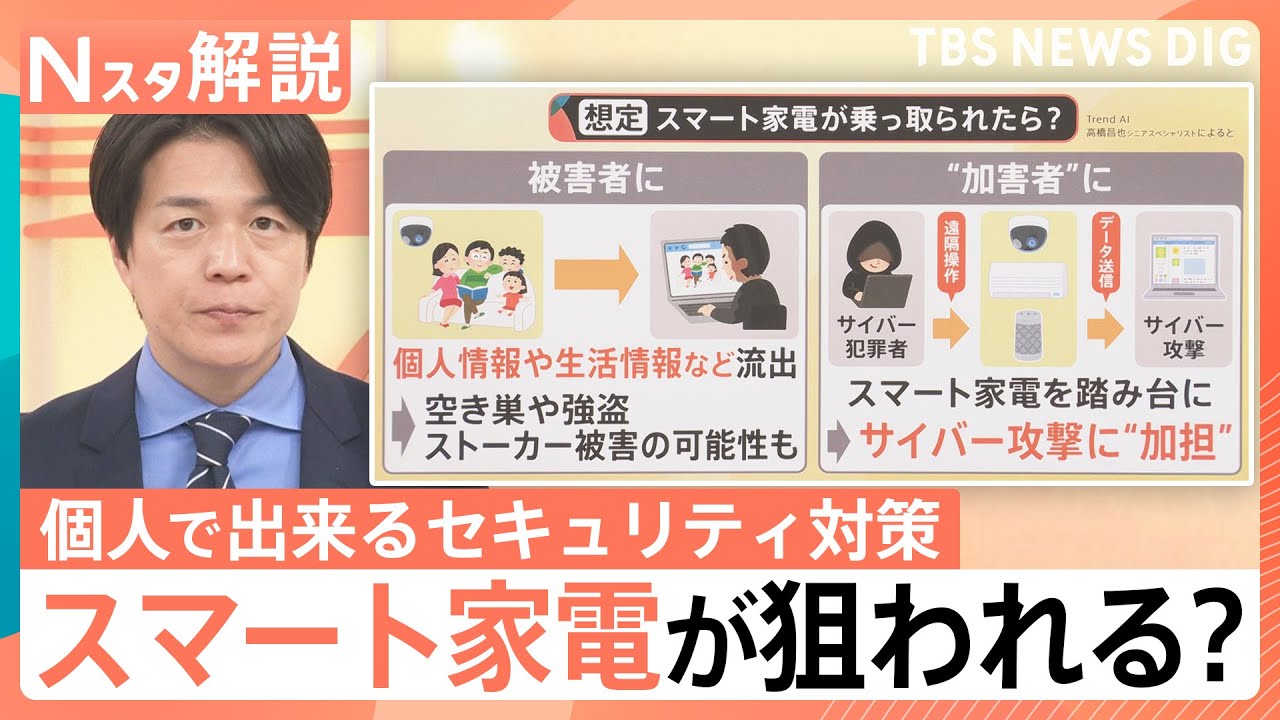 狙われる「スマート家電」サイバー攻撃の約3割…見守りカメラから空き巣・ストーカー被害?加害者になるおそれも 個人でできる対策とは【Nスタ解説】|TBS NEWS DIG
Things we can learn from the video
Press to jump
- 0:00Good Smile Company announces a customer credit-card information leak; an affected customer describes checking account activity.
- 0:47The report presents Anthropic's warning about Claude Mythos potentially infiltrating and spreading across smart appliances.
- 2:21Nanba cites NICT observations indicating that around 30% of observed cyberattacks targeted IoT devices.
- 4:03Matsuda demonstrates how searchable device information can help attackers identify equipment running outdated software.
- 5:43Compromised devices could expose household routines or become relays for cyberattacks against other people and organizations.
- 7:30Disconnect unused connections, change default passwords, update software, and check security labels and manufacturer support periods.
A camera installed to watch a pet or protect a home can also give strangers a window inside. A Japanese news segment examines how poorly secured smart appliances can expose household routines, or be commandeered to carry out cyberattacks against someone else.
Japan's TBS NEWS DIG Powered by JNN opens its N Star report with Good Smile Company's announcement of a customer credit-card information leak. An affected customer describes checking their account history after receiving a notification. The report then shifts from company databases to internet-connected equipment inside homes, including cameras, speakers, refrigerators and air conditioners.
Presenter Masatoshi Nanba cites a report from Japan's National Institute of Information and Communications Technology showing that roughly 30% of the cyberattacks it observed targeted Internet of Things devices. The segment also presents an Anthropic warning about the potential for its Claude Mythos AI model to infiltrate connected appliances and spread between them.
Cybersecurity expert Kazuyuki Matsuda explains the exposure through a demonstration: an online search service displays information about millions of internet-connected devices. Finding a device in such a directory is not itself the same as breaking into it. But, he explains, attackers can use the information to identify outdated software and select targets. Some camera feeds can also be exposed without an intrusion because passwords were never configured.
The report describes two different risks. Stolen images and information about daily routines could assist burglary or stalking. Separately, a compromised appliance could become a relay for attacks against businesses or individuals, concealing the attacker's origin. That does not mean the appliance's owner knowingly participated; the device itself has been taken over.
The closing advice is specific. Disconnect unused equipment from the internet. Where unplugging is impractical, as with a refrigerator, switch off unused Wi-Fi functions instead. Replace default passwords with complex ones and keep device software updated.
For new purchases, the segment points to Japan's JC-STAR security-labeling scheme as a way to assess security features. Masaya Takahashi, a senior specialist at Trend AI, also urges owners to check the manufacturer's support period: once support ends, security updates may end too, making replacement worth considering.
A Japanese hobby-product manufacturer and video game developer. Its products include the Nendoroid and Figma figure lines.
More on Wikipedia ›Japan's main national research institute for information and communications, based in Koganei, Tokyo.
More on Wikipedia ›An American artificial intelligence company based in San Francisco. It develops Claude, a family of large language models.
More on Wikipedia ›An American-Japanese cybersecurity software company that develops protection for business networks, servers, cloud environments and devices.
More on Wikipedia ›Published on Trari
Where next?



- Channel
- TBS NEWS DIG Powered by JNN
- Subscribers
- 3,420,000
- Channel views, pace per day
- 8,047,480 (on a normal day: 3,520,636)
- Video published
- October 30, 2026
- Video views so far
- 111,316 (less than a day online)
- Video views, pace per day
- 134,827
The numbers
The smart-appliance security report drew about 111,000 views since yesterday.
