
 United States
 United Kingdom
 Canada
 Australia
 New Zealand
 Ireland
El Niño's strongest winter effects still ahead, Canadian researcher says
Chris Fletcher tells The Current that unusually warm November weather precedes the season when El Niño typically has its greatest influence.
Why this story? One of CBC News's most watched videos since yesterday, with 152,860 views.
CBC News: The news division of the CBC, Canada's public broadcaster. 4.8M subscribers and 3.4B views.
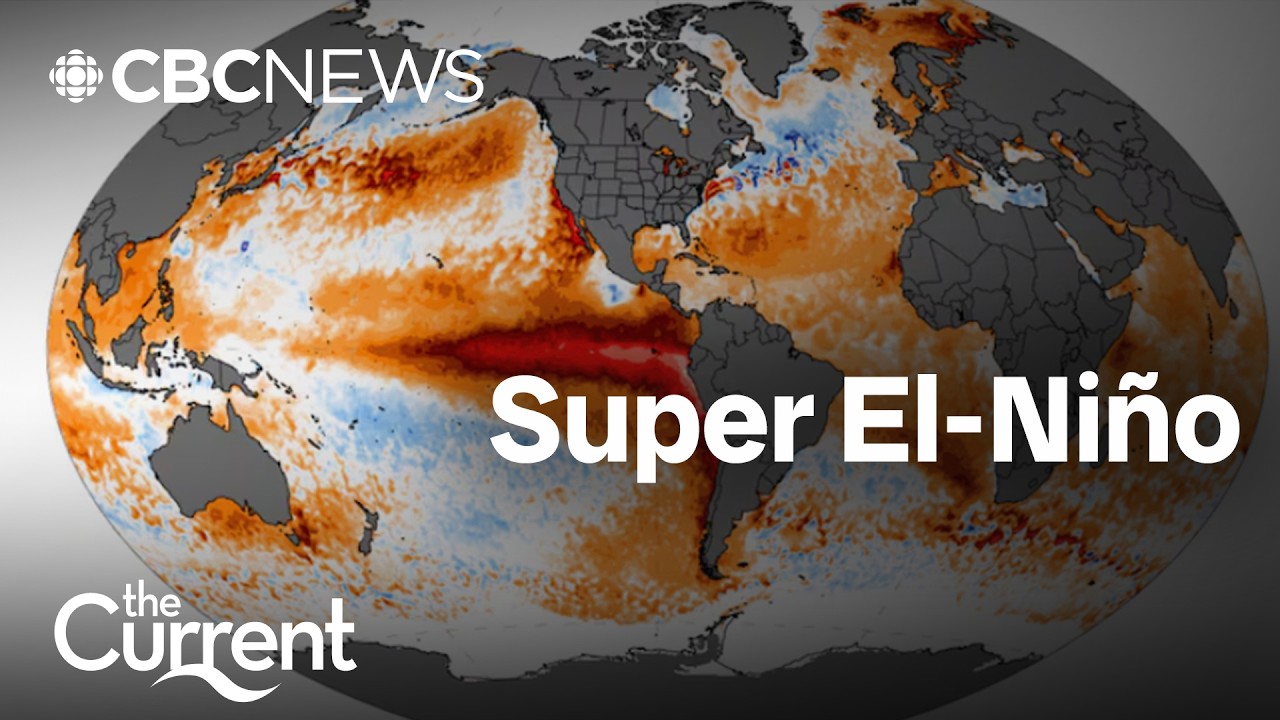 Super El-Niño is changing Canadian winters | The Current
Things we can learn from the video
Press to jump
- 0:39El Niño is a naturally recurring climate pattern centered on the equatorial Pacific.
- 2:14Fletcher explains the "super" label by citing exceptionally elevated central Pacific ocean temperatures.
- 3:29El Niño's peak influence typically arrives in winter, rather than during the early-November warmth.
- 4:33Federal forecasts point toward a high probability of warmer-than-normal winter temperatures across Canada.
- 5:45Less snow can affect recreation, ice roads, spring water supplies, soil moisture and wildfire risk.
- 7:12Fletcher explains how natural El Niño variability operates on top of human-caused climate warming.
Canada's early-November warmth is not necessarily the main event. Climate researcher Chris Fletcher says El Niño's strongest effects usually arrive between December and February, with forecasts pointing toward a warmer-than-normal Canadian winter.
In an audio interview from Canada's Canadian Broadcasting Corporation (CBC) News, host Matt Galloway asks Fletcher what the unusually powerful Pacific warming event could mean beyond a few comfortable autumn afternoons. The conversation plays over a still photograph of people walking and running in a Toronto park.
Fletcher, chair of geography and environmental management at the University of Waterloo in Ontario, describes El Niño as a naturally recurring climate pattern centered on the equatorial Pacific. Changes there can influence weather far beyond the ocean itself.
He calls this event a "Super El Niño," citing central Pacific ocean temperatures approaching three degrees Celsius above the reference threshold he describes. Fletcher says its magnitude is unprecedented in the instrumental record.
The winter outlook matters more than the November temperatures alone. Fletcher says Environment and Climate Change Canada's forecasts show a high probability of above-normal temperatures across Canada, highlighting the Pacific Northwest and areas east of the Rockies. He also expects below-average snowfall and snow cover.
That would affect more than skiing. Fletcher explains that reduced snow and warmer conditions can disrupt winter recreation and ice roads, while leaving less stored water for spring. Snowpack supplies moisture as it melts; a smaller reserve can have consequences for soils and wildfire risk later in the year.
Fletcher also distinguishes the natural cycle from the warmer climate in which it is occurring. Human-caused warming, he says, provides the background on top of which El Niño operates. His central point is that a pleasant warm spell and a consequential winter outlook can be part of the same story.
The warming phase of a recurring climate pattern involving tropical Pacific winds and sea temperatures. Its effects extend beyond the tropics to influence weather in other parts of the world.
More on Wikipedia ›A public research university in Waterloo, Ontario, and a member of Canada's U15 group of research-intensive universities.
More on Wikipedia ›The Canadian federal department that coordinates environmental policies and programs and works to protect the natural environment and renewable resources. It is also known by its former name, Environment Canada.
More on Wikipedia ›Published on Trari
Where next?


- Channel
- CBC News
- Subscribers
- 4,780,000
- Channel views, last 7 days
- 17,256,505
- Channel views, pace per day
- 2,048,657 (on a normal day: 2,427,866)
- Video published
- November 5, 2026
- Video views so far
- 185,283 (2 days online)
- Video views, pace per day
- 153,014 (on a normal day: 71,772)
The numbers
The interview drew roughly 153,000 views since yesterday, placing it among Canada's most-watched new news videos.

💡 Test your knowledge
When does Fletcher say El Niño typically reaches its peak influence on Canadian winter weather?
Fletcher says El Niño generally peaks during the winter season, between December and February.