
French TGV drivers explain restricted restarts after Spain collision
A French television report pairs disputed instructions in Spain's train-control recordings with an explanation of automatic braking and low-speed running in France.
 France
Why this story? One of TF1 INFO's most watched videos since yesterday, with 206,489 views.
TF1 INFO: The news division of TF1, a private French television channel owned by the Bouygues group. 1.8M subscribers and 1.9B views.
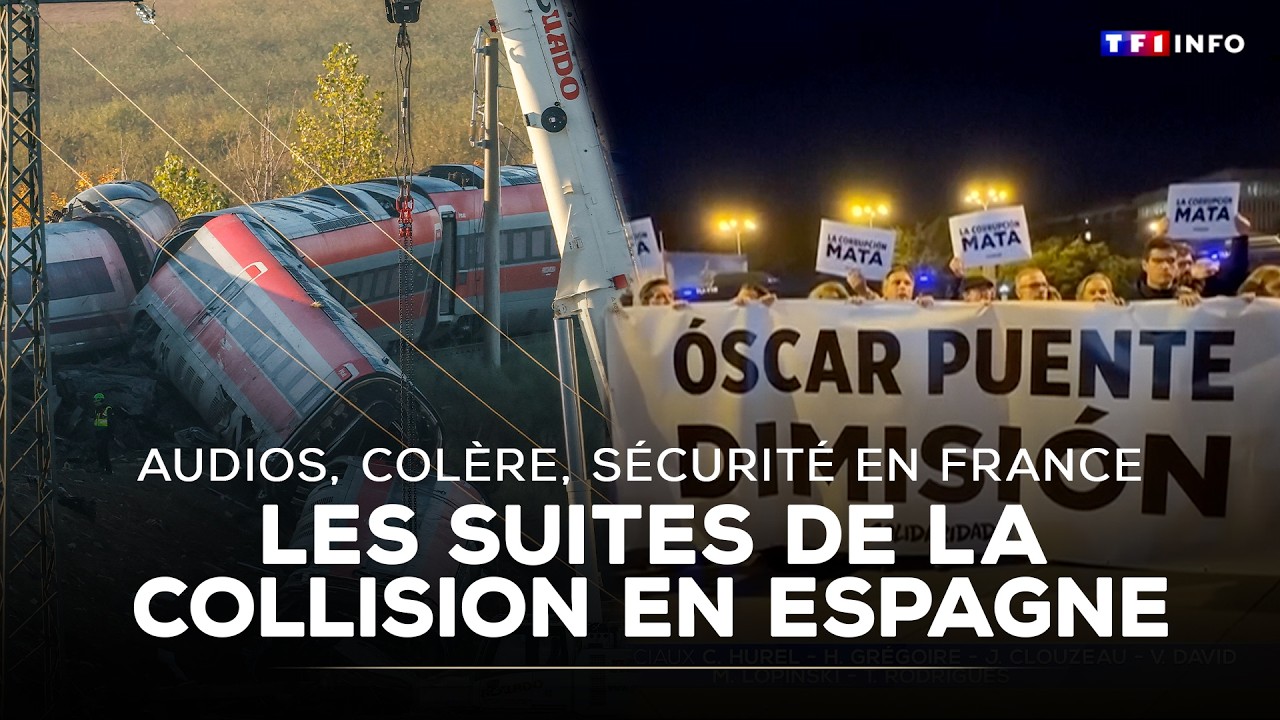 COLLISION EN ESPAGNE : Ce que révèlent les enregistrements audio quelques minutes avant le drame
Things we can learn from the video
Press to jump
- 1:12Radio exchanges reconstruct a disputed authorization to restart at normal speed before the collision.
- 2:35The broadcast reports national mourning and calls for the transport minister's resignation.
- 3:01Families await news outside Toledo's hospital and morgue as DNA samples help identify victims.
- 4:40The report turns to French TGV procedures following an unexpected stop.
- 5:01Track sections and automatic emergency braking form part of the French safety explanation.
- 6:14Driver Grégory Moser explains running by sight at no more than 30 km/h.
Permission to restart is not necessarily permission to resume normal speed. That distinction anchors France's TF1 INFO report on the fatal railway collision at Urda, in the province of Toledo, and the safeguards used on French high-speed lines.
The broadcast reconstructs radio exchanges between Spanish train drivers and a control center. In the recording presented, a driver asks whether to proceed at normal speed and receives an affirmative response. The report examines that instruction as a possible human error, rather than presenting it as a settled finding about responsibility for the collision.
At the wreckage, emergency crews and Spain's Guardia Civil continue searching damaged carriages and clearing debris. Elsewhere, families wait outside Toledo's hospital and morgue, with DNA samples being collected to help identify victims. Manuel and Esther are seeking news of a missing passenger; Esther says they simply want to know what has happened.
The broadcast reports that several French nationals remain unaccounted for. It also describes three days of national mourning and shows demands for Transport Minister Óscar Puente to resign.
The second part asks what happens when a French TGV stops unexpectedly. Its explanation begins with the division of track into signaling sections, which help maintain separation between trains, and automatic systems designed to bring trains to a halt when required.
SNCF driver Grégory Moser explains restricted running known as "marche à vue": proceeding by sight without exceeding 30 km/h. Former TGV driver Denis Claudel also contributes to the account of safety procedures.
Rail journalist Marie-Hélène Poingt describes the French system as particularly safe. The report cites the response to railway sabotage in July 2024 as an example of those protections, while keeping its French safety explanation separate from the unresolved question of what failed in Spain.
One of Spain’s two national law enforcement agencies. It is a military-style force responsible for civilian policing under the interior and defence ministries.
More on Wikipedia ›Spain’s Minister of Transport and Sustainable Mobility since 2023. He belongs to the Spanish Socialist Workers’ Party and previously served as mayor of Valladolid.
More on Wikipedia ›France’s state-owned railway operator, which runs passenger and freight services, including the TGV, and manages railway infrastructure.
More on Wikipedia ›Published on Trari
Where next?



- Channel
- TF1 INFO
- Subscribers
- 1,760,000
- Channel views, pace per day
- 4,052,637 (on a normal day: 2,253,571)
- Video published
- October 29, 2026
- Video views so far
- 206,489 (less than a day online)
- Video views, pace per day
- 282,666
The numbers
The report drew about 206,000 views since yesterday, making it one of France's most watched new news videos over that period.
