
 United States
 United Kingdom
 Canada
 Australia
 New Zealand
 Ireland
Why New Zealand's election can make Parliament bigger
News24's Cameron Reddin explains overhang seats, the party-vote threshold and why coalition arithmetic can shift on election night.
 News24
Story of
Why this story? The video opened at a pace of 140,246 views a day, 16 times a normal first day on this channel (8,703).
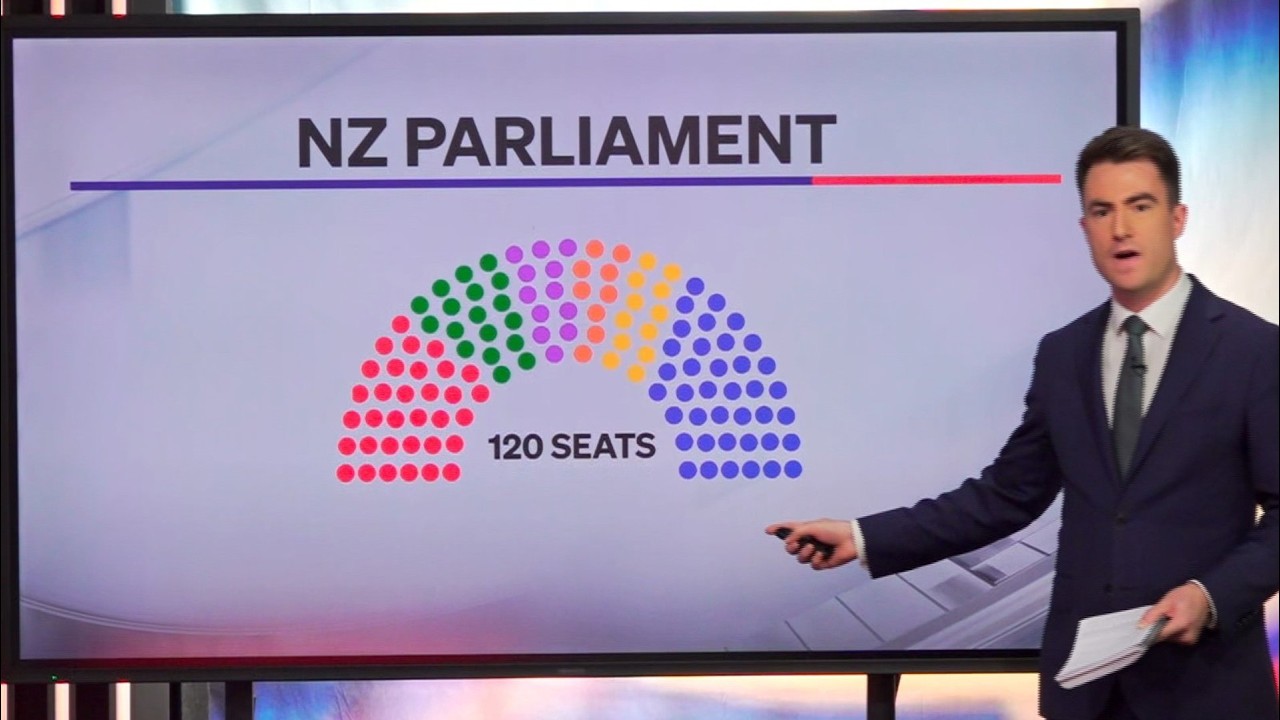 NZ election 2026: Everything you need to know
Things we can learn from the video
Press to jump
- 0:36Voters choose a local electorate representative and a party in New Zealand's single-chamber parliamentary system.
- 1:00List seats help bring qualifying parties' total representation into line with their share of the party vote.
- 2:01A party qualifies by winning an electorate or reaching five per cent of the party vote.
- 2:18Overhang seats expand Parliament when a party wins more electorates than its proportional allocation allows.
- 3:19Te Pāti Māori's 2023 results illustrate how an overhang can increase the number needed for a majority.
- 4:06Reddin identifies National's support, The Opportunities Party's threshold prospects and coalition numbers as election-night questions.
Cameron Reddin gives New Zealand's election count an extra complication: voters aren't just deciding who fills Parliament, but can also change how big it becomes.
In News24's "NZ election 2026: Everything you need to know", the political correspondent uses a touchscreen to unpack mixed-member proportional representation, usually shortened to MMP. Voters choose both a local representative and a party, with the party vote determining each qualifying party's overall share of seats.
The wrinkle is the overhang. When a party wins more electorate seats than its party-vote share would normally entitle it to, it keeps those seats and Parliament expands. That can also raise the number needed for a majority. Reddin uses Te Pāti Māori's electorate wins in the 2023 election to show how it works.
There is another crucial distinction: a party can qualify for seats by reaching five per cent of the party vote or by winning an electorate. A small party's local result can therefore matter well beyond that constituency.
The explainer drew roughly 134,000 views in less than a day, far above News24's usual start for regular videos.
Reddin finishes with questions rather than a result: how far National's support might fall, whether The Opportunities Party clears the threshold, and how many partners will be needed to form a government.
New Zealand’s legislature consists of the monarch and a single chamber, the House of Representatives. It is based in Wellington.
More on Wikipedia ›New Zealand’s general election took place on 7 November 2026. Voters elected 131 MPs through a mix of electorate contests and party lists.
More on Wikipedia ›A left-wing New Zealand party advocating Māori rights. It mainly contests the reserved Māori electorates, where Labour is its principal rival.
More on Wikipedia ›New Zealand’s centre-right National Party is the senior party in the governing coalition and one of the country’s two major political parties.
More on Wikipedia ›Now called the Opportunity Party, this centrist New Zealand party was founded in 2016 by economist Gareth Morgan. It advocates evidence-based policy.
More on Wikipedia ›Published on Trari
Where next?


 Is this your channel?For the channel's owners and team: a ready picture and text for your audience
Share the story with your audience. Everything is ready:
For an Instagram story or a WhatsApp status
For a community post or your channel's description
- Channel
- News24
- Subscribers
- 6,270,000
- Channel views, last 7 days
- 22,299,517
- Channel views, pace per day
- 1,743,948 (on a normal day: 3,789,671)
- Video published
- November 7, 2026
- Video views so far
- 133,939 (less than a day online)
- Video views, pace per day
- 140,246
The numbers
The election explainer's early views put it well beyond News24's usual first-day audience for regular uploads.

💡 Test your knowledge
Which party's 2023 results does Reddin use to explain overhang seats?
Reddin uses Te Pāti Māori's electorate wins in 2023 to demonstrate how overhang seats expand Parliament.