
 United States
 United Kingdom
 Canada
 Australia
 New Zealand
 Ireland
Dave's Garage builds new RAM for a vintage PDP-11
AI helps design the memory card, but getting it working takes a careful hunt through the FPGA's internal routing.
 Dave's Garage
Story of
Why this story? The channel's weekly summary: what went up this week, what is drawing views now, and where the channel stands among similar channels.
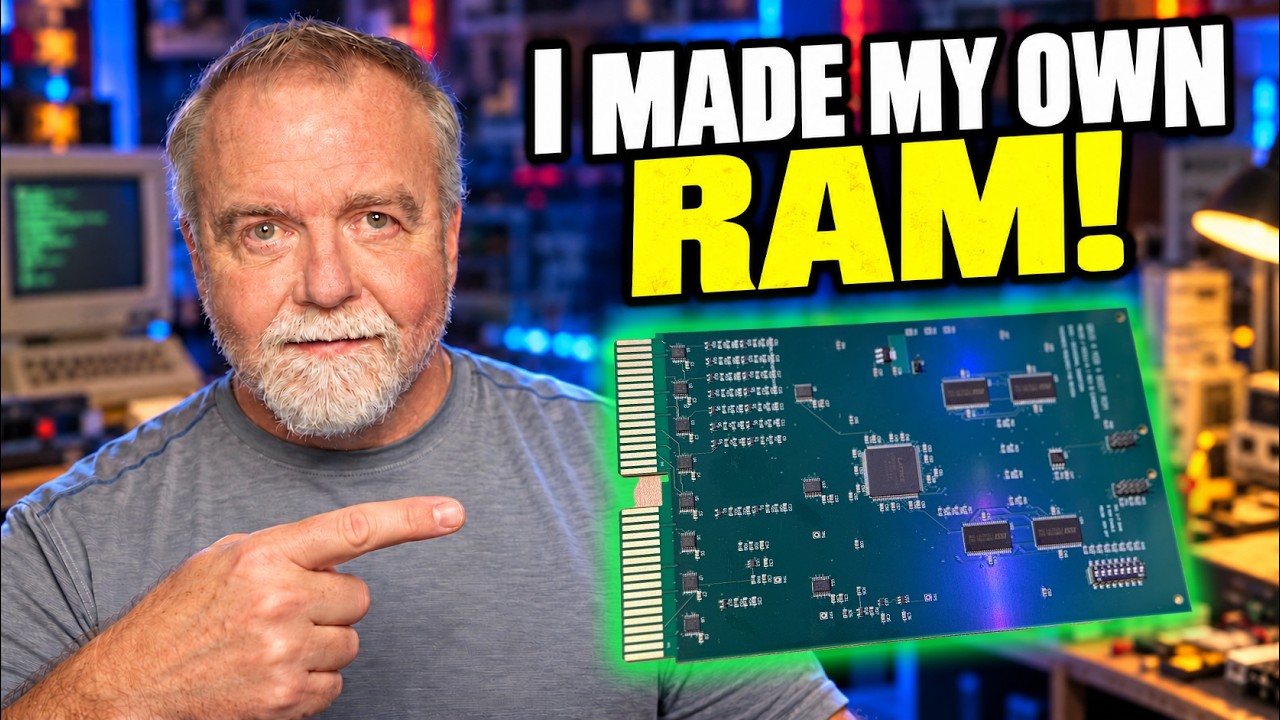 I Made My Own RAM - But Will It Boot?
Things we can learn from the video
Press to jump
- 0:00Codex helps Dave design a four-megabyte memory expansion card for a vintage PDP-11.
- 4:05An FPGA bridges the modern memory circuitry to the computer's vintage Q-bus.
- 7:07The computer detects the memory, but testing reveals single-bit errors.
- 9:53Swapping data-bit assignments traces the problem to the FPGA rather than faulty memory chips.
- 14:59Repositioning capture registers within the FPGA resolves the remaining errors without physical board changes.
- 15:40Dave boots 2.11BSD Unix and RSX-11M to confirm the memory works.
The computer recognizes the new memory. Then the tests start finding errors, just a single wrong bit at first. For Dave Plummer, that is where the real project begins.
"I Made My Own RAM - But Will It Boot?" was the only new upload on Dave's Garage this week, reaching about 55,000 views in its first six hours. Dave uses Codex to help design a four-megabyte memory expansion for a vintage PDP-11, from the circuit schematic and board layout to the logic inside an FPGA. The video also contains a sponsored segment.
Having assembled boards arrive is not the finish line. Dave swaps data-bit assignments to isolate the trouble, then encounters another bug: writing to one address changes memory at another. The eventual fixes happen inside the programmable logic, without alterations to the physical board. By the end, the memory tests pass and the PDP-11 boots both Unix and RSX-11M.
That diagnostic process is a talking point in the comments. Viewers with engineering experience recognize the rhythm of forming a hypothesis, testing it and narrowing the possibilities. Others tease Dave about whether he can keep calling himself a software guy after this.
The RAM project has the most momentum on the channel right now. "What Would Happen?", his electrical-outlet explainer, remains active too, followed by his experiment in using AI to recreate software functionality from binaries.
Across the week, Dave's Garage added nearly 800,000 views while its subscriber count held steady. Daily viewing is a little below its usual level. Nearby in technology, Low Level and Matt Wolfe had larger weekly view gains, while Teacher's Tech had a quieter week than Dave's Garage. Here, the week's distinctive pleasure is an old computer accepting a newly built piece of hardware, after some very modern debugging.
Published on Trari
Where next?



What viewers say
As a diagnostics guy, I recognize the process. The process of repeatedly forming hypothesis, and performing experiments to rule things in or out until the machine works is quite satisfying.
@robertkesselringSee it on YouTubeRetired Electronics Engineer here (45years). Great work! You are now officially Hardware Design and Test Team Leader. Congratulations!
@Johnwashere-dt2ovSee it on YouTubeI helped to design and build semiconductor memory to replace core memory!
@baxtermullins1842See it on YouTube
1 more comment
Thanks for this taste of the future. Designing circuit schematics, laying out boards, building component trees and purchasing all of that with AI needs to start with relatively simple boards. Yours is the first deep dive into how well that's working circa 2026. Many thanks.
@BillwzwSee it on YouTube
Public comments from the video's page on YouTube
 Is this your channel?For the channel's owners and team: a ready picture and text for your audience
Share the story with your audience. Everything is ready:
For an Instagram story or a WhatsApp status
For a community post or your channel's description
The videos drawing views on Dave's Garage right now


- Channel
- Dave's Garage
- Subscribers
- 1,150,000
- Channel views, last 7 days
- 786,122
- Videos published this week
- 1
- Video published
- November 2, 2026
- Video views so far
- 54,812
The numbers
Here is how the week added up for Dave's Garage.

💡 Test your knowledge
What does FPGA stand for?
An FPGA is a field-programmable gate array, a chip whose digital logic can be configured after manufacture.