
 United States
 United Kingdom
 Canada
 Australia
 New Zealand
 Ireland
Tiny air bubbles complicate Applied Science's transparent refrigerator
Ben Krasnow's seventh prototype reaches its cooling target, with copper, Teflon tape and treated mesh solving different problems.
 Applied Science
Story of
Why this story? The channel's weekly summary: what went up this week, what is drawing views now, and where the channel stands among similar channels.
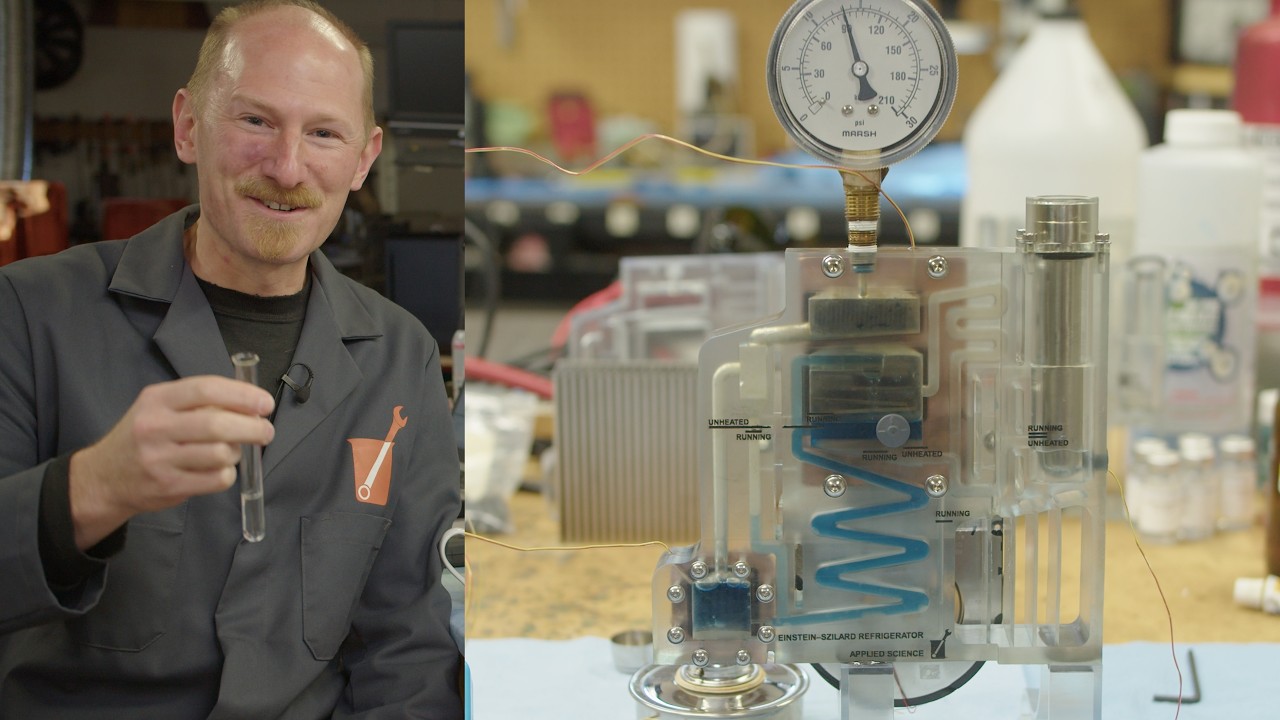 3D-printed, alcohol-powered, Einstein-Szilard absorption refrigerator
Things we can learn from the video
Press to jump
- 2:14Conventional absorption refrigeration uses ammonia, water and hydrogen in a heat-driven cooling cycle.
- 7:53The Einstein-Szilard design reverses the fluids' roles, with perfluoropentane supplying the third component in this build.
- 10:10Trapped air in tiny printed passages became a major obstacle across successive prototypes.
- 20:04Ammonia attacks copper, limiting the usefulness of internal copper heatsinks to short experiments.
- 21:49The temperature graph shows cooling reaching the target of five degrees Celsius below ambient.
- 22:00Torch-treated stainless steel mesh becomes hydrophilic, helping distribute fluid evenly across the absorber's fins.
Making a refrigerator transparent has an advantage: you can see some of the things stopping it from working. In Applied Science's only new upload this week, Ben Krasnow explains how trapped air became a major obstacle inside the small passages of his resin-printed absorption refrigerator.
"3D-printed, alcohol-powered, Einstein-Szilard absorption refrigerator" has reached about 354,000 views. It is comfortably the channel's busiest video right now, with the sodium-water reactor experiment and an older homemade iron-nitride magnet project also drawing viewers.
The refrigerator is already on its seventh iteration. Beyond explaining the thermodynamics, Krasnow gets into the practical negotiations between materials: a copper slug transfers heat from the burner into the resin device, while silicone septums let him adjust the fluids without admitting air. Copper helps with heat transfer but presents another problem, because ammonia attacks it.
Then there are the droplets that won't go where they should. Water's surface tension obstructs the dense perfluoropentane, prompting a fix with Teflon tape. The temperature graph eventually shows the unit meeting his target of five degrees Celsius below ambient. That is a useful distinction from promising an ice-cold drink, and viewers are asking about operating temperatures and how cold the contents could actually become. Others single out the copper-clad circuit board used as a solderable insulator.
The channel added subscribers modestly over the week, although daily viewing is currently well below its usual level. Its weekly views were close to those of similarly sized chemistry channel Reactions. For Applied Science viewers, the most reusable detail may be one of the smallest: Krasnow torch-treats stainless steel mesh so water spreads across the absorber's fins more evenly.
Published on Trari
Where next?


What viewers say
The copper-clad pcb as a solderable insulator is unbelievably elegant, made me smile
@FliesLikeABrickSee it on YouTubeThat Einstein guy who figured this refrigerator out must have been a smart cookie. I wonder how he would have done outside the appliance business.
@EdwinSteinerSee it on YouTubeI did not expect to watch a full 23 minute video about refrigerators. Alas, I chilled out for the whole thing
@aaronreSee it on YouTube
3 more comments
What were the working/running temperatures. I could't quite see the temps on your TC plotter. It looks like ~14 DegC for the cooling but curious what it could actually cool your drink down to and what was the ambient temperature. It may have all been in the video but I either missed it or couldn't read it.
@kissingfrogsSee it on YouTubeSuch a cool project, and gorgeous prints too! Definitely stashing that hydrophilic mesh tip for later 🙂
@BreakingTapsSee it on YouTubethis man is a hero, you can hear the joy in his voice about what he is doing
@KabodankiSee it on YouTube
Public comments from the video's page on YouTube
 Is this your channel?For the channel's owners and team: a ready picture and text for your audience
Share the story with your audience. Everything is ready:
For an Instagram story or a WhatsApp status
For a community post or your channel's description
The videos drawing views on Applied Science right now


- Channel
- Applied Science
- Subscribers
- 891,000 ▲ 1,000 this week
- Channel views, last 7 days
- 402,419
- Videos published this week
- 1
- Video published
- October 28, 2026
- Video views so far
- 353,663
- Views on its first day
- 195,454
The numbers
Here is Applied Science's week in views and subscribers.

💡 Test your knowledge
Which liquid supplies the third chemical component in Krasnow's refrigerator?
Krasnow identifies perfluoropentane as the third component used in his Einstein-Szilard-inspired build.