
 United States
 United Kingdom
 Canada
 Australia
 New Zealand
 Ireland
Applied Science takes on Einstein's refrigerator with alcohol and 3D printing
Ben Krasnow's heat-powered cooling project arrives as the channel's daily views climb far beyond their usual pace.
 Applied Science
Story of
Why this story? The whole channel is running at 153,822 views a day, 15 times a normal day (10,489).
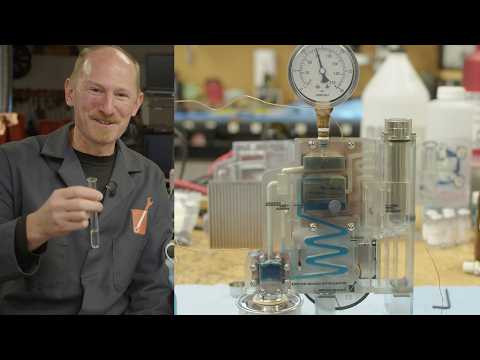 3D-printed, alcohol-powered, Einstein-Szilard absorption refrigerator
Cooling something down by supplying heat sounds backward. That is the principle behind Applied Science's new project, which brings 3D printing and alcohol power to a refrigerator design associated with Albert Einstein and fellow physicist Leo Szilard.
Ben Krasnow's upload, "3D-printed, alcohol-powered, Einstein-Szilard absorption refrigerator," arrived October 28. The channel has since recorded roughly 154,000 views in a day, nearly fifteen times its usual daily pace. That is a channel-wide jump, not a count for the refrigerator video alone.
Einstein and Szilard patented their refrigerator design in 1930. Unlike the compressor-driven appliance familiar from most kitchens, their approach used heat to drive cooling without moving mechanical parts. The famous name is a hook, but the engineering question is interesting on its own: how can adding heat help carry heat away?
It is also familiar territory with a different mechanism for Krasnow. His 2016 upload, "A refrigerator that works by stretching rubber bands," remains among Applied Science's most watched regular videos. That project explored the temperature changes that accompany stretching rubber. This time, the title puts an old absorption-refrigerator design alongside a much newer fabrication tool: 3D printing.
Published on Trari
Where next?


 Is this your channel?For the channel's owners and team: a ready picture and text for your audience
Share the story with your audience. Everything is ready:
For an Instagram story or a WhatsApp status
For a community post or your channel's description
The videos drawing views on Applied Science right now
 Drawing electricity from this sodium-water reactor prevents it from e…331,269 views · 2026-09-30
 See inside insects with an electron microscope and a femtosecond laser252,244 views · 2026-07-16
 Atomic Force Microscope high-speed video, selective stainless steel e…272,544 views · 2026-07-02
 Acoustic Radiometer spins in 130dB sound, clockwise and counter-clock…129,595 views · 2025-11-17
- Channel
- Applied Science
- Subscribers
- 890,000
- Channel views, last 7 days
- 189,612
- Channel views, pace per day
- 153,822 (on a normal day: 10,489)
The numbers
Applied Science's daily views are running well above their usual pace following the refrigerator upload.

💡 Test your knowledge
Which discovery earned Albert Einstein his Nobel Prize in Physics?
Einstein received the 1921 Nobel Prize in Physics especially for his discovery of the law of the photoelectric effect.