
 United States
 United Kingdom
 Canada
 Australia
 New Zealand
 Ireland
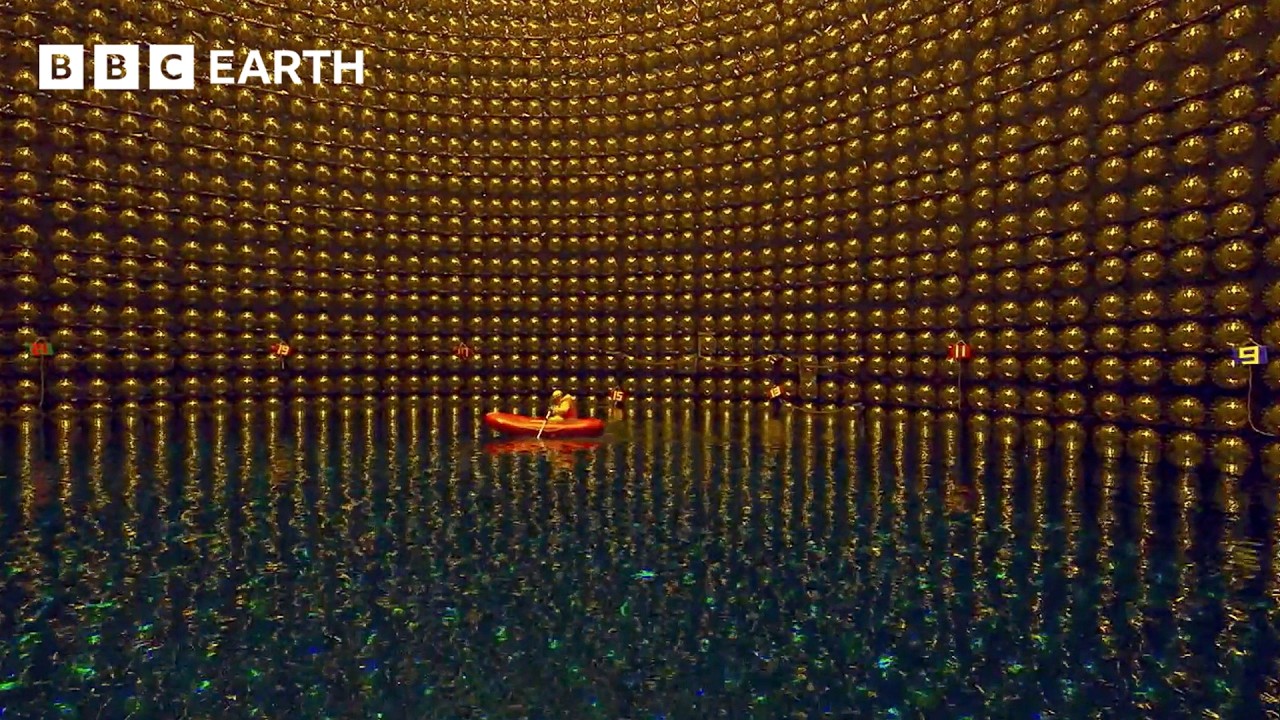
Teppei Katori's selfie from inside Japan's giant neutrino detector
The Science's Greatest Mysteries clip follows the T2K experiment's search for a difference between neutrinos and their antimatter twins.
 BBC Earth Science
Story of
No. 31 on the daily chartNo. 2 on the Science chart
Why this story? One of the most watched videos since yesterday, with 946,472 views.
 Inside Japan’s Giant Neutrino Detector | BBC Earth Science
Things we can learn from the video
Press to jump
- 0:20The T2K experiment's underground chamber: a huge tank of water lined with light sensors.
- 0:32Teppei Katori shows his photo in the "Dream Boat", calling it more selfie than work.
- 0:53Trillions of neutrinos pass through 50,000 tons of pure water; rare hits make flashes caught by 13,000 sensors.
- 1:30Katori says the sensors could see a flashlight on the Moon from Earth.
- 1:40The goal: compare how neutrinos and antineutrinos change type as they travel.
- 2:11In 2020, after ten years of data, the two looked like they may differ, a clue to why matter dominates.
Teppei Katori is happy to admit that one of his favourite photographs from work does not show much work. It shows the physicist in a small boat on the water inside Super-Kamiokande, the vast detector buried beneath the mountains of central Japan. "In this picture I'm not really working, it's more like a selfie because I think it's really cool," he says.
He calls it the "Dream Boat for neutrino scientists", and the setting explains why. The chamber holds 50,000 tonnes of ultra-pure water and is lined with about 13,000 light sensors, so sensitive that, in Katori's words, a flashlight on the Moon could still be seen from Earth. They watch for the faint flashes produced when a neutrino, out of the trillions sent through the tank, actually hits something.
Those neutrinos are fired by the T2K experiment, whose name stands for Tokai to Kamioka: a beam from Japan's east coast crosses roughly 295 kilometres of rock to reach the detector. The team compares how neutrinos change type along the way with how antineutrinos do. In 2020, after ten years of data, they reported that the two may behave differently, a possible clue to why the universe is made of matter rather than an even mix of matter and antimatter.
The clip, from the BBC's 2022 series Science's Greatest Mysteries, drew about 950,000 views since yesterday. It fits a run of antimatter stories on the channel: a week earlier, a clip from the same series followed a giant magnet hunting for antimatter in orbit, and it has since passed a million views.
The comments split between two subjects. Many viewers simply marvel at how the gold-studded chamber looks like a film set, and several think of the thriller Eagle Eye. Just as many ask what the result really means, and one long plain-English explainer has become the busiest corner of the discussion. Katori, for his part, offers the human scale: his team works around the clock, he says, before conceding that he does sleep sometimes.
Published on Trari
Where next?


What viewers say
"In this picture I'm not really working, it's more like a selfie", said the most honest salaryman in Japan.
@nobitanobi8888See it on YouTubeAlways love how this facility looks. Sci-fi aura but actually real.
@johnlucas6683See it on YouTubeTo answer all possible questions you may have about this video, in layman terms:
1. What even is a neutrino?
A fundamental subatomic particle with almost zero mass and no electric charge. Trillions pass straight through your body every second without touching an atom.
2. Why build this massive tank 1,000 meters underground?
The Earth blocks cosmic rays and background radiation that would drown out the signal. The detector is a 50,000-ton tank of ultra-pure water lined with 13,000 light sensors.
3. Why is there water in the tank?
On rare occasions, a neutrino collides with an atom in the…@NameNik223Read it all on YouTube
7 more comments
Such a beautiful machine! Looks like a surreal sci-fi movie set.
@joecaljapanSee it on YouTubeI love how much this guy loves his job
@sabresisterSee it on YouTube0:36 it my dream now too! It looks really beautiful in there!
@benbernard9135See it on YouTubeAbsolutely beautiful installation. It could be an art exhibit if wasnt so useful to science!
@OutlawStarK9See it on YouTubeIt's a place where science and art meet, wow what a machine <3
@mrilla4382See it on YouTubeThese are the kinds of projects that push the bounds of humanity
@nafnaf0See it on YouTubeCan someone explain in layman terms, why is this experiment is so important and what does the discovery mean?
@1two3four5sixerSee it on YouTube
Public comments from the video's page on YouTube
 Is this your channel?For the channel's owners and team: a ready picture and text for your audience
Share the story with your audience. Everything is ready:
For an Instagram story or a WhatsApp status
For a community post or your channel's description
- Channel
- BBC Earth Science
- Subscribers
- 1,830,000 ▲ 10,000 this week
- Channel views, last 7 days
- 4,154,519
- Channel views, pace per day
- 1,353,869 (on a normal day: 397,564)
- Video published
- October 28, 2026
- Video views so far
- 1,267,936 (3 days online)
- Video views, pace per day
- 946,664 (on a normal day: 241,431)
The numbers
A three-day-old clip from a 2022 series, and nearly a million people pressed play on it since yesterday.

💡 Test your knowledge
In which year did Super-Kamiokande's predecessor, Kamiokande, detect neutrinos from an exploding star?
Kamiokande caught a burst of neutrinos from supernova SN 1987A in February 1987, work that helped Masatoshi Koshiba win the 2002 Nobel Prize in Physics.