
 United States
 United Kingdom
 Canada
 Australia
 New Zealand
 Ireland
Veritasium's "alien matter" is helium that climbs out of its cup
Derek Muller and Casper Mebius rebuild a century of cold-physics experiments in Nottingham, ending with a fountain powered by light.
 Veritasium
Story of
No. 27 on the daily chartNo. 1 on the Science chart
Why this story? One of the most watched videos since yesterday, with 1,868,303 views.
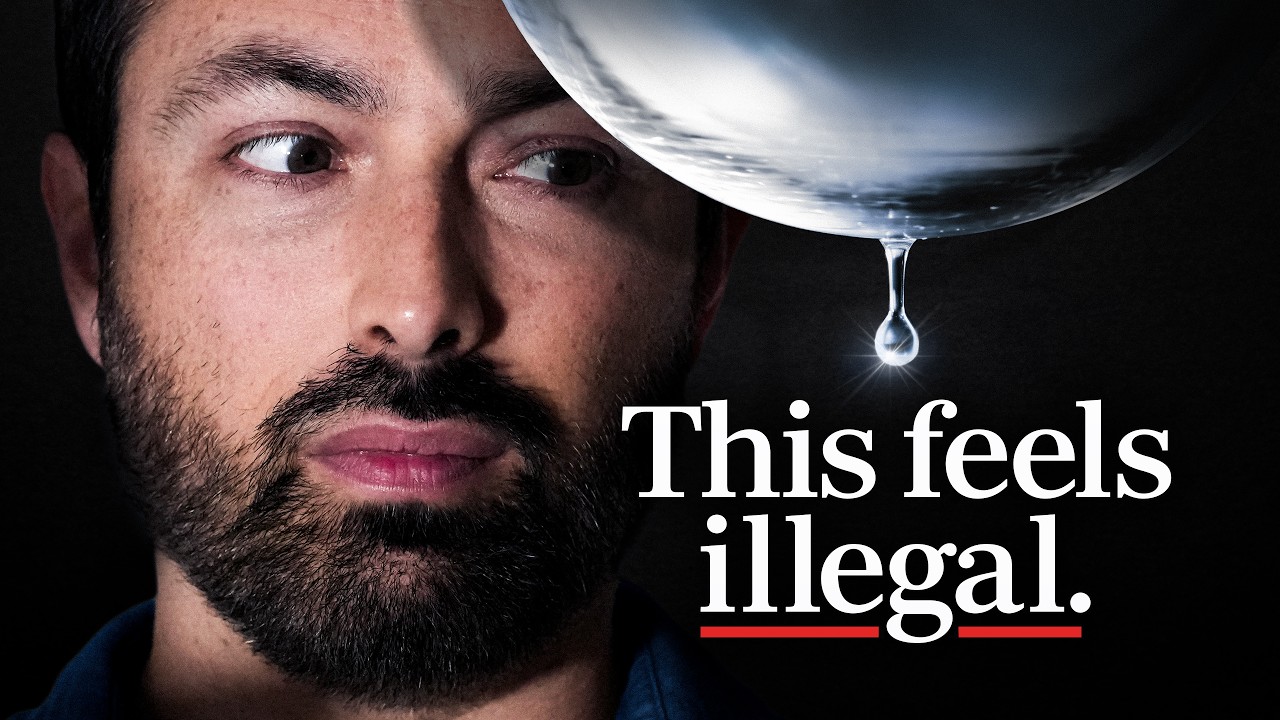 The Closest Thing We Have to Alien Matter
Things we can learn from the video
Press to jump
- 0:00Liquid helium at minus 269 degrees Celsius turns superfluid at 2.17 kelvin and leaks through an aerogel base.
- 7:35Heike Kamerlingh Onnes extracts rare helium from monazite sand in Leiden to attempt liquefaction.
- 17:18Reenactment of 1908, when Onnes liquefies helium for the first time.
- 24:51In the Nottingham lab, superfluid helium creeps up and out of an elevated cup.
- 46:20Light focused on emery powder drives a fountain of liquid helium upward.
- 48:04Landau's phonons, rotons and two-fluid model explain why superfluid flow has strictly zero friction.
Helium that leaks through a solid floor, crawls up the walls of a cup and empties itself over the rim: Veritasium's new film opens with demonstrations and spends the next hour explaining them.
"The Closest Thing We Have to Alien Matter" has drawn nearly 1.9 million views since it went up. The title echoes "The Closest Thing We Have to Alien Technology," posted last New Year's Eve and already one of the channel's most watched videos. This time the subject is a liquid. "This is liquid helium," Derek Muller says in the first seconds. "It's currently sitting at negative 269 degrees Celsius." Cool it a little further, to 2.17 kelvin, and it becomes a superfluid, slipping through an aerogel base that held it a moment earlier.
Muller presents alongside Casper Mebius, who wrote, produced and directed the film. They worked with Dr. Chris Goodwin at the Gravity Laboratory at Nottingham University, where the team recreates the old experiments on modern equipment. Goodwin points out that their setup is "really similar" to the one Heike Kamerlingh Onnes used in Leiden, where he extracted scarce helium from monazite sand and, in 1908, became the first to liquefy it. Onnes described the liquid surface as standing out "like the edge of a knife against a glass wall."
The story then turns into a detective case. Onnes stumbles onto superconductivity in mercury. The helium's boiling stops dead at one temperature. Pyotr Kapitsa measures frictionless flow and coins the word "superfluid" in 1938, and later rescues Lev Landau from a Soviet prison. Landau supplies the theory: phonons, rotons and two fluids sharing one container. "Friction is forbidden," Muller says of his result.
The comments came in quickly, already past a usual first full day's total in about half that time. The fountain, made by focusing light on emery powder, arrives just after the 46-minute mark.
Published on Trari
Where next?


 Is this your channel?For the channel's owners and team: a ready picture and text for your audience
Share the story with your audience. Everything is ready:
For an Instagram story or a WhatsApp status
For a community post or your channel's description
- Channel
- Veritasium
- Subscribers
- 21,400,000
- Channel views, last 7 days
- 13,701,024
- Channel views, pace per day
- 2,192,489 (on a normal day: 2,531,258)
- Video published
- November 4, 2026
- Video views so far
- 1,868,303 (less than a day online)
- Video views, pace per day
- 2,687,248
The numbers
Roughly 1.9 million views in about half a day, with a comment section already busier than a typical full first day for the channel's long videos.

💡 Test your knowledge
In which Dutch city did Heike Kamerlingh Onnes first liquefy helium?
Onnes ran his famous low-temperature laboratory at Leiden University, where he liquefied helium in 1908.