
 United States
 United Kingdom
 Canada
 Australia
 New Zealand
 Ireland
Two Bit da Vinci asks how to destroy forever chemicals
Ricky examines an Arizona State University membrane that uses hydrogen and palladium to break down PFAS at room temperature.
 Two Bit da Vinci
Story of
Why this story? The channel's weekly summary: what went up this week, what is drawing views now, and where the channel stands among similar channels.
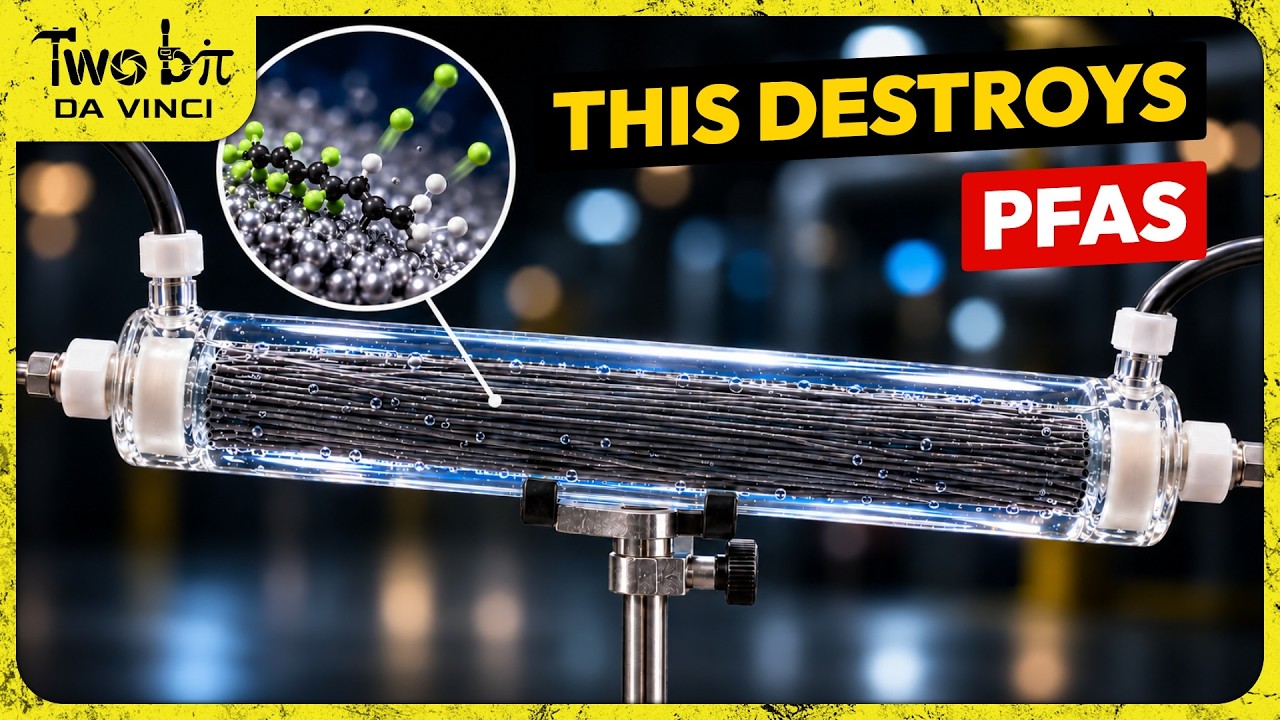 Destroying PFAS & Forever Chemicals - New Breakthrough
Things we can learn from the video
Press to jump
- 0:56Conventional filtration concentrates PFAS into waste rather than destroying the molecules.
- 5:33The research uses hydrogen to replace fluorine atoms in PFAS at room temperature.
- 6:48Palladium nanoparticles coat hollow fibers that deliver hydrogen into the reactor.
- 9:25A continuous lab test reports different results for PFAS removal and fluoride release, distinguishing capture from breakdown.
- 9:52Scaling requires addressing palladium costs and losses, acidic water requirements and limited flow rates.
Two Bit da Vinci's Ricky makes an important distinction in his only new upload this week: getting PFAS out of water isn't necessarily getting rid of them.
"Filtering PFAS is like emptying a vacuum cleaner," he says. "Yeah, the floor is clean, but that dust is still in the bag." In "Destroying PFAS & Forever Chemicals - New Breakthrough," the alternative is a membrane reactor whose palladium-coated hollow fibers bring hydrogen and the contaminants together, helping strip fluorine from the molecules at room temperature.
The video, which has reached about 81,000 views, gives the engineering as much attention as the promise. Ricky separates removal from destruction when explaining the lab results, then works through the obstacles: expensive palladium, acidic operating conditions and limited flow rates. A successful experiment is not yet a municipal water-treatment system. The upload also contains a sponsored segment for an AI platform.
Viewers are asking practical follow-up questions, including whether another filter could recover escaping palladium and how concentrating the contaminants might fit into a treatment process. Others focus on who should pay for cleanup.
Meanwhile, the channel's strongest viewing momentum belongs to "The Cheapest Way to Go Solar in 2026," now past two million views. That product-focused EcoFlow installation follows a solar-and-battery setup at Ricky's friend Karl's house, including a grid-outage test. Solar has long been part of this channel's identity, with years-later ownership reviews among its most-watched regular videos.
Daily viewing across Two Bit da Vinci is more than twice its usual level, although subscribers were unchanged over the week. Among its nearby technology peers, Low Level and Matt Wolfe also drew substantial weekly audiences. For Ricky, the contrast is particularly clear: a busy solar installation is bringing the volume while the new PFAS explainer tackles what happens after a filter has done its job.
Published on Trari
Where next?


What viewers say
If palladium is lossed by leaching off from the filter. Why don't they put a secondary filter after the treated water and florine byproducts to filter out and recover the lossed precious metal?
@07TimmersSee it on YouTubeit sounds like a three step process is in order, isolate out, concentrate, then destroy.
@larryseibold4287See it on YouTubeWith all those abandoned mines that have standing water filling them... how many chemicals, minerals or elements are in that soup? Could they be "mined" for all those dissolved things?
@ArahknidSee it on YouTube
Public comments from the video's page on YouTube
 Is this your channel?For the channel's owners and team: a ready picture and text for your audience
Share the story with your audience. Everything is ready:
For an Instagram story or a WhatsApp status
For a community post or your channel's description
The videos drawing views on Two Bit da Vinci right now


- Channel
- Two Bit da Vinci
- Subscribers
- 817,000
- Channel views, last 7 days
- 2,068,625
- Videos published this week
- 1
- Video published
- October 31, 2026
- Video views so far
- 80,714
- Views on its first day
- 49,864
The numbers
Here is how Two Bit da Vinci's week looks in views and subscribers.

💡 Test your knowledge
Which state's university developed the PFAS reactor featured in Ricky's video?
The research featured in the video comes from Arizona State University.