
Eisenkot's diplomacy pledge faces limits in Israel's election deadlock
A Japanese election analysis examines frustration with open-ended wars, while warning that a change of prime minister may not bring a sharp change in security policy.
 JapanStory of
Why this story? One of TBS NEWS DIG Powered by JNN's most watched videos since yesterday, with 205,404 views.
TBS NEWS DIG Powered by JNN: The news channel of JNN, a Japanese news network led by TBS. 3.4M subscribers and 5.7B views.
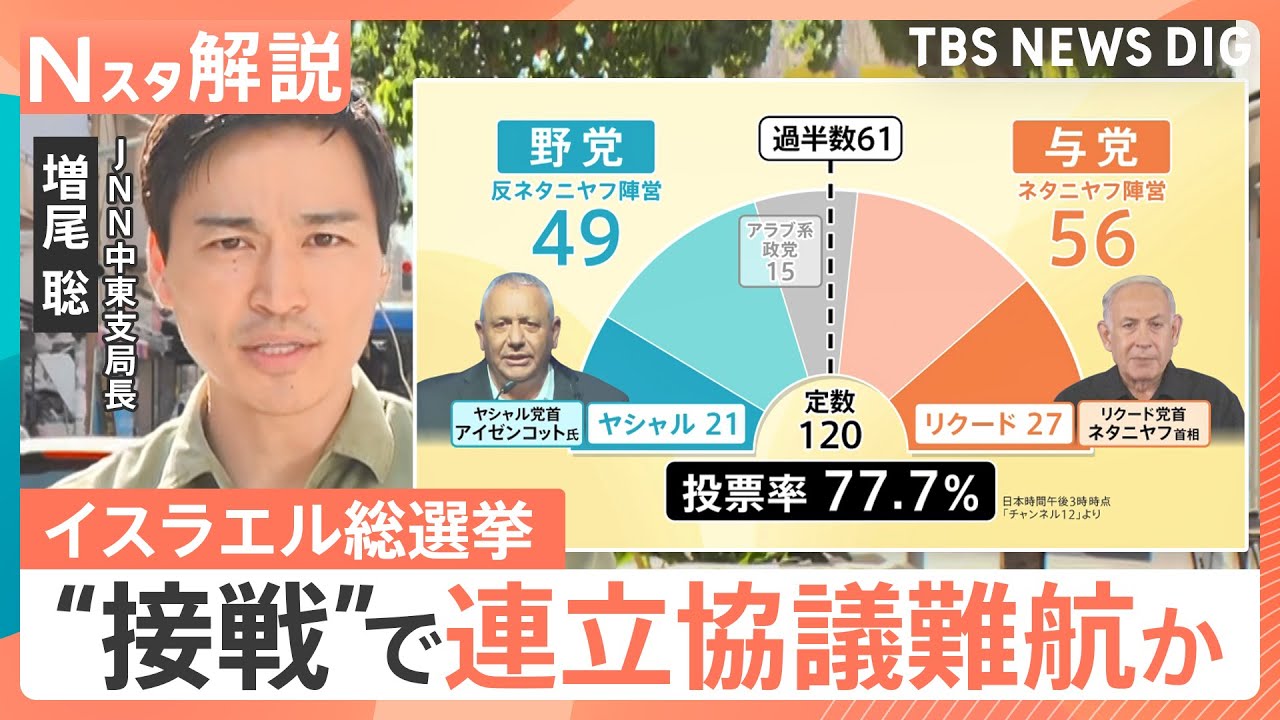 「イスラエル総選挙」与野党接戦で過半数届かず 終わりの見えない戦争に不満も…ネタニヤフ首相続投か政権交代か?【Nスタ解説】|TBS NEWS DIG
Things we can learn from the video
Press to jump
- 0:48Early projections leave both Netanyahu's bloc and the opposition short of a governing majority.
- 2:21Proportional representation makes coalition agreements essential; the largest party cannot automatically form a government.
- 4:40The correspondent links projected government losses to October 7 accountability demands and frustration with prolonged wars.
- 6:15Difficult coalition talks would leave Netanyahu in office; the report raises concerns about possible further action against Iran.
- 7:26Eisenkot emphasizes diplomacy, but the correspondent sees substantial overlap with Netanyahu on security.
- 8:37Meij argues that the election lacks a clearly dialogue-led alternative to competing hard-line approaches.
Gadi Eisenkot has argued that Israel needs diplomacy as well as military force, and must avoid international isolation. But his security outlook remains close enough to Benjamin Netanyahu's that a change of government would not necessarily transform the regional situation, according to an election analysis from Japan's TBS NEWS DIG Powered by JNN.
Reporting from Tel Aviv for the program N Star, JNN's Middle East bureau chief describes voters questioning whether Netanyahu is pursuing wars without a clear destination. He also identifies demands for accountability over the Hamas-led October 7, 2023, attacks as an important election issue. In his assessment, those grievances help explain the projected losses for Netanyahu's governing bloc.
The broadcast presents an unfinished count, not a final result. Citing Israeli broadcaster Channel 12 with roughly half the votes counted, it projects Netanyahu's bloc at 56 seats and the opposition grouping around Eisenkot at 49, both below the 61 needed for a parliamentary majority. Likud is projected to remain the largest individual party, ahead of Eisenkot's centrist Yashar.
The studio explains why that distinction matters: Israel allocates parliamentary seats through proportional representation, and governments depend on agreements among several parties. Leading the largest party does not, by itself, secure the premiership. The report records turnout at nearly 78 percent.
Coalition negotiations could be difficult for either side, the correspondent says. Netanyahu would remain prime minister during that process. The report also raises a concern that he could seek another strike against Iran before a new government takes office, presenting this as a possible risk rather than an announced plan.
Eisenkot, a former military chief, offers a potential difference in emphasis: greater use of diplomacy alongside defense. The correspondent cautions that this would not guarantee an immediate improvement in the Middle East's conflicts. Studio commentator Harold George Meij goes further, arguing that voters have been offered competing degrees of toughness rather than a clearly dialogue-led alternative. That is the broadcast's central distinction: dissatisfaction with how Netanyahu has conducted the wars does not necessarily amount to an electoral mandate for a fundamentally different security policy.
Leader of Israel’s Yashar party and Netanyahu’s main challenger in the 2026 election. He headed the Israeli military from 2015 to 2019 and served in the unity government from 2023 to 2024.
More on Wikipedia ›A major right-wing political party in Israel, founded in 1973 through an alliance of several right-wing parties.
More on Wikipedia ›Published on Trari
Where next?



- Channel
- TBS NEWS DIG Powered by JNN
- Subscribers
- 3,420,000
- Channel views, pace per day
- 3,230,119
- Video published
- October 28, 2026
- Video views so far
- 205,404 (less than a day online)
- Video views, pace per day
- 231,870
The numbers
The report drew about 205,000 views since yesterday, placing it among Japan's most-watched new news videos.
