
Coalition red lines complicate Netanyahu and Eisenkot's paths to power
A three-guest election discussion examines surplus-vote deals, Arab-party support and whether campaign promises would survive government negotiations.
 Arab worldStory of
Why this story? One of سكاي نيوز عربية's most watched videos since yesterday, with 12,261 views.
سكاي نيوز عربية: An Arabic news channel broadcasting from Abu Dhabi since 2012. 7.4M subscribers and 3.9B views.
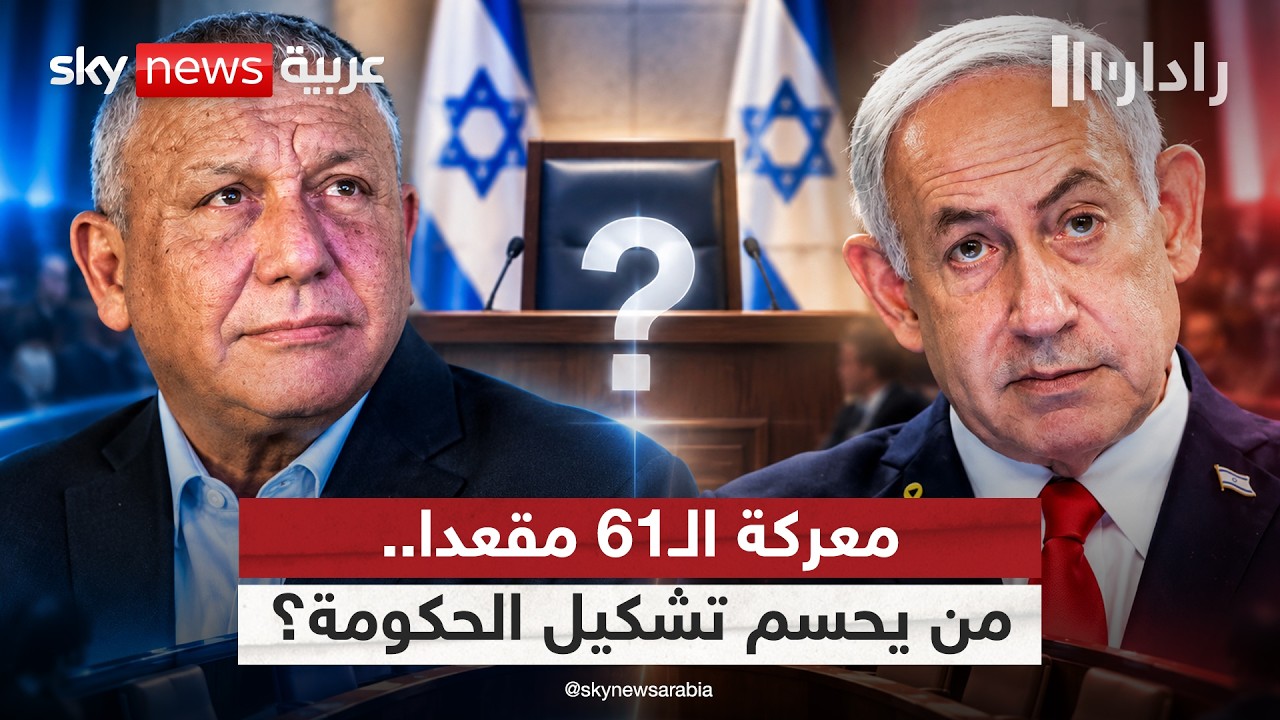 نتنياهو وآيزنكوت.. لماذا لا تحسم المقاعد هوية رئيس الحكومة؟ | #رادار
Things we can learn from the video
Press to jump
- 4:30Sawalha explains how surplus-vote agreements can affect the final distribution of parliamentary seats.
- 7:35Safadi frames the election as a referendum on Netanyahu and rates his chances above those of his challengers.
- 13:54Eviatar argues neither camp is assured a majority and explores conditional support from Mansour Abbas.
- 20:00Sawalha examines coalition red lines and questions the stability of a minority government dependent on Arab support.
- 24:28Safadi suggests Likud could recruit politicians or parties from Eisenkot's camp rather than negotiate with the entire bloc.
- 26:34Eviatar considers how Netanyahu's legal proceedings could influence coalition choices or another election.
Campaign promises about whom not to govern with could become the biggest obstacle to forming Israel's next government, analysts argue in an election discussion on United Arab Emirates-based Sky News Arabia.
The program, Radar, examines the options facing Prime Minister Benjamin Netanyahu and opposition figure Gadi Eisenkot, a former Israeli military chief. Its central distinction is between having enough seats on paper and assembling parties willing to govern together. A governing majority requires 61 seats.
Abdullah Sawalha, an Israeli affairs analyst, begins with the mechanics that can alter the final balance. Parties failing to cross the electoral threshold lose out on parliamentary representation, while surplus-vote agreements can affect the allocation of remaining seats under the proportional system. He then argues that Netanyahu's camp has greater ideological cohesion than the more divided grouping seeking to replace him.
Mendi Safadi, speaking from Tel Aviv, frames the election as a referendum on Netanyahu's continued leadership and judges his prospects stronger than those of Eisenkot or former prime minister Naftali Bennett. Later, Safadi suggests Likud could attract individual politicians or parties from the opposing camp rather than secure an agreement with that entire bloc.
Alon Eviatar, a former adviser in Israel's Defense Ministry speaking from Jerusalem, offers a different emphasis: close polling leaves neither camp assured of a majority, making Arab parties potentially decisive. He explores whether Mansour Abbas, leader of Ra'am, could support an Eisenkot-led coalition under negotiated conditions.
Sawalha questions the durability of a minority government dependent on Arab support and considers alternative partnerships involving Likud or ultra-Orthodox parties. Campaign commitments can change, he argues, but the objective should be a stable government rather than one lasting only months.
Another election remains among the scenarios discussed. Sawalha calls it the most dangerous and least likely option, arguing it could threaten the political futures of figures including Bennett and Yair Lapid. Eviatar also raises Netanyahu's legal proceedings as a factor in his choices, including a possible legal agreement or another electoral round.
Sawalha's warning about the starting point is straightforward: polls are indicators, not established outcomes, and turnout can still change the calculation.
Israeli politician and leader of the Yashar party. He headed Israel's military from 2015 to 2019 and served as a minister without portfolio in the unity government from 2023 to 2024.
More on Wikipedia ›Israel's prime minister from 2021 to 2022. He now leads the Bennett 2026 party, which is allied with Yesh Atid in an alliance called Together.
More on Wikipedia ›A major right-wing Israeli political party founded in 1973. Benjamin Netanyahu won the 1996 prime ministerial election as its candidate.
More on Wikipedia ›An Israeli Arab politician who leads Ra'am and represents it in Israel's parliament, the Knesset.
More on Wikipedia ›Israel's opposition leader and head of the centrist Yesh Atid party. He served as prime minister from July to December 2022.
More on Wikipedia ›Published on Trari
Where next?


- Channel
- سكاي نيوز عربية
- Subscribers
- 7,400,000
- Video published
- October 26, 2026
- Video views so far
- 12,261 (less than a day online)
- Video views, pace per day
- 18,617
The numbers
The discussion drew about 12,000 views since yesterday.

💡 Test your knowledge
Which party was founded by Yair Lapid?
Lapid founded the centrist Yesh Atid party in 2012.