
Iraqi council chief faces arrest warrant over border-crossing ultimatum
Bahjat al-Kurdi portrays the Maysan dispute as Iranian pressure on Prime Minister Ali al-Zaidi, while Baghdad attributes the closure to technical and logistical reasons.
 Arab worldStory of
Why this story? One of سكاي نيوز عربية's most watched videos since yesterday, with 67,043 views.
سكاي نيوز عربية: An Arabic news channel broadcasting from Abu Dhabi since 2012. 7.4M subscribers and 3.9B views.
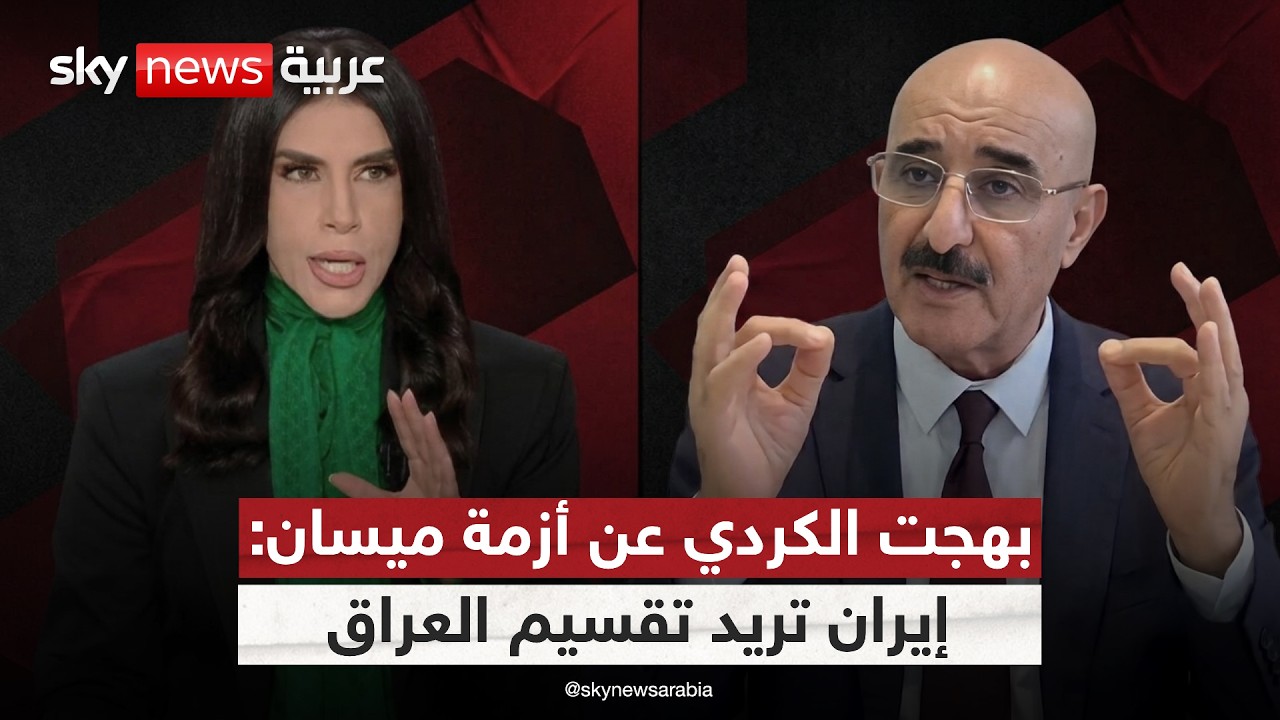 بهجت الكردي: إيران تريد تقسيم العراق وأزمة ميسان رسالة للزيدي | #ستوديو_وان_مع_فضيلة
Things we can learn from the video
Press to jump
- 0:00Souissi reports an arrest warrant following Duair's threat of civil disobedience over the closed al-Sheeb crossing.
- 1:30Al-Kurdi argues that the Maysan ultimatum pressures Baghdad and serves Iranian interests.
- 4:40He alleges that border revenues benefit Iran-aligned militias and parties rather than Iraq's treasury.
- 5:45Souissi raises al-Shatri's removal; al-Kurdi links the wider developments to pressure on al-Zaidi's government.
- 8:15Al-Kurdi alleges that inadequately controlled crossings enable money, counterfeit currency and drug smuggling.
An ultimatum to reopen an Iraq-Iran border crossing has prompted an arrest warrant against Maysan provincial council chairman Mustafa Duair, according to Sky News Arabia, the United Arab Emirates-based broadcaster.
Presenter Fadila Souissi reports that Iraqi judicial authorities issued the warrant after Duair threatened civil disobedience over the continued closure of the al-Sheeb crossing. An on-screen caption says he gave Baghdad until Thursday to reopen it. Prime Minister Ali al-Zaidi ordered an investigation into his remarks, the report says.
Maysan lies in southeastern Iraq along the Iranian border. Baghdad says the crossing is closed for technical and logistical reasons. But Iraqi political researcher Bahjat al-Kurdi, joining the program from Vienna, argues that the confrontation is about more than disrupted trade or higher food prices.
Al-Kurdi characterizes the council chairman's threats as an attempt to pressure the government in service of Iranian interests. He argues that using everyday economic grievances to issue deadlines to Baghdad undermines the state's authority, and interprets the escalation as a message to al-Zaidi about Tehran's influence inside Iraq.
The discussion broadens when Souissi asks about al-Zaidi's decision to end Hamid al-Shatri's appointment as head of the Iraqi National Intelligence Service. Al-Kurdi places that development within his wider argument that Iran is seeking to weaken the prime minister and his government.
He also makes sweeping accusations about border revenues, saying that since 2003 they have benefited Iran-aligned militias and parties rather than the Iraqi treasury. Later, he alleges that crossings outside full state control facilitate the smuggling of money, counterfeit currency and drugs. These are al-Kurdi's accusations, rather than findings established by the interview.
His central argument is that control of the border is a test of sovereignty: a government unable to control its crossings, he contends, cannot effectively exercise authority over the country.
A province in southeastern Iraq that borders Iran. Its administrative centre is Amarah.
More on Wikipedia ›Iraq’s prime minister since 2026, and a banker and businessman. He took office at 40, becoming the country’s youngest prime minister.
More on Wikipedia ›Iraq’s civilian intelligence agency, responsible for gathering intelligence, assessing national security threats and advising the government. It reports directly to the prime minister and is overseen by parliament.
More on Wikipedia ›Published on Trari
Where next?



- Channel
- سكاي نيوز عربية
- Subscribers
- 7,400,000
- Video published
- October 26, 2026
- Video views so far
- 67,043 (less than a day online)
- Video views, pace per day
- 97,013
The numbers
The interview drew about 67,000 views since yesterday.
