
Rail unions give contrasting safety accounts in Urda crash report
The investigation must establish why automatic protection and fallback signals failed to prevent the collision, RTVE reports.
 SpainStory of
Why this story? One of RTVE Noticias's most watched videos since yesterday, with 166,351 views.
RTVE Noticias: The news division of RTVE, Spain's public broadcaster. 2.7M subscribers and 2B views.
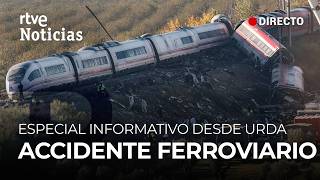
 ¿Qué falló para que un AVE embistiera a otro tren que había avisado de que estaba parado? | RTVE
Things we can learn from the video
Press to jump
- 0:19Separate judicial and technical investigations examine responsibility and the circumstances of the Urda collision.
- 1:40SEMAF's Diego Martín warns that crews increasingly work with degraded systems.
- 1:58An animation reconstructs the LZB failure, while UGT's representative says it has not complained about safety systems.
- 2:20Railway recordings cover normal running conditions and the Iryo driver's inability to restart LZB.
- 2:41The report asks why fallback signaling did not stop the train; an engineer says systems must absorb human error.
A train drivers' union leader warns that crews are increasingly working with degraded systems. A representative of another rail union says it has never complained about the safety systems themselves. Those contrasting accounts feature in Spain's public broadcaster Radio y Televisión Española's RTVE Noticias report on the fatal collision at Urda, in Toledo province.
The report examines how an AVE high-speed train struck a stationary Iryo train whose driver had reported being unable to restart its automatic protection system. It does not establish a final cause.
Presenter Javier Gutiérrez explains that two investigations are proceeding: a judicial inquiry at a court in Orgaz and a technical investigation into the accident. The distinction matters because determining responsibility and explaining how to prevent another collision are separate tasks.
An animated reconstruction traces the loss of the LZB automatic train-protection system. Diego Martín, secretary general of the drivers' union SEMAF, says crews are increasingly having to operate with degraded systems. Francisco Cárdenas, representing UGT at Renfe, offers a different emphasis: his union has not complained about the safety systems.
Recorded railway communications include an exchange about proceeding under normal running conditions, alongside the Iryo driver's report that she cannot restart LZB. Adif manages the railway infrastructure and signaling; Renfe operates train services, including AVE, while Iryo is a separate high-speed operator.
The report then examines the remaining layers of protection, including lineside signals and the ASFA system, asking why they did not stop the approaching train. Salvador García-Ayllón, a civil engineering department director at the Polytechnic University of Cartagena, argues that safety cannot depend on people never making mistakes: the system must be capable of absorbing human error.
A private high-speed rail operator in Spain, jointly owned by Trenitalia, Air Nostrum and Globalvia.
More on Wikipedia ›A major Spanish trade union historically affiliated with the Spanish Socialist Workers' Party (PSOE).
More on Wikipedia ›Spain's state-owned national railway company. It runs train services and was separated from the country's railway infrastructure manager in 2005.
More on Wikipedia ›Spain's state-owned manager of most railway infrastructure, including tracks, signaling and stations. It is separate from the companies that run train services.
More on Wikipedia ›A technical university in Cartagena, Spain, established in 1883.
More on Wikipedia ›Published on Trari
Where next?


- Channel
- RTVE Noticias
- Subscribers
- 2,690,000
- Channel views, pace per day
- 3,039,085 (on a normal day: 1,232,063)
- Video published
- October 29, 2026
- Video views so far
- 166,351 (less than a day online)
- Video views, pace per day
- 355,367
The numbers
The report drew about 166,000 views since yesterday, making it one of Spain's most watched new news videos.
