
Urda crash analysis examines braking distance and failed safeguards
Engineers explain why automatic protection and restricted-speed procedures matter when a high-speed train needs kilometers to stop.
 SpainStory of
Why this story? One of RTVE Noticias's most watched videos since yesterday, with 188,525 views.
RTVE Noticias: The news division of RTVE, Spain's public broadcaster. 2.7M subscribers and 2B views.
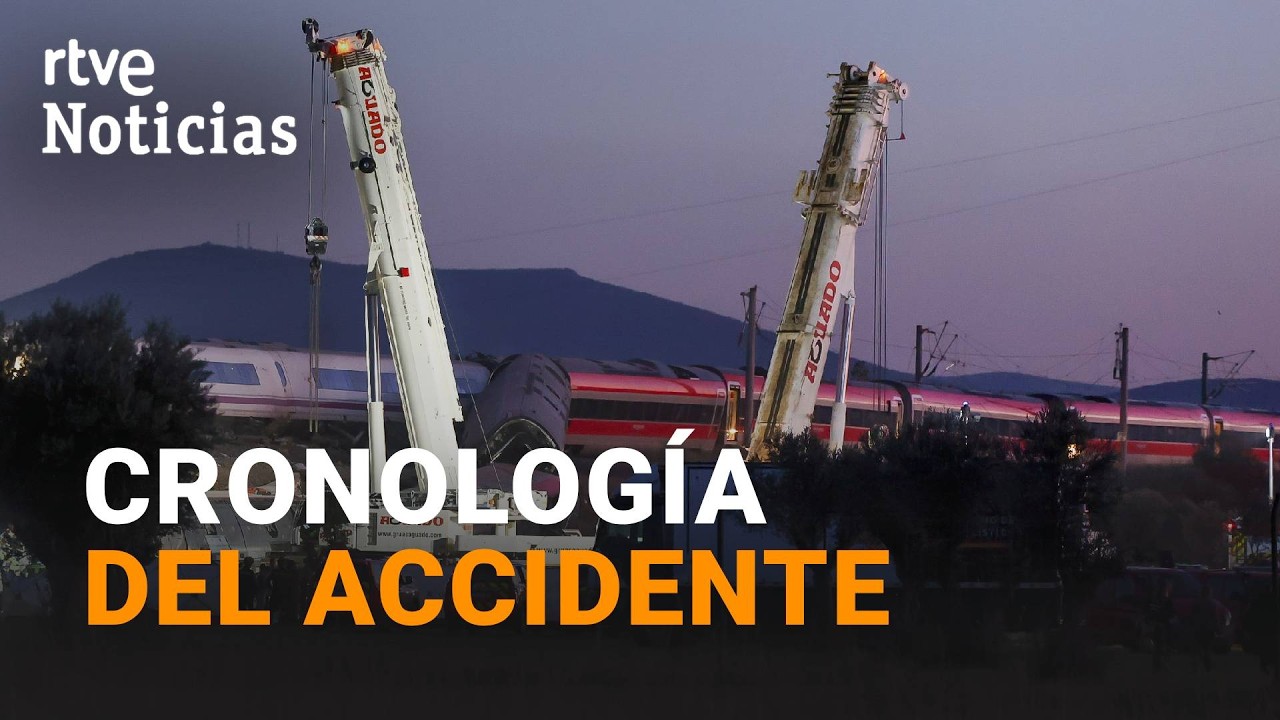 Alcance de trenes en Urda | Las claves de cómo sucedió el accidente ferroviario | RTVE Noticias
Things we can learn from the video
Press to jump
- 1:03A graphic reconstructs the train-control failure, resumed movement and rear-end collision.
- 1:53Engineers explain the automatic braking and overlapping safeguards that should keep trains separated.
- 3:40Minaya explains railway blocks, LZB signaling and running on sight when normal protection is unavailable.
- 5:56An AVE at 200 kilometers per hour can need nearly three kilometers to stop, Minaya says.
- 6:34The discussion considers why the Iryo remained stationary and how recording equipment could clarify the sequence.
- 8:24Three survivors describe the collision and its aftermath inside the carriages.
At high speed, seeing a stationary train ahead may leave too little distance to avoid a collision. Engineer Fernando Minaya makes that point in a technical examination of the Urda rail disaster, explaining that an AVE traveling at 200 kilometers per hour can need nearly three kilometers to stop in an emergency.
RTVE Noticias, the news service of Spain's public broadcaster Radio Televisión Española, reconstructs the collision and asks how successive layers of railway protection could have failed. The broadcast reports at least 68 deaths and 77 injured people hospitalized after the crash near Urda, in Toledo province, south of Madrid.
According to its reconstruction, both trains were heading south on the Madrid-Seville high-speed line when a failure of the LZB train-control system brought services to a halt. The report says the control center of infrastructure manager ADIF subsequently instructed trains to resume normal running. The Iryo service remained stationary, while the Renfe AVE behind it resumed its journey and struck it from the rear. The graphic depicts an impact at close to 200 kilometers per hour, though the investigation must establish the precise sequence and circumstances.
The distinction between the organizations matters: ADIF manages tracks and signaling, while Renfe and private operator Iryo run the trains.
Civil engineer Óscar Carballo says a following train should have braked automatically. Antonio Martín-Carrillo, from the Spanish Engineering Institute, explains that control-center signals turn red to stop trains when protection fails, and argues that several things must have gone wrong together for this collision to occur.
In the studio, Minaya describes railway blocks, the sections used to keep trains separated, and the restricted procedure known as running on sight. That requires movement slow enough for a driver to stop before an obstruction, rather than relying on the long-distance protection available during normal high-speed operation.
Why the Iryo did not restart remains an important question in the discussion. The engineers identify the trains' recording equipment as essential to resolving what happened. The report closes with survivors describing the impact and the scenes inside the damaged carriages.
A municipality in Toledo province, in Spain’s Castile-La Mancha region.
More on Wikipedia ›A 472-kilometer railway linking Madrid and Seville. Opened in 1992, it was Spain’s first high-speed rail connection.
More on Wikipedia ›Spain’s state-owned railway infrastructure manager, responsible for most of the country’s tracks, signaling and stations. It is separate from the companies that run train services.
More on Wikipedia ›A private high-speed rail operator in Spain, jointly owned by Trenitalia, Air Nostrum and Globalvia.
More on Wikipedia ›Spain’s national state-owned train operator. It was created in 2005 when railway services were separated from infrastructure management, which went to ADIF.
More on Wikipedia ›Published on Trari
Where next?



- Channel
- RTVE Noticias
- Subscribers
- 2,690,000
- Channel views, pace per day
- 1,232,063
- Video published
- October 28, 2026
- Video views so far
- 188,525 (less than a day online)
- Video views, pace per day
- 384,901
The numbers
The technical report drew about 189,000 views since yesterday.
