
Russia's war funding burdens regions and banks, Japanese panel says
A detailed television analysis connects opaque military financing with growing armored reserves and a drone base reportedly built in six weeks.
 JapanStory of
Why this story? One of 日テレNEWS's most watched videos since yesterday, with 224,610 views.
日テレNEWS: The news division of Nippon TV, a Japanese commercial television network. 3.4M subscribers and 6.3B views.
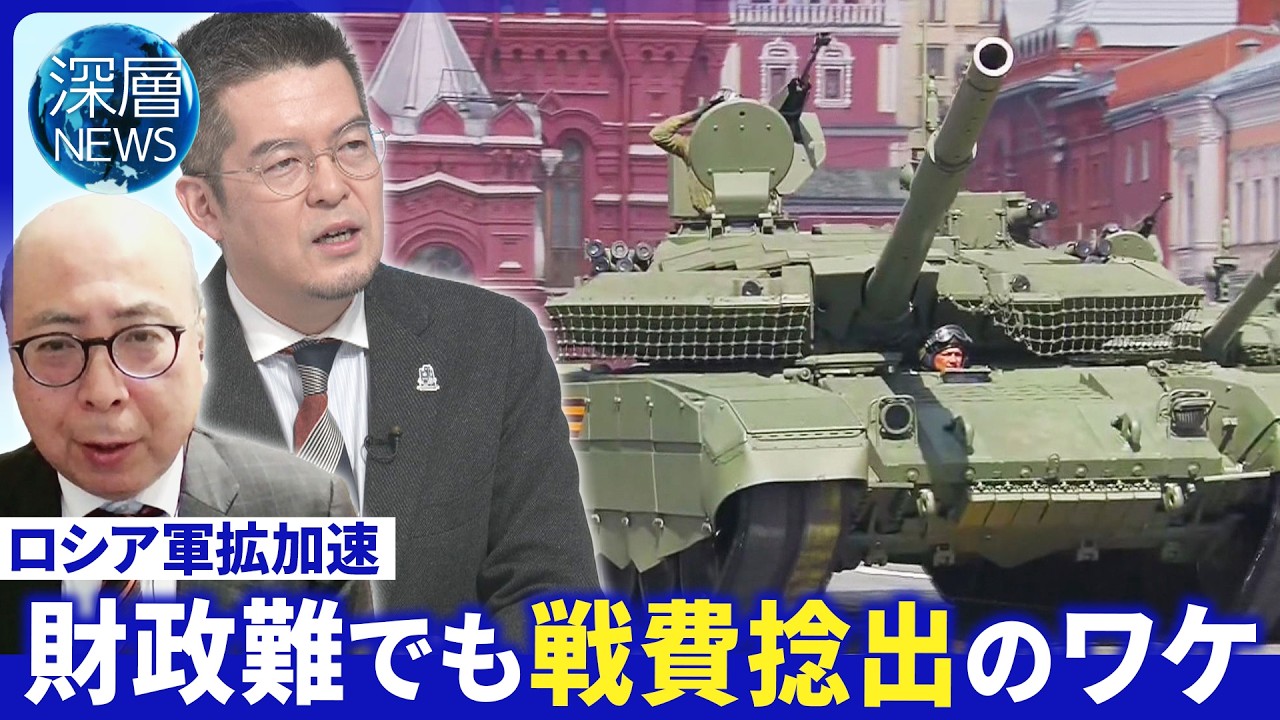 露軍装甲車両の備蓄増加か▽無人機基地1か月半で“完成”▽ロシア戦費捻出の“からくり”【深層NEWS】10月28日(水)
Things we can learn from the video
Press to jump
- 2:01Koizumi interprets attacks on Russian factories as efforts to disrupt missile supplies and disperse air defenses.
- 8:55The program presents growing armored reserves; the panel weighs industrial, tactical and military-reform explanations.
- 19:23Satellite images purportedly show a Rostov drone launch base completed in roughly six weeks.
- 24:45The panel examines drone production and air-defense positions at Alabuga in Tatarstan.
- 32:06Hattori explains how regional obligations and bank lending help finance military activity beyond the central budget.
- 41:30Hattori warns that preferential military lending could leave banks carrying bad debts.
Russia's military expansion is drawing on more than its published defense budget, according to experts on Japan's Nippon Television News program Shinsō NEWS. Regional governments, banks and businesses are absorbing costs that the panel says make the full burden of the war harder to see.
The October 28 broadcast brings together University of Tokyo military analyst Yu Koizumi and Hokkaido University professor Michitaka Hattori. Their discussion links attacks on Russian industry, equipment accumulating behind the front and rapidly expanding drone infrastructure to a central question: how is Moscow sustaining its war effort?
Hattori describes a financing system that pushes obligations onto regional authorities and channels lending to military manufacturers through banks. Koizumi points to regional payments for soldiers and increasingly undisclosed defense spending. Hattori warns that preferential military loans could eventually become bad debts, while businesses face pressure to shoulder air-defense costs. The report also includes citizens' complaints about utility bills and taxes alongside reductions in social spending.
That financial strain does not, in the panel's account, mean weapons production has stopped expanding. The program presents evidence of growing armored-vehicle and self-propelled artillery stockpiles at rear bases, including facilities in Kostroma and Karelia. Hattori considers several possible explanations, including maintaining factory operations and changing battlefield requirements. Koizumi also connects the buildup to military reforms and stronger defenses near Finland following NATO's enlargement.
Drones have reduced the relative importance of traditional armor, Koizumi argues, but have not eliminated the need for tanks and artillery. He uses a baseball analogy: adding an important player does not remove the need for the other positions.
Satellite images provide the program's most concrete construction example. The broadcast identifies a jet-powered drone launch base in Rostov as having been completed in roughly a month and a half. Koizumi examines launch catapults and vehicle surfaces, arguing that the speed of construction suggests similar facilities could be replicated. The discussion then turns to drone production and air defenses at Alabuga in Tatarstan.
The opening section explains Ukraine's reported attacks on missile-component factories, petrochemical plants and oil infrastructure across Russia. Koizumi interprets these as efforts to disrupt missile supplies and stretch Russian air defenses when Ukraine lacks sufficient ballistic-missile interception capacity. Hattori says dependence on imported precision components and machine tools leaves Russian industry vulnerable to delays and higher costs, even when sanctions do not completely block supplies.
The panel ends with another pressure on that system: inexpensive attack drones can force expensive defensive responses. Koizumi adds that more military orders do not necessarily mean contented manufacturers when workloads rise but the prices they receive remain constrained.
An industrial special economic zone in Russia’s Republic of Tatarstan, near the city of Yelabuga.
More on Wikipedia ›Published on Trari
Where next?



- Channel
- 日テレNEWS
- Subscribers
- 3,380,000
- Channel views, pace per day
- 5,345,386 (on a normal day: 3,652,358)
- Video published
- October 29, 2026
- Video views so far
- 239,366 (less than a day online)
- Video views, pace per day
- 224,583
The numbers
The broadcast drew about 225,000 views since yesterday, placing it among Japan's most watched new news videos.
