
Chey presses for faster chip construction as infrastructure needs loom
A Korean news compilation pairs SK's expansion ambitions with Vietnam's factory delays and government-backed memory investment in Japan.
 South KoreaStory of
Why this story? One of KBS News's most watched videos since yesterday, with 290,304 views.
KBS News: The news division of KBS, South Korea's public broadcaster. 3.7M subscribers and 12B views.
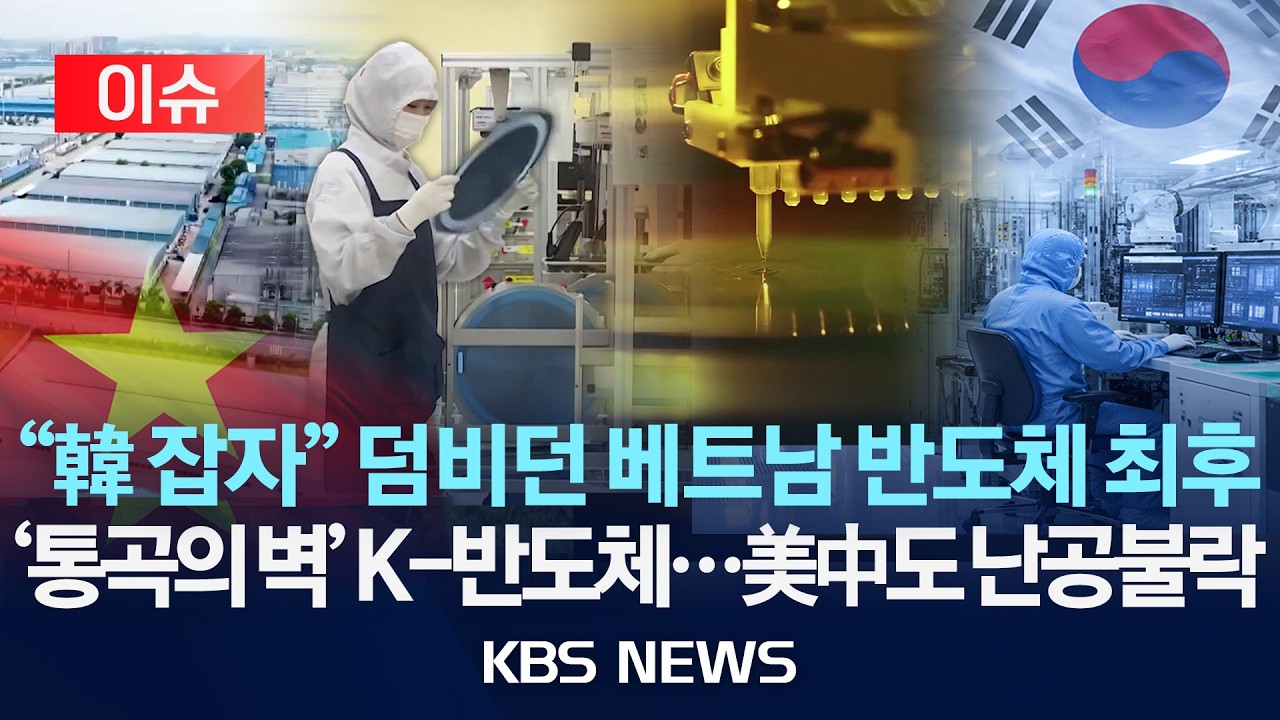 [이슈] "한국 잡자" 덤비던 베트남 반도체 최후/'통곡의 벽' K-반도체...미국·중국도 난공불락/2026년 10월 28일(수)/KBS
Things we can learn from the video
Press to jump
- 0:00Vietnam's integrated chip factory faces delays involving experience, financing and equipment, threatening its trial-production schedule.
- 0:54Solidigm is discussing a $45 billion NAND flash plant in the United States, according to the report.
- 1:26KBS reports that CXMT rejected Apple's lower-price supply proposal and is concentrating on Chinese demand.
- 3:13Chey Tae-won urges rapid construction at the proposed Gwangju cluster despite concerns about water and electricity infrastructure.
- 5:07Kwon Hyeok-jung examines Kioxia's rejection of Chey's manufacturing proposal and the idea of closer Korea-Japan economic cooperation.
- 9:20Micron's Hiroshima expansion receives Japanese subsidies, with the government emphasizing stable domestic memory production.
Chey Tae-won wants chip factories built faster, even if the water and electricity infrastructure takes longer to arrive. Visiting a proposed semiconductor cluster at Gwangju's military airport, the SK Group chairman describes accelerating construction to keep up with rising demand.
South Korea's Korean Broadcasting System (KBS) News includes the visit in a compilation of semiconductor reports spanning several months. Its headline presents Korean chips as a formidable barrier to other countries' ambitions, but the individual reports describe a more complicated landscape of delayed projects, overseas investment and unsuccessful partnership proposals.
The opening segment reports that Vietnam's first fully integrated chip fabrication plant is behind schedule, putting its planned trial production next year in doubt. KBS attributes the difficulties to the state-owned telecommunications company's limited factory-building experience, administrative obstacles to government financing and problems obtaining equipment.
The focus then shifts to Korean investment abroad. According to the report, SK hynix subsidiary Solidigm is discussing a $45 billion NAND flash plant in the United States. NAND provides storage that retains information when power is switched off, unlike the working memory used while a computer runs.
China supplies a different example. KBS reports that memory maker CXMT rejected an Apple supply proposal that demanded lower prices, choosing instead to concentrate on domestic demand. The segment places that decision within China's emphasis on semiconductor self-sufficiency.
Chey's Gwangju visit brings the discussion back to construction speed. He says supply needs to catch up with rapidly increasing demand and indicates a willingness to move ahead before utilities are fully ready if doing so improves the schedule.
A studio discussion with economic commentator Kwon Hyeok-jung examines Japanese manufacturer Kioxia's rejection of Chey's joint-manufacturing proposal and the broader idea of a Korea-Japan economic community. The final report describes Micron breaking ground on expanded DRAM and high-bandwidth memory facilities in Hiroshima with Japanese government subsidies. Japanese industry minister Ryosei Akazawa stresses the importance of establishing a dependable domestic memory manufacturing base and stable supplies.
South Korean businessman and chairman of SK Group, a conglomerate whose subsidiaries include chipmaker SK Hynix.
More on Wikipedia ›South Korean semiconductor company that makes DRAM and flash memory chips. It is one of the world's three largest memory manufacturers, alongside Samsung Electronics and Micron.
More on Wikipedia ›ChangXin Memory Technologies is a Chinese chipmaker based in Hefei, Anhui, specializing in DRAM memory.
More on Wikipedia ›Japanese semiconductor memory and data-storage group based in Tokyo. Its main operating subsidiary makes NAND flash memory, solid-state drives and related storage products.
More on Wikipedia ›American semiconductor company that makes DRAM, flash memory, high-bandwidth memory and solid-state drives. It is one of the world's three largest computer memory manufacturers.
More on Wikipedia ›Japanese Liberal Democratic Party politician and member of the House of Representatives, representing Tottori's second district.
More on Wikipedia ›Published on Trari
Where next?



- Channel
- KBS News
- Subscribers
- 3,730,000
- Channel views, pace per day
- 6,731,231 (on a normal day: 17,467,906)
- Video published
- October 29, 2026
- Video views so far
- 560,762 (less than a day online)
- Video views, pace per day
- 290,268
The numbers
The compilation drew roughly 290,000 views since yesterday, placing it among South Korea's most watched news uploads.

💡 Test your knowledge
What does HBM stand for in semiconductor manufacturing?
HBM means high-bandwidth memory, a memory technology featured in the report on Micron's Hiroshima expansion.