
 United States
 United Kingdom
 Canada
 Australia
 New Zealand
 Ireland
Supermarket freezers switched to defrost in European cyber-attack
BBC News follows discarded food outside Brussels with a security question: why were vulnerable refrigeration systems still accessible online?
 BBC News
Story of
Why this story? One of the most watched videos since yesterday, with 263,468 views.
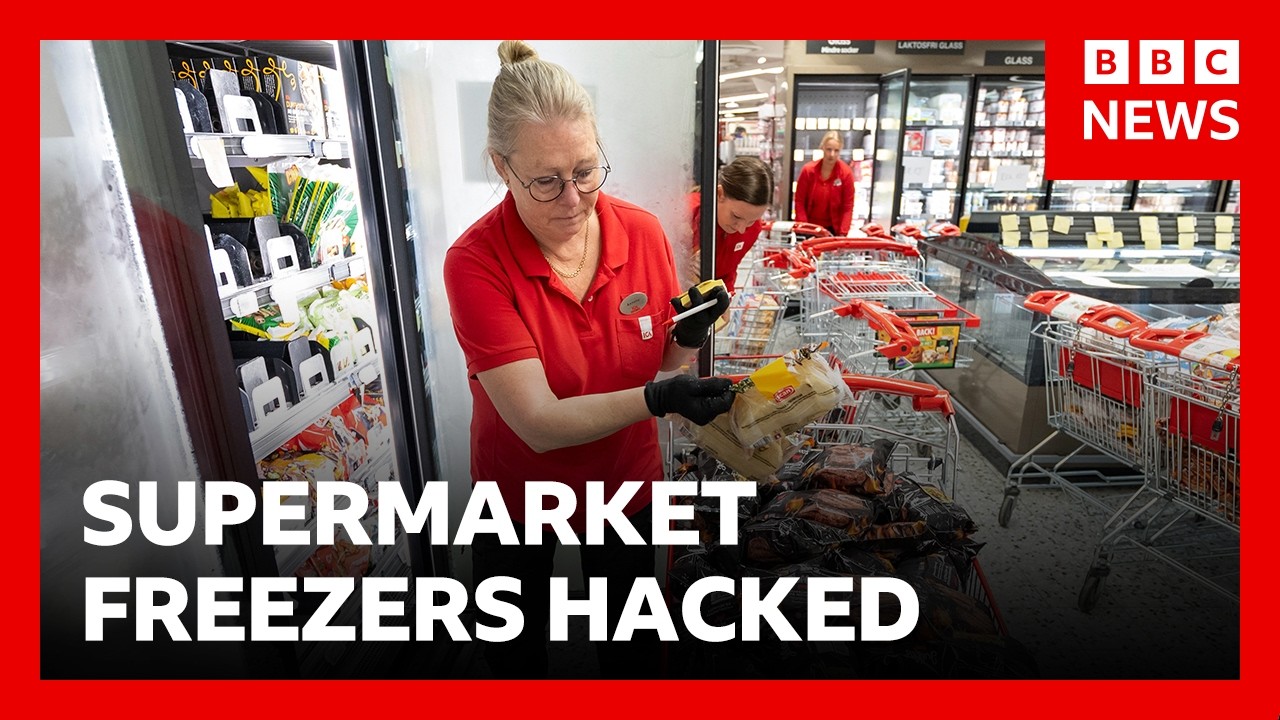 Shop freezers in seven European countries hit by cyber-attack | BBC News
Things we can learn from the video
Press to jump
- 0:33Nick Beake shows defrosted supermarket food being discarded outside Brussels.
- 1:10The report explains how altered refrigeration settings raised temperatures in affected shops.
- 1:51Forescout's Daniel dos Santos warns of repeat attacks following the earlier incidents in France.
- 2:36Will Guyatt says thousands of refrigeration units remained exposed online after the vulnerability became known.
- 3:22Guyatt says a software fix has existed for over a year and suggests disconnecting equipment as an interim measure.
- 4:10Guyatt discusses AI's potential to identify vulnerabilities by analysing software code.
Frozen food goes into a skip outside Brussels, not into shoppers' baskets. BBC correspondent Nick Beake shows the physical cost of a cyber-attack that has reached supermarket refrigeration systems across seven European countries.
The BBC News report, uploaded today, has drawn about 260,000 views in its first eleven hours. It connects an unusually tangible consequence of hacking with a warning about equipment left exposed online.
Around forty Delhaize supermarkets in Belgium and Luxembourg were affected, alongside smaller numbers of shops in Sweden, Ireland, the Netherlands, Estonia and Finland, the BBC reports. Belgian refrigeration manufacturer Sabcobel says affected units' evaporators were switched into defrost mode, warming them up.
Swedish store manager Rickard Nilsson struggles to understand the purpose of the intrusion into temperature-monitoring systems. The report then turns to an earlier attack on French supermarkets, where local media reported that millions of euros' worth of food had to be discarded in October. Forescout's Daniel dos Santos warns that the pattern could recur.
In the studio discussion, LBC technology reporter Will Guyatt says thousands of units remained exposed online weeks after the vulnerability became known. His account makes the problem less about an unstoppable new technique than a failure to address an existing weakness: "Well, a software fix has been available for over a year."
Guyatt suggests disconnecting affected equipment from the internet as an interim measure. He also discusses AI's potential to uncover software flaws, but the immediate question in this report is what happened to a fix that already existed.
Published on Trari
Where next?



 Is this your channel?For the channel's owners and team: a ready picture and text for your audience
Share the story with your audience. Everything is ready:
For an Instagram story or a WhatsApp status
For a community post or your channel's description
- Channel
- BBC News
- Subscribers
- 20,200,000
- Channel views, last 7 days
- 35,407,747
- Channel views, pace per day
- 3,877,270 (on a normal day: 5,064,825)
- Video published
- November 3, 2026
- Video views so far
- 9,037 (less than a day online)
The numbers
The report reached roughly a quarter of a million views within its first eleven hours online.
