
Eisenkot's coalition dilemma extends beyond an exit-poll lead
ZDF's election-night analysis asks whether excluding Arab parties remains workable when neither main bloc has a governing majority.
 GermanyStory of
Why this story? One of ZDFheute Nachrichten's most watched videos since yesterday, with 135,678 views.
ZDFheute Nachrichten: The news division of ZDF, a German public broadcaster. 1.9M subscribers and 2B views.
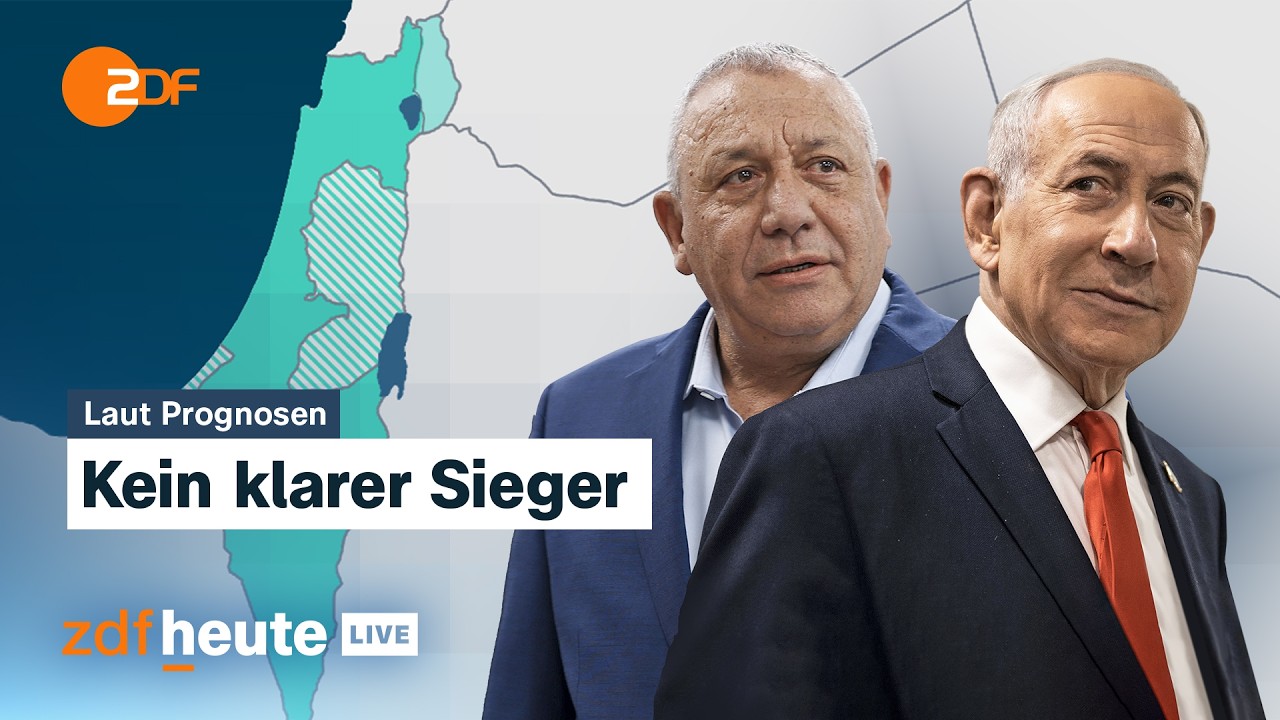 Israel-Wahl: Netanjahus Partei wohl stärkste Kraft, aber Eisenkots Lager vorn | ZDFheute live
Things we can learn from the video
Press to jump
- 8:58Initial television projections put Likud first individually, but Eisenkot's bloc narrowly ahead overall; neither has a majority.
- 12:06Reichart identifies Arab parties as potentially decisive in forming the next government.
- 16:33Reichart distinguishes Eisenkot's positions on justice, settlements and security from Netanyahu's.
- 23:22Eigendorf reports Palestinian uncertainty, settler violence and limited expectations of policy change from Ramallah.
- 29:03Gerlach says both camps seek center-right voters and Eisenkot also rejects a two-state solution.
- 36:01Gerlach argues that increased Arab Israeli participation makes their parties' inclusion in coalition negotiations necessary.
Gadi Eisenkot's projected advantage leaves him facing a difficult question: how can he assemble a government without the Arab parties he has resisted bringing into a coalition?
That dilemma runs through Germany's ZDFheute Nachrichten election-night broadcast, hosted by Christopher Wehrmann, with correspondent Thomas Reichart reporting from Eisenkot's Yashar party headquarters in Tel Aviv. Eisenkot, a former Israeli military chief, is challenging Prime Minister Benjamin Netanyahu.
The Israeli broadcasters' initial projections shown on screen put Netanyahu's Likud ahead as an individual party. But the combined parties in Eisenkot's camp hold a narrow advantage over Netanyahu's bloc. Neither reaches the 61 seats needed for a parliamentary majority. These are election-night projections, not a confirmed result.
Reichart highlights the strong showing of Arab parties as potentially decisive. Wehrmann presses the apparent contradiction: neither Netanyahu nor, to his understanding, Eisenkot had agreed beforehand to form a coalition with them. Middle East analyst Daniel Gerlach argues that Eisenkot may not be able to maintain that position. Gerlach also cautions against declaring an election victory before the coalition possibilities become clearer.
The discussion separates a possible change of government from a fundamental change in policy. Reichart describes Eisenkot as supporting settlements while opposing militant settlers. Gerlach says both camps primarily seek center-right voters and that Eisenkot also rejects a two-state solution.
Reporting from Ramallah in the occupied West Bank, special correspondent Katrin Eigendorf describes uncertainty rather than celebration among Palestinians. She reports increasing settler violence, displacement and sharply restricted freedom of movement, with little expectation among those she speaks to that an Eisenkot government would bring a substantial shift.
The broadcast also examines relations with Iran and the United States, including Netanyahu's relationship with Donald Trump. An image of a nuclear explosion over Tel Aviv shown during the discussion is explicitly labeled AI-generated, not footage of an actual event.
For Gerlach, the immediate political issue is whether the increased participation of Arab Israeli voters translates into a meaningful place for their parties in negotiations over the next government.
Leader of Israel's Yashar party and Netanyahu's main challenger in the 2026 election. He headed the Israeli military from 2015 to 2019 and served in the unity government from 2023 to 2024.
More on Wikipedia ›A major right-wing political party in Israel, founded in 1973. Its 1977 election victory marked the first time a right-wing party won the most votes in Israel.
More on Wikipedia ›Published on Trari
Where next?



- Channel
- ZDFheute Nachrichten
- Subscribers
- 1,890,000
- Video published
- October 27, 2026
- Video views so far
- 135,678 (less than a day online)
- Video views, pace per day
- 295,125
The numbers
The broadcast drew about 136,000 views since yesterday, placing it among Germany's most-watched new news videos.

💡 Test your knowledge
Tel Aviv lies on the coast of which sea?
Tel Aviv sits on Israel's Mediterranean coastline.