
 United States
 United Kingdom
 Canada
 Australia
 New Zealand
 Ireland
TLDR contrasts Eisenkot's draft pledge with his Gaza stance
Georgina Findlay's election explainer distinguishes domestic policy differences from foreign-policy continuity, then examines why neither bloc has an easy route to government.
 TLDR News Global
Story of
Why this story? One of the most watched videos since yesterday, with 852,092 views.
 Israel’s Election Results Explained
Things we can learn from the video
Press to jump
- 1:04Proportional representation and a 3.25% electoral threshold make coalition governments central to Israel's political system.
- 2:16Findlay identifies ultra-Orthodox military exemptions and the fallout from October 7 as pressures on Netanyahu.
- 4:02The opposition includes Yashar, The Democrats, Yisrael Beiteinu and the Together alliance.
- 5:18Eisenkot promises to repeal draft exemptions and hold an October 7 inquiry, while taking similar positions on Gaza.
- 6:56Neither bloc has a straightforward majority; Findlay examines coalition options and the possibility of another election.
Repealing military draft exemptions and investigating the October 7 attacks would mark a departure from Benjamin Netanyahu's government. On Gaza and a two-state solution, however, TLDR News Global's election analysis describes much less distance between Netanyahu and his principal challenger, Gadi Eisenkot.
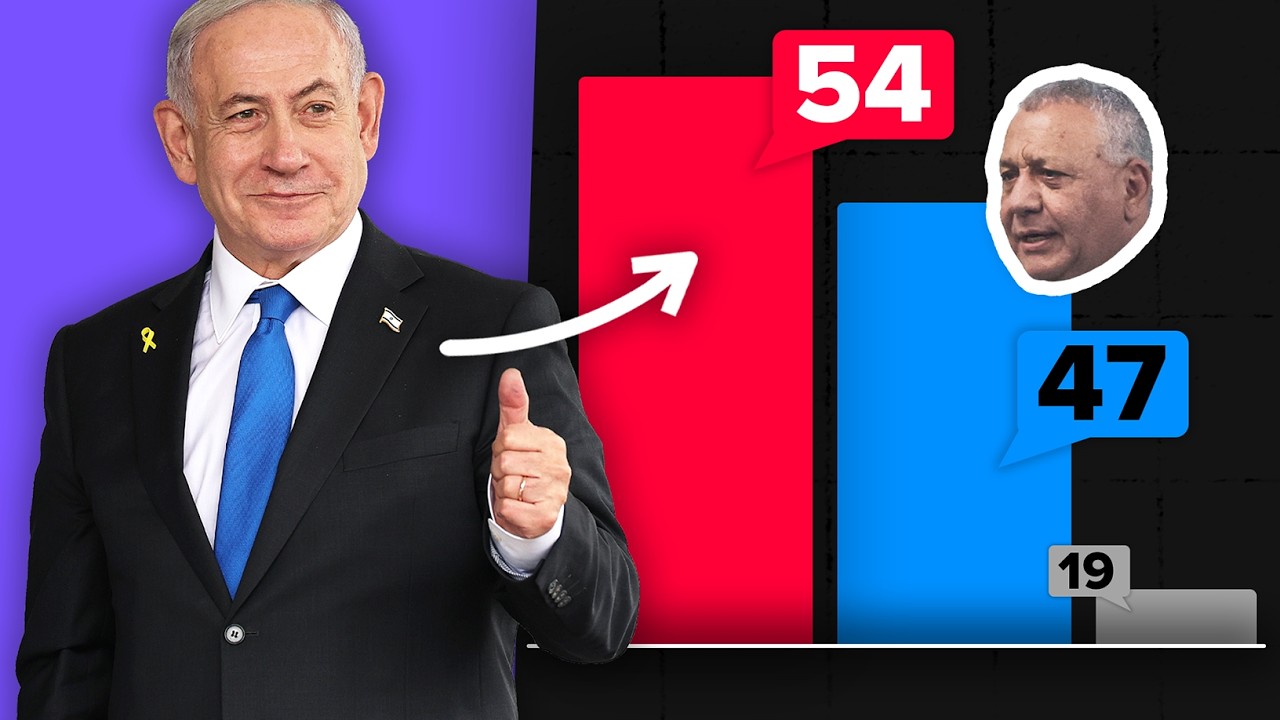
That distinction gives "Israel's Election Results Explained" something beyond coalition arithmetic. Presented by Georgina Findlay, the report has drawn roughly 850,000 views since yesterday, taking viewers through both the preliminary result and what a change of leadership might actually change.
Findlay identifies July's military exemption laws for ultra-Orthodox men and the fallout from October 7 as important pressures on Netanyahu. She then introduces the opposition's constituent parties, including Eisenkot's Yashar, The Democrats, Yisrael Beiteinu and the Together alliance, rather than treating them as a single political project.
The electoral rules help explain the impasse. Parties must clear a minimum share of the vote to enter parliament, and proportional representation makes coalition-building central to governing. In the preliminary projections presented here, both Netanyahu's bloc and the opposition fall short of a majority, while Arab parties hold a substantial share of the seats.
At 06:56, the report turns to the possible exits: finding additional partners, securing Arab party support, forming a national unity government or returning to elections. Findlay presents obstacles to each governing arrangement. The central problem is not simply who has more seats, but which parties are willing to govern together.
Leader of Israel's Yashar party and a former military chief of staff. He was the main challenger to Prime Minister Benjamin Netanyahu in the 2026 election.
More on Wikipedia ›Published on Trari
Where next?


 Is this your channel?For the channel's owners and team: a ready picture and text for your audience
Share the story with your audience. Everything is ready:
For an Instagram story or a WhatsApp status
For a community post or your channel's description
- Channel
- TLDR News Global
- Subscribers
- 1,180,000
- Channel views, last 7 days
- 5,816,897
- Video published
- October 28, 2026
- Video views so far
- 852,092 (less than a day online)
- Video views, pace per day
- 1,003,597
The numbers
The explainer has drawn a substantial audience before completing its first full day online. Its comment count has also already exceeded the channel's usual first-day total.

💡 Test your knowledge
What vote threshold must a party clear to enter the Knesset, as explained in the video?
Findlay explains that parties must receive at least 3.25% of the vote to qualify for parliamentary seats.