
 United States
 United Kingdom
 Canada
 Australia
 New Zealand
 Ireland
Ingram maps Ukrainian counterattacks around the Donbas fortress belt
The Sun's Battle Plans analysis links reported territorial gains to an effort to prevent Russian forces from encircling defended cities.
 The Sun
Story of
Why this story? One of The Sun's most watched videos since yesterday, with 267,989 views.
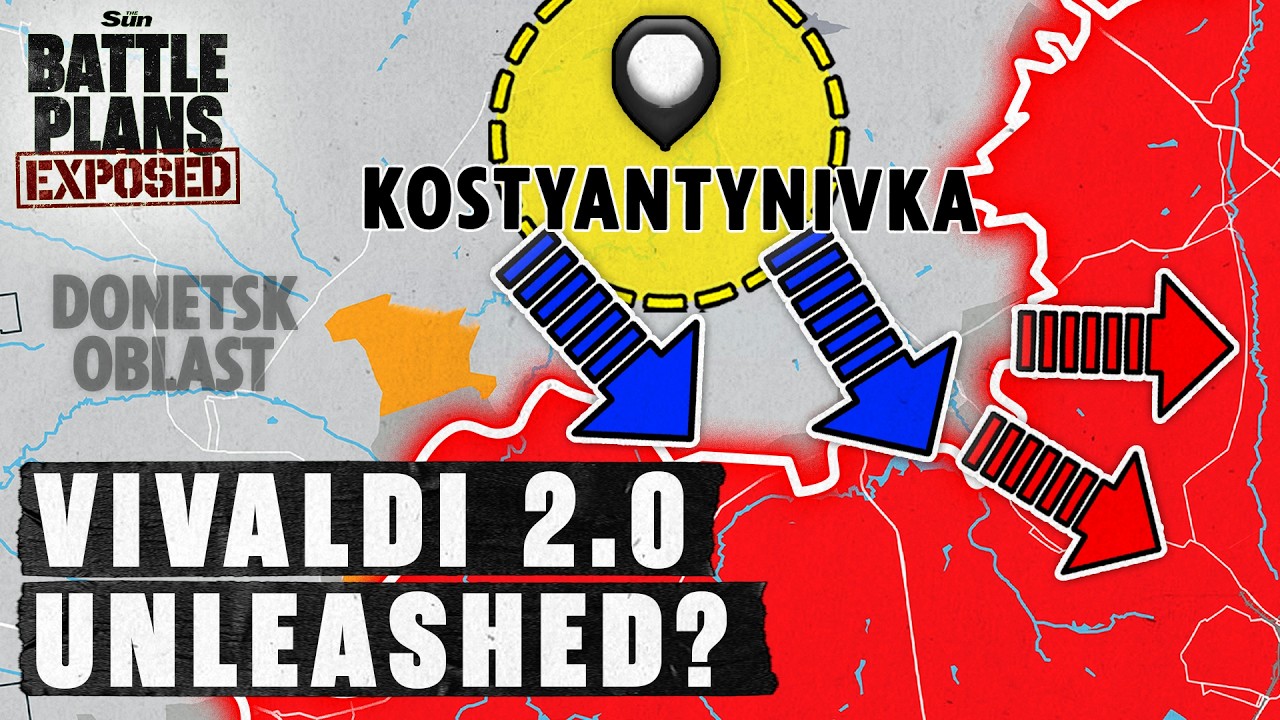 EXPOSED: Ukraine 'triggers Vivaldi 2.0’ as counter-attack shatters Russian spearhead | Battle Plans
Things we can learn from the video
Press to jump
- 3:40Ingram links reported Ukrainian strikes on Russian oil infrastructure to difficulties distributing fuel.
- 7:34His tabletop map traces reported Ukrainian gains around Nykyforivka, Yurkivka and Tykhonivka.
- 10:40The "Vivaldi 2.0" discussion explains his argument that counterattacks can block Russian pincer movements around defended cities.
- 15:13Ingram says autonomous guidance and optical matching let long-range drones navigate without foreign satellite communications links.
- 20:00He recounts a June 2024 operation involving 28 days of digging through an abandoned irrigation pipe near Pokrovsk.
- 22:06According to Ingram, the tunnel allowed assault troops to bypass minefields and drone surveillance for a flank attack.
Ukrainian counterattacks near Kostyantynivka are disrupting Russian attempts to outflank the Donbas fortress belt, former intelligence officer Philip Ingram says in The Sun's Battle Plans Exposed.
Using a tabletop map, Ingram describes Ukrainian forces regaining ground around Nykyforivka, Yurkivka and Tykhonivka. He argues that these manoeuvres have narrowed Russia's options for attacking the defended cities from their flanks. Kostyantynivka is an industrial city and an important railway junction in eastern Ukraine, helping explain its place in the discussion of the wider defensive belt.
The episode's title calls the prospect "Vivaldi 2.0". Ingram's central argument is that coordinated counter-thrusts can frustrate Russian pincer movements, rather than merely hold a fixed line. That assessment comes alongside footage he presents as Ukrainian attacks on an ammunition depot, a Russian helicopter and oil infrastructure inside Russia.
The deep-strike section examines how drones can navigate using autonomous guidance and optical matching. Ingram says these systems allow attacks without depending on foreign satellite communications links such as Starlink.
A later section looks back rather than reporting a new operation. Ingram recounts a June 2024 mission near Pokrovsk in which Ukrainian sappers spent 28 days digging through an abandoned irrigation pipe. According to his account, the completed passage let assault troops bypass minefields and surveillance drones to attack from behind Russian positions.
The episode drew about 268,000 views since yesterday, making it The Sun's most-watched new upload over that period. Its analysis moves between modern navigation systems and a much older battlefield tool: a concealed route beneath the ground.
An industrial city in Ukraine’s eastern Donetsk region. It developed into an important railway junction and a major centre for glassmaking and metal production.
More on Wikipedia ›Published on Trari
Where next?



 Is this your channel?For the channel's owners and team: a ready picture and text for your audience
Share the story with your audience. Everything is ready:
For an Instagram story or a WhatsApp status
For a community post or your channel's description
- Channel
- The Sun
- Subscribers
- 6,550,000
- Channel views, last 7 days
- 9,318,073
- Channel views, pace per day
- 658,674 (on a normal day: 1,442,991)
- Video published
- November 10, 2026
- Video views so far
- 267,989 (less than a day online)
- Video views, pace per day
- 506,315
The numbers
This Battle Plans episode drew the most views since yesterday among The Sun's new uploads.
