
Tsikhanouskaya warns Belarus needs freedom, not revolving-door prisoner deals
The opposition leader links Russian subjugation to Europe's security, while drawing on her longstanding ties to Ireland to explain the struggle for national identity.
 Ireland
Why this story? One of RTÉ News's most watched videos since yesterday, with 1,852 views.
RTÉ News: The news division of RTÉ, Ireland's public broadcaster. 255K subscribers and 181M views.
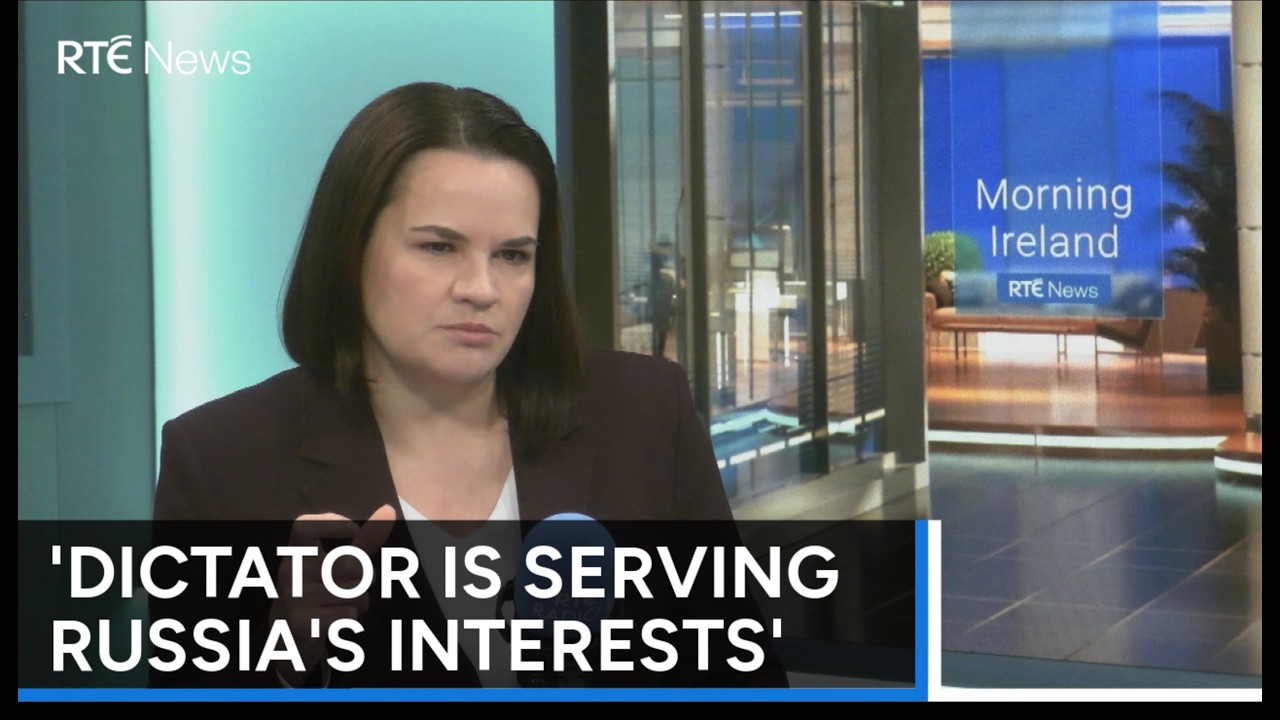 Opposition leader says Belarus is experiencing 'Russification' under dictatorship | RTÉ News
Things we can learn from the video
Press to jump
- 0:48Tsikhanouskaya describes Russification in Belarus and draws parallels with Ireland's struggle to preserve national identity.
- 1:46She says more than 900 political prisoners remain detained, facing harsh conditions and inadequate medical assistance.
- 2:44Her husband spent five years imprisoned, including two years without communication, she says.
- 3:48She warns that prisoner-release negotiations must not become a revolving-door business that leaves repression intact.
- 5:41She argues that a Ukraine settlement leaving Belarus unaddressed would leave Europe vulnerable to further threats.
- 9:10She calls Ireland her second home and plans a November visit to her host family in Roscrea.
Releasing prisoners must not become a substitute for freeing Belarus from dictatorship, opposition leader Sviatlana Tsikhanouskaya says, warning that negotiations risk becoming a transactional cycle of detention and release.
Speaking to Audrey Carville on Morning Ireland, she describes two connected struggles: resistance to Alexander Lukashenko's rule and the preservation of Belarusian identity against what she calls "Russification." The interview was published by RTÉ News, the news service of Ireland's public broadcaster Raidió Teilifís Éireann.
Tsikhanouskaya, who challenged Lukashenko in the 2020 presidential election and leads an opposition movement from exile, draws a parallel with Ireland's efforts to preserve its national identity. Belarus lies between Russia, Ukraine and European Union countries, making its political future consequential beyond its borders.
She says more than 900 political prisoners remain detained, describing harsh conditions and a lack of medical assistance. Her husband's release after five years in prison gives the discussion a personal dimension: she says he spent his imprisonment in solitary confinement, including two years completely cut off from communication.
Carville asks about American negotiations and eased sanctions. "At the moment, it looks like revolving doors," Tsikhanouskaya replies. Her concern is that individual releases become a recurring bargaining mechanism without ending repression. She summarizes the different purposes she wants sanctions to serve: "American sanctions to release the people, European sanctions to release the country."
The same argument shapes her view of Ukraine. She contends that settling the war without addressing Belarus would leave Europe exposed to continuing threats from Lukashenko. She also rejects the idea that the Belarusian opposition is simply another political party, describing it instead as a broad grassroots movement against dictatorship.
The interview closes with a connection that predates her political life. Asked about childhood visits to County Tipperary after Chernobyl, Tsikhanouskaya calls Ireland her second home. In Dublin for an Irish-Belarusian conference on national identity at the Abbey Theatre, she says she plans to return in November and visit her host family in Roscrea.
A landlocked country in Eastern Europe, bordered by Russia, Ukraine, Poland, Lithuania and Latvia. Its capital is Minsk.
More on Wikipedia ›A Belarusian opposition leader who challenged Alexander Lukashenko in the 2020 presidential election. She leads opposition to his rule through an alternative government operating from Lithuania and Poland.
More on Wikipedia ›A weekday breakfast news programme on RTÉ Radio 1 and Ireland's most listened-to radio programme.
More on Wikipedia ›Belarus's president since 1994 and the only person to have held the office since it was established.
More on Wikipedia ›Published on Trari
Where next?


- Channel
- RTÉ News
- Subscribers
- 255,000 ▲ 1,000 this week
- Channel views, last 7 days
- 2,082,925
- Channel views, pace per day
- 102,354 (on a normal day: 339,021)
- Video published
- October 27, 2026
- Video views so far
- 1,852 (less than a day online)
- Video views, pace per day
- 2,361
The numbers
The interview drew about 1,900 views since yesterday, placing it among the most-watched new reports on Ireland's leading news channels.
