
Dublin's Quaker heritage connects familiar businesses with silent worship
Nationwide visits meeting rooms, archives and a burial ground to explore how equality shapes the Religious Society of Friends.
 Ireland
Why this story? One of RTÉ News's most watched videos since yesterday, with 1,923 views.
RTÉ News: The news division of RTÉ, Ireland's public broadcaster. 255K subscribers and 181M views.
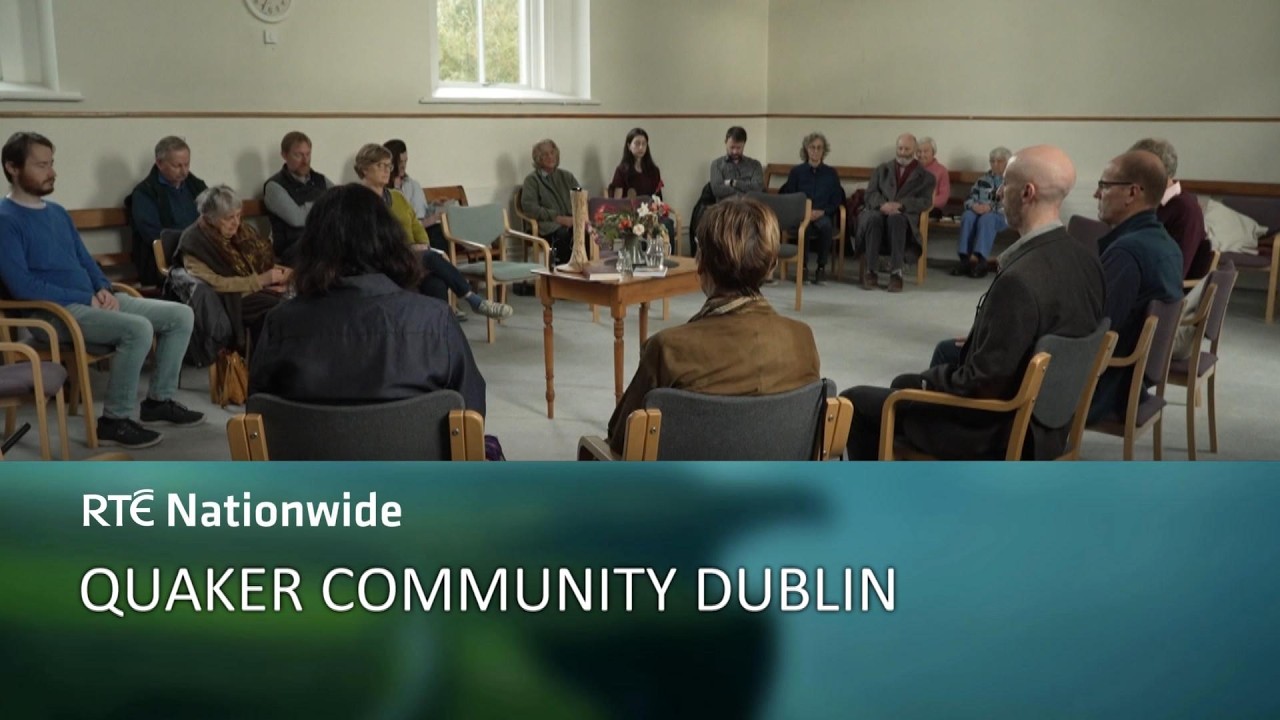 Inside Dublin's Quaker Community | Nationwide
Things we can learn from the video
Press to jump
- 0:00Bewley's, Goodbody and Jacob's introduce the Quaker connections behind familiar Irish businesses.
- 2:05Churchtown worship centers on silent, active waiting, with contributions made when someone feels moved to speak.
- 3:01The movement's English Civil War origins lead into its commercial history in Ireland and Britain.
- 5:44The report recounts Quaker opposition to slavery, pacifism and Great Famine relief work.
- 6:02Archive books preserve arguments for women's spiritual equality and records of penalties over religious tithes.
- 7:47Uniform burial-ground headstones express simplicity and equality; the closing section follows modern community support and advocacy.
Bewley's cafés, Jacob's biscuits and Goodbody stockbrokers are familiar names in Ireland. Their shared Quaker heritage is the starting point for "Inside Dublin's Quaker Community | Nationwide," a feature from Ireland's public broadcaster, RTÉ News.
Reporter John Kilraine follows that commercial history into a community whose worship dispenses with priests and a prescribed order of service. At a meeting in Churchtown, people sit together in silence, speaking when they feel moved to contribute.
Bairbre Nic Aongusa describes leaving Catholicism at eighteen and later finding the Quaker community while seeking spiritual support as a parent. The absence of hierarchy and discrimination against women mattered to her. She calls the worship "an active silence," rather than a passive one.
At Quaker House and its library in Rathfarnham, the report traces the movement to the English Civil War. Will Haire, clerk of the Quakers' Yearly Meeting, explains how belief in direct access to God and equality brought early Friends into conflict with established authority.
The business story extends beyond Dublin to the chocolate makers Cadbury, Rowntree's and Fry's. Alongside it, the feature recounts Quaker opposition to slavery, pacifism and humanitarian assistance during Ireland's Great Famine.
Historical committee member Peter Lamb shows archival records of penalties for refusing religious tithes and early writing defending women's spiritual authority, including a pamphlet by Margaret Fell. These documents connect the community's principles with the practical costs of holding them.
At the Friends Burial Ground at Temple Hill in Blackrock, Susanna Murdoch explains how simplicity continues in the uniform headstones and their wording. Earlier Friends avoided headstones altogether, regarding them as unnecessary for the dead and an expression of pride among the living.
The feature concludes with the community's work today: support around addiction and homelessness, refugee advocacy and an emphasis on equality beyond the meeting room.
A member of the Religious Society of Friends, a Christian movement with Protestant roots. Members also call one another Friends.
More on Wikipedia ›An Irish television programme produced by RTÉ Cork, covering human-interest stories and cultural events across Ireland.
More on Wikipedia ›Published on Trari
Where next?



- Channel
- RTÉ News
- Subscribers
- 255,000 ▲ 1,000 this week
- Channel views, last 7 days
- 2,062,198
- Channel views, pace per day
- 267,471 (on a normal day: 346,971)
- Video published
- October 24, 2026
- Video views so far
- 9,484 (3 days online)
- Video views, pace per day
- 1,922 (on a normal day: 2,049)
The numbers
The feature drew about 1,900 views since yesterday.

💡 Test your knowledge
Where does the feature show a silent Quaker worship meeting?
The worship meeting shown in the report takes place in Churchtown.