
 United States
 United Kingdom
 Canada
 Australia
 New Zealand
 Ireland
SS United States becomes a laboratory for life on a wreck
PBS NewsHour's reef-deployment broadcast drew an extraordinary audience while scientists explained what they hope to learn beneath the surface.
 PBS NewsHour
Story of
Why this story? The video opened at a pace of 1,544,290 views a day, 43 times a normal first day on this channel (36,226).
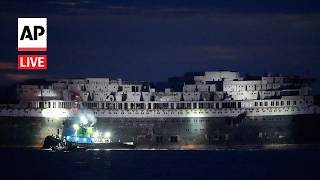
 WATCH LIVE: SS United States, once world’s fastest ocean liner, sinks to become reef off Florida
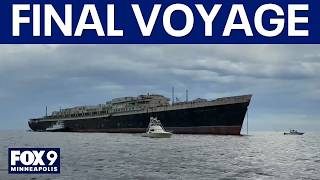
Next story: SS United States' planned sinking took eight hours, FOX 9 reports
11 more stories on SS United States reef sinking ›
Things we can learn from the video
Press to jump
- 0:00A historical introduction follows the liner from its record-setting maiden crossing to preparation for reefing.
- 13:00Adams outlines a ten-year research partnership to study the ship as an artificial reef.
- 14:28Meyer-Kaiser explains marine colonization and how the Loop Current transports larvae.
- 31:39Contractor Tim Mullane describes the ship's construction and the cleanup required before sinking.
- 52:13Drone feeds show tugboats positioning the liner and crews preparing for scuttling.
PBS NewsHour brought about 1.5 million views to the SS United States' final voyage in its first day, carrying a dockside broadcast of the historic liner's sinking off Florida. Amid the tugboats, aerial feeds and harbor interviews, a marine biologist offered a different way to see the occasion: the beginning of a community, not just the end of a ship.
Kirstin Meyer-Kaiser of Woods Hole Oceanographic Institution put it plainly: "This is the prime opportunity to study formation of a marine community from scratch." She described research into how organisms colonize wrecks and how larvae travel via the Loop Current. A ten-year research partnership will follow the ship's transformation into habitat.
The broadcast, hosted by Destin-Fort Walton Beach tourism director Jennifer Adams, also shows the practical work behind that transformation. Contractor Tim Mullane discusses the liner's engineering and the meticulous cleanup needed before reefing. Offshore cameras show tugboats positioning the vessel as crews prepare for the sinking.
That mix of maritime farewell and underwater future reached far beyond PBS NewsHour's usual audience for a long broadcast, drawing more than forty times its typical first-day views. A separate, shorter upload of the sinking also attracted an unusually large audience.
For viewers interested in what follows the spectacle, Meyer-Kaiser's segment supplies a concrete question: how does marine life turn a newly submerged ocean liner into a living reef?
An American ocean liner built in 1950–1951. It was the largest liner built entirely in the United States and still holds the record for the fastest Atlantic crossing by an ocean liner.
More on Wikipedia ›A private, nonprofit research and higher education institution focused on marine science and engineering.
More on Wikipedia ›Published on Trari
More on SS United States reef sinking

Where next?


What do you think?
 Is this your channel?For the channel's owners and team: a ready picture and text for your audience
Share the story with your audience. Everything is ready:
For an Instagram story or a WhatsApp status
For a community post or your channel's description
- Channel
- PBS NewsHour
- Subscribers
- 5,410,000
- Channel views, last 7 days
- 13,740,161
- Channel views, pace per day
- 3,275,587 (on a normal day: 1,813,803)
- Video published
- November 12, 2026
- Video views so far
- 1,546,913 (less than a day online)
- Video views, pace per day
- 568,166
The numbers
The live broadcast was far outside PBS NewsHour's usual first-day range for long videos and streams. Its shorter sinking video also drew substantially more views than a typical regular upload.

💡 Test your knowledge
Across which ocean did SS United States set its famous passenger-liner speed record?
SS United States set its transatlantic speed record on its maiden voyage in 1952.