
 United States
 United Kingdom
 Canada
 Australia
 New Zealand
 Ireland
SS United States' final minutes turn a liner into a reef
AP's nighttime broadcast drew more than two million views as the ship, longer than Titanic, rolled beneath the Gulf of Mexico.
 Associated Press
Story of
Why this story? The video opened at a pace of 2,067,844 views a day, 25 times a normal first day on this channel (81,857).
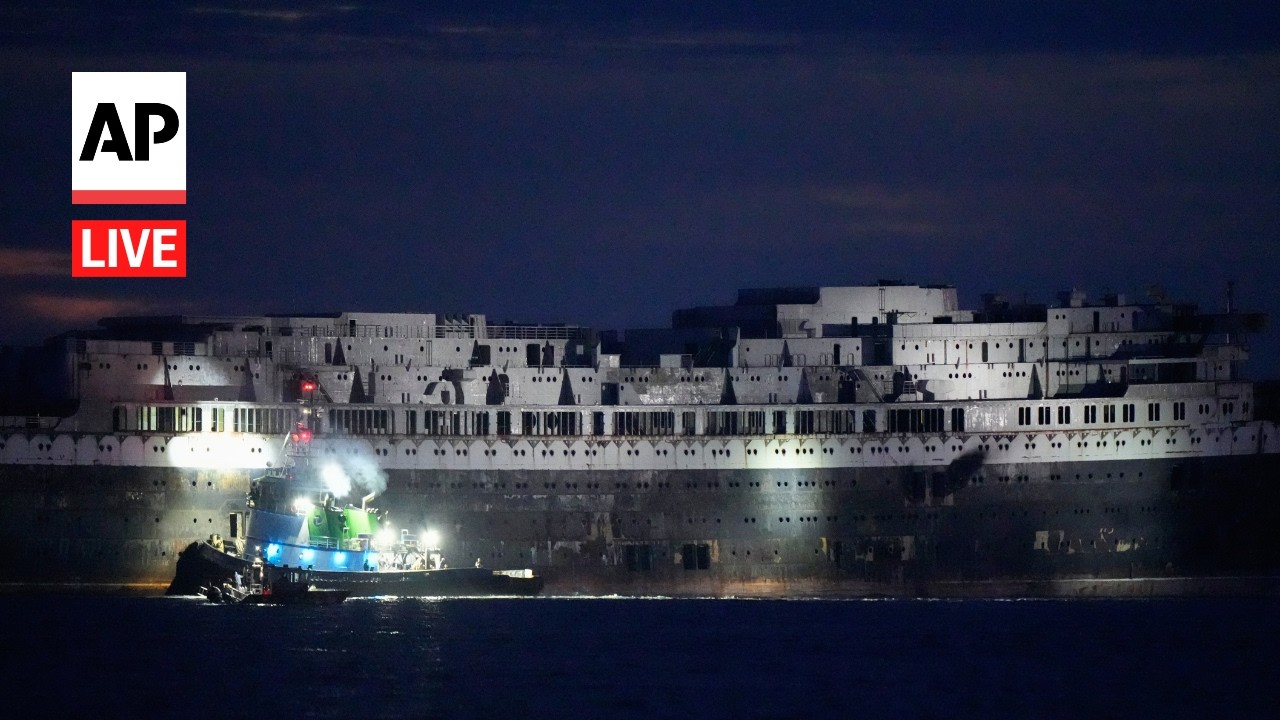 LIVE: SS United States sinks to create the world’s largest artificial reef
Next story: SS United States' planned sinking took eight hours, FOX 9 reports
11 more stories on SS United States reef sinking ›
Video summary
Press to jump
- 0:00The illuminated liner lists in open water at night, surrounded by support boats and tugs.
- 2:00Aerial views show the ship tilting farther to port as it takes on water.
- 4:00Close-ups show water rising along the decks and superstructure.
- 5:40The liner rolls onto its side and submerges in spray; it disappears completely at 05:58.
- 7:45The disturbed water settles, leaving small craft and their lights above the sinking site.
Water rises along the deck structures, illuminated against the darkness. The SS United States tilts farther onto its side, then disappears in a surge of spray and churning white water. Support boats remain above a patch of sea where an ocean liner had been.
The Associated Press broadcast shows the planned sinking off Destin-Fort Walton Beach, Florida, where the ship was deliberately sent to the seabed to become an artificial reef. AP credits Destin-Fort Walton for the footage.
For a vessel that crossed the Atlantic more than 800 times, this was a very different kind of arrival. Longer than Titanic, the former passenger liner was being deployed as what organizers call the world's largest artificial reef.
The broadcast passed roughly two million views in its first day, around twenty-five times AP's usual opening audience for long videos and live streams. Its comment section was also much busier than usual, with some viewers bringing memories of the ship's passenger days to the footage.
One recalls a Southampton-New York crossing more than six decades ago. Others focus on the final visible lettering on the bow. In the broadcast, the cameras stay after the hull has vanished, following the foaming water until it settles back into dark sea.
An American ocean liner built in 1950–1951 for United States Lines. It holds the record for the fastest Atlantic crossing by an ocean liner in either direction, first set on its maiden voyage in 1952.
More on Wikipedia ›Published on Trari
More on SS United States reef sinking


Where next?



What viewers say
What we have lost! I was fortunate enough to have made a trans Atlantic crossing on the SS United States from Southampton to New York. That was over 64 years ago. She put a spell on me and I have never stopped loving her. She never lost her grace and dignity even right up to the very end. She was so special. Funny, it feels like losing an old friend.
@anniem57See it on YouTubeThe last bit of the ship to go under the water being the name painted on the starboard bow is *chefs kiss*
@ConsumerwhreSee it on YouTubeWow. I wish we had a daytime view of it sinking but still awesome to see it go.
@than217See it on YouTube
Public comments from the video's page on YouTube
 Is this your channel?For the channel's owners and team: a ready picture and text for your audience
Share the story with your audience. Everything is ready:
For an Instagram story or a WhatsApp status
For a community post or your channel's description
- Channel
- Associated Press
- Subscribers
- 4,720,000 ▲ 10,000 this week
- Channel views, last 7 days
- 16,000,511
- Channel views, pace per day
- 5,632,469 (on a normal day: 2,258,576)
- Video published
- November 12, 2026
- Video views so far
- 2,071,014 (less than a day online)
- Video views, pace per day
- 543,753
The numbers
The reef broadcast drew an unusually large first-day audience for an AP live stream. Comments also arrived several times faster than usual.

💡 Test your knowledge
Which honor recognizes the fastest passenger-liner crossing of the Atlantic?
The Blue Riband recognizes the fastest average-speed Atlantic crossing by a passenger liner, an honor earned by SS United States in 1952.