
 United States
 United Kingdom
 Canada
 Australia
 New Zealand
 Ireland
A Bronze Age fingerprint brings Odyssey to St Michael's Mount
Digging for Britain tests the Cornish island's links to ancient tin trading, with axe-casting experiments adding a practical lesson.
 Odyssey - Ancient History Documentaries
Story of
Why this story? The channel's weekly summary: what went up this week, what is drawing views now, and where the channel stands among similar channels.
 St Michael's Mount: Evidence for the Lost Tin Island Ictis?
Things we can learn from the video
Press to jump
- 3:18Tori Herridge investigates whether St Michael's Mount matches the ancient tin-trading island described by Pytheas.
- 8:54Bronze Age pottery preserves fingerprint impressions left by the people who handled the clay.
- 10:14X-ray testing finds concentrated tin residues on stone tools, supporting evidence of tin processing.
- 12:37Experimental axe casting tests how different copper-to-tin mixtures affect a bronze tool's durability.
- 29:35Conserved Roman cavalry swords reveal pattern welding through X-rays.
- 48:45Coins and pottery at Buckspool suggest ritual offerings near coastal chasms.
"That is a Bronze Age fingerprint," says Tori Herridge, examining pottery unearthed at St Michael's Mount. Among the empires and supercities in Odyssey - Ancient History Documentaries' three new uploads, that small human trace supplies the week's most tangible connection to the past.
"St Michael's Mount: Evidence for the Lost Tin Island Ictis?" was the most watched of the new releases, reaching about 19,000 views. The Digging for Britain episode investigates whether the tidal island off Cornwall could be Ictis, the ancient tin-trading centre described by Pytheas. Stone tools tested for tin residues provide evidence of processing on the island, though that is not the same as settling its ancient identity.
The programme also gets its hands dirty with experimental metalworking. Stuart Prior and Mark Vivian-Penny cast axes with different proportions of copper and tin, then strike them to test their durability. The right mixture matters: some break, while the working-tool bronze withstands the blows. Farther afield, the episode follows Roman swords found in Gloucestershire and fragile surgical tools reproduced through scanning and resin printing.
The other uploads widen the map considerably. "500–479 BC: The Complete History Of The Greco-Persian Wars" follows the invasions of Darius and Xerxes, while "The Complete History Of The Maya Empire: Secrets Of Mesoamerica's Supercities" turns to monumental cities in Central America. The latter is already among the channel's busiest videos, alongside the Mount investigation and the older Leptis Magna documentary.
Across the channel, the week brought roughly 834,000 views, with subscribers unchanged. Daily viewing is running above its usual level. Nearby in the documentary world, VICE Sports is enjoying a particularly busy day, while Banijay History is quieter than usual. Odyssey's own continuing attraction is archaeological evidence at close quarters: a fingerprint in clay, tin on stone and an axe put to the hammer.
British palaeontologist and senior lecturer at the University of Sheffield. Her research includes the evolution of island mammals, and she co-founded TrowelBlazers.
More on Wikipedia ›A tidal island near Penzance in Cornwall, England, connected to Marazion by a granite causeway accessible at lower tides. It is managed by the National Trust.
More on Wikipedia ›A British television documentary series covering recent and ongoing archaeology, presented by Alice Roberts and produced for the BBC by 360 Production.
More on Wikipedia ›Published on Trari
Where next?



What viewers say
I was at Michael's mount in 1994;:-) it was epic
@mariposaswallowtail4410See it on YouTube
Public comments from the video's page on YouTube
 Is this your channel?For the channel's owners and team: a ready picture and text for your audience
Share the story with your audience. Everything is ready:
For an Instagram story or a WhatsApp status
For a community post or your channel's description
The videos drawing views on Odyssey - Ancient History Documentaries right now

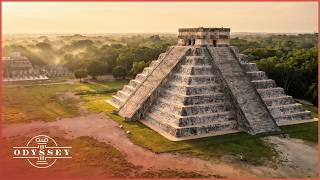

- Subscribers
- 1,060,000
- Channel views, last 7 days
- 834,266
- Videos published this week
- 3
- Video published
- November 1, 2026
- Video views so far
- 19,273
- Views on its first day
- 16,153
The numbers
Here is how Odyssey's audience and uploads moved over the week.

💡 Test your knowledge
Which metal is mixed with tin to make the bronze tested in the programme?
The metalworkers cast axes using different proportions of copper and tin.