
 United States
 United Kingdom
 Canada
 Australia
 New Zealand
 Ireland
Vietnam's factory hiring squeeze reaches classrooms and shopping streets
A South Korean report follows Chinese-language demand and idle production lines as manufacturers struggle to recruit workers.
 South KoreaStory of
Why this story? One of KBS News's most watched videos since yesterday, with 309,592 views.
KBS News: The news division of KBS, South Korea's public broadcaster. 3.7M subscribers and 12B views.
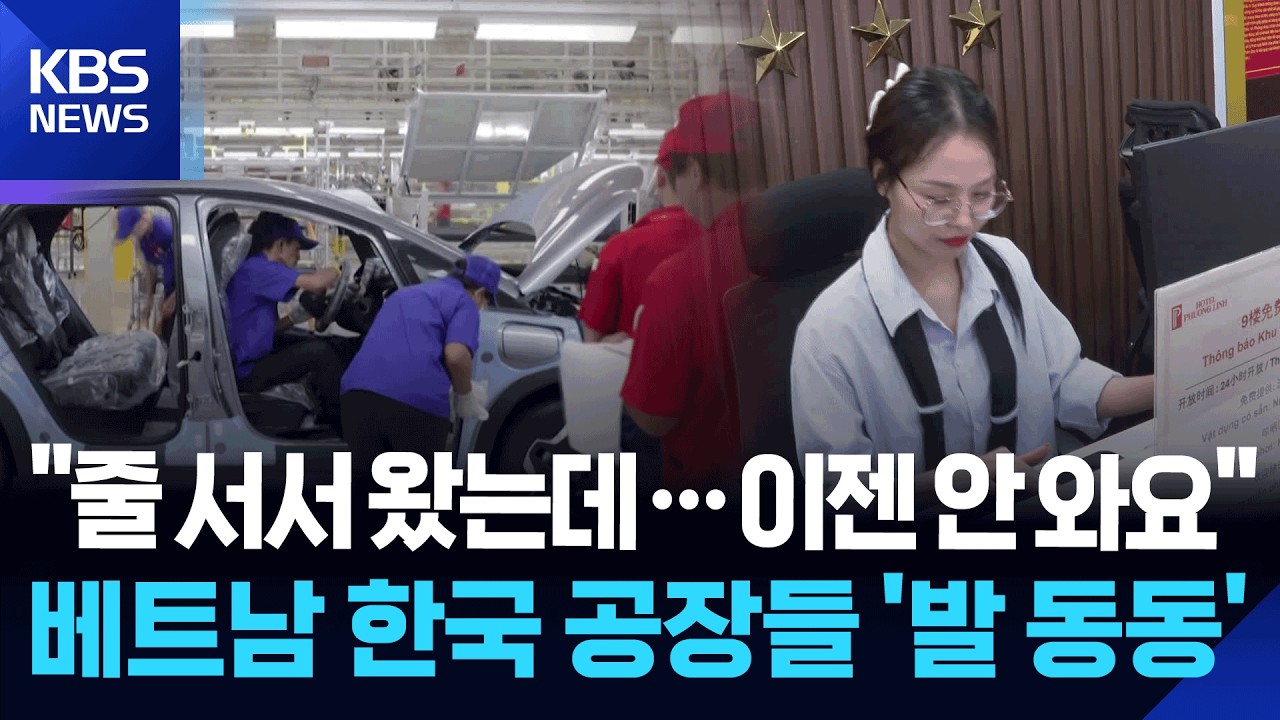 [글로벌K] 베트남서 터진 ‘인력쟁탈전’…한국 기업, 중국 공세에 ‘비상’ / KBS 2026.11.07.
Things we can learn from the video
Press to jump
- 0:16A Korean automotive-parts manager contrasts former crowds of applicants with today's near-empty recruitment pipeline.
- 0:50KBS links Chinese companies' large recruitment drives with mounting hiring pressure and changing storefronts in Bac Ninh.
- 1:33Workers and students pursue Chinese qualifications for employment, communication and study opportunities.
- 2:43Clothing and packaging manufacturers show unstaffed equipment and describe difficulty retaining workers.
- 3:22A researcher explains why accessible delivery work can appeal more than physically demanding factory jobs.
- 4:09The report concludes that manufacturers must reconsider viewing Vietnam chiefly as a source of low-wage labor.
Chinese-language signs have replaced Korean ones along a shopping street in Bac Ninh, northern Vietnam. A former Korean restaurant has become a Chinese-style gaming venue. For manufacturers nearby, the changing streetscape reflects a more consequential shift in who is hiring, and which jobs workers want.
South Korea's Korean Broadcasting System (KBS) follows that shift through correspondent Yang Sung-mo's report on Korean-owned factories facing recruitment difficulties as Chinese businesses expand and young Vietnamese workers seek alternatives to manufacturing.
Bac Ninh, home to a major Samsung Electronics phone factory, has long been a manufacturing base for Korean companies. Choi Byung-yoon, who heads a local automotive-parts operation, recalls crowds of applicants arriving at the factory gates in 2019. These days, he says, sometimes only a single résumé comes in. He describes Chinese companies recruiting workers on a scale his operation cannot match.
The report names electric-vehicle maker BYD among the Chinese businesses expanding in northern Vietnam. It also follows the opportunities opening outside factory work. Hotel employee Nguyen Ngoc Lien studies Chinese between duties, explaining that the language offers better pay, career prospects and easier communication with guests.
At Hanoi University, candidates gather for a Chinese-language proficiency examination even on a weekend without classes. KBS reports that Vietnam had roughly 146,000 candidates for the test last year, more than any other country. It also says the university's Chinese-language admissions cutoff exceeded the Korean-language cutoff this year.
Elsewhere, the consequences are visible in unstaffed sections of Korean-owned clothing and packaging factories. Managers describe physically demanding jobs, difficulty retaining recruits and particular pressure on smaller, labor-intensive businesses.
Kim Je-guk, a researcher at the Korea Institute for International Economic Policy, points to another attraction: delivery and other platform work. Widespread motorcycle ownership makes those jobs accessible, he explains, while young workers may regard factory employment as something they can take up later.
Yang closes with experts' argument that Vietnam can no longer be treated simply as a low-wage alternative production base. For the manufacturers interviewed, the problem is not just another employer opening nearby, but a workforce with more choices.
A centrally governed city in Vietnam’s Red River Delta region, bordering Hanoi.
More on Wikipedia ›A Chinese manufacturing group based in Shenzhen. Its subsidiaries make vehicles, electronic components and electric-vehicle batteries.
More on Wikipedia ›A university in Hanoi focused on foreign-language teaching and research, established in 1959.
More on Wikipedia ›Published on Trari
Where next?



- Channel
- KBS News
- Subscribers
- 3,730,000
- Channel views, last 7 days
- 93,711,044
- Channel views, pace per day
- 9,922,369 (on a normal day: 14,722,801)
- Video published
- November 9, 2026
- Video views so far
- 309,592 (less than a day online)
- Video views, pace per day
- 328,416
The numbers
The report drew about 310,000 views since yesterday, placing it among South Korea's most-watched new news videos.

💡 Test your knowledge
Which Samsung product is made at the major Bac Ninh factory mentioned in the report?
The report identifies Samsung's major mobile-phone factory as a landmark of Bac Ninh's manufacturing economy.