
 United States
 United Kingdom
 Canada
 Australia
 New Zealand
 Ireland
Aichi quake did not change plate locking, Japanese panel concludes
The weather agency revised the earthquake's epicenter, but experts found no observed changes indicating a heightened likelihood of a Nankai Trough megaquake.
 JapanStory of
Why this story? One of TBS NEWS DIG Powered by JNN's most watched videos since yesterday, with 2,239,041 views.
TBS NEWS DIG Powered by JNN: The news channel of JNN, a Japanese news network led by TBS. 3.4M subscribers and 5.8B views.
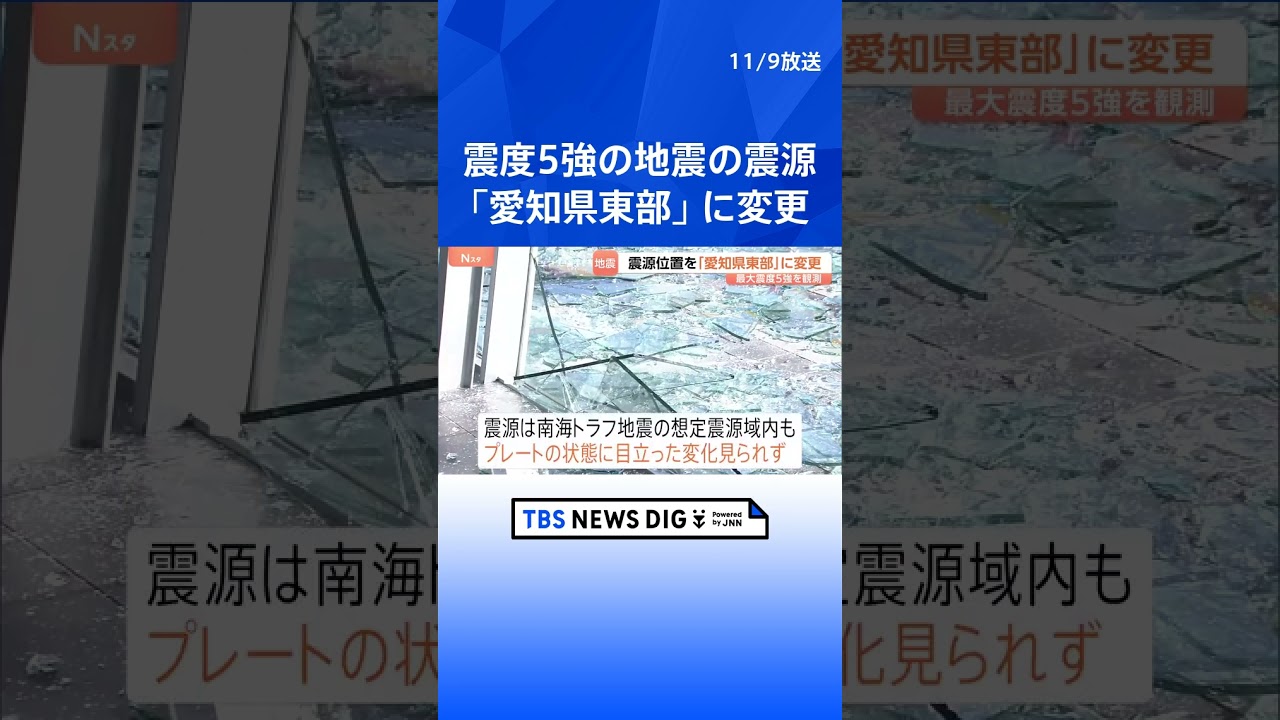 きのう愛知県で震度5強観測した地震 気象庁が震源を「愛知県東部」に変更 南海トラフ巨大地震の可能性高める変化は観測されず プレート状態に変化なし|TBS NEWS DIG #shorts
Japan's earthquake assessment panel says the tremor that shook Aichi did not change how the tectonic plates beneath the region are locked together, despite its revised epicenter falling within the anticipated Nankai Trough earthquake zone.
Japan's TBS NEWS DIG Powered by JNN, the news service of Tokyo Broadcasting System and the Japan News Network, shows committee chairman Hirata explaining that conclusion at a press conference. The report says experts observed no significant plate changes that would indicate an increased likelihood of a megaquake.
The Japan Meteorological Agency relocated the earthquake's epicenter from western Shizuoka Prefecture to eastern Aichi Prefecture. The quake struck around 1:04 a.m. and produced shaking rated upper 5 in Chita, a city in central Japan. That is a measure of shaking at a particular location, not the earthquake's magnitude.
Footage includes views of Nagoya Station and Chubu Centrair International Airport, followed by shattered windows and toppled stone lanterns at a shrine.
The Nankai Trough marks a plate boundary beneath the sea off southwestern Japan. The committee's conclusion concerns whether this earthquake changed that wider threat: it found no evidence of an increase, rather than declaring the region free of earthquake risk.
A prefecture in central Japan’s Chūbu region on Honshū. Nagoya is its capital and largest city.
More on Wikipedia ›A major earthquake along the fault beneath the Nankai Trough, where the Philippine Sea plate sinks beneath the Amurian Plate. Different sections of the fault can rupture separately or together.
More on Wikipedia ›Japan’s national agency for observing and researching weather and natural phenomena, including earthquakes and volcanoes. It is part of the transport and infrastructure ministry.
More on Wikipedia ›A city in Aichi Prefecture, Japan.
More on Wikipedia ›Published on Trari
Where next?



- Channel
- TBS NEWS DIG Powered by JNN
- Subscribers
- 3,430,000 ▲ 10,000 this week
- Channel views, last 7 days
- 49,793,097
- Channel views, pace per day
- 6,220,522 (on a normal day: 5,841,209)
- Video published
- November 9, 2026
- Video views so far
- 2,239,041 (less than a day online)
- Video views, pace per day
- 2,727,891
The numbers
The short report drew about 2.2 million views since yesterday.
