
 United States
 United Kingdom
 Canada
 Australia
 New Zealand
 Ireland
Veritasium asks how the Draupner wave broke the rules
Henry van Dyck and Emilia Gyles go from a French explorer's doubted sighting to a lab tank where crossing waves build a crest too steep for the old theory.
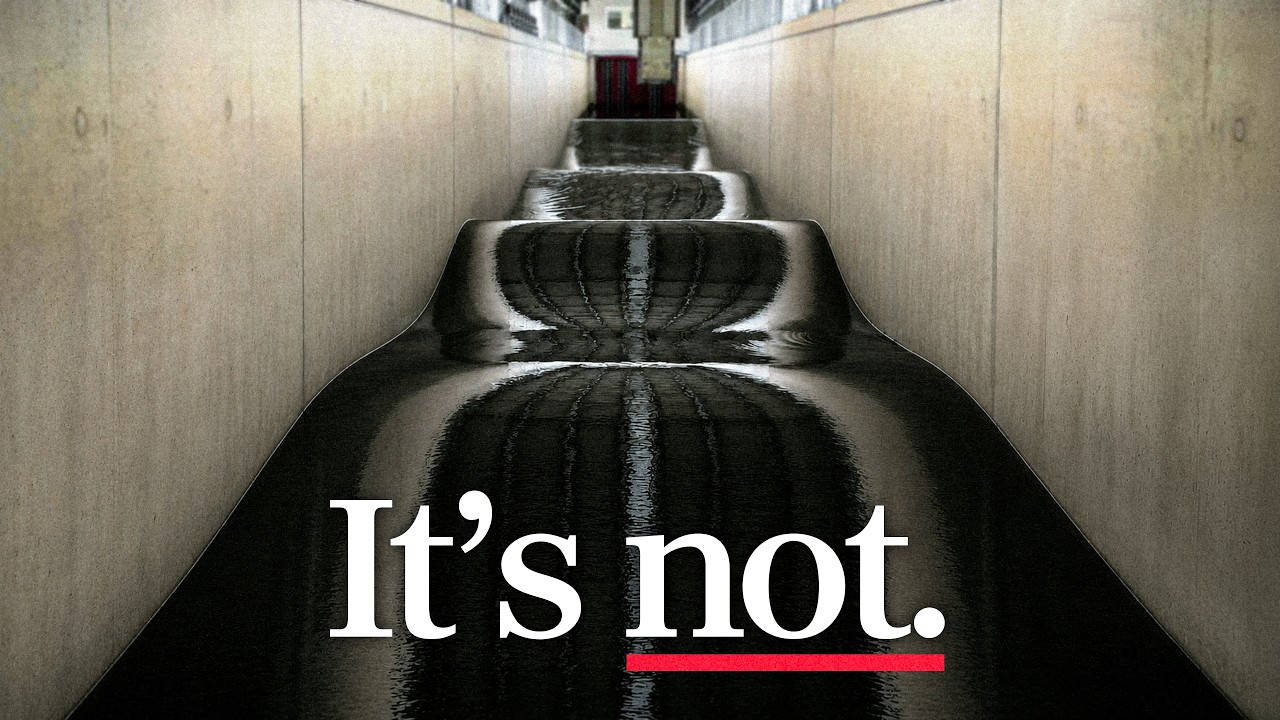 Scientists Said This Wave Was Impossible
Up nextTrari.com home page ›



 Veritasium
Story of
No. 4 on the daily chartNo. 2 on the Science chart
Why this story? 3,589,174 views so far, and here is what is inside it.
For a long time, sailors who described walls of water were told they were exaggerating. In "Scientists Said This Wave Was Impossible," Veritasium goes back to one of them. In 1829, the French explorer Jules Dumont d'Urville reported waves of enormous height, and the physicist François Arago publicly doubted him.
The video starts with the evidence that ended the argument. On New Year's Day 1995, the Draupner gas platform in the North Sea recorded a wave 25.6 meters high, far taller than the sea around it. In December 2000, the European Union launched MaxWave, a satellite radar survey that found more of these giants around the world.
The hard part is explaining them. At the Imperial Hydrodynamics Laboratory in London, Emilia Gyles watches a lab engineer call out "Let's go hurricane" before the paddles start. A simple demonstration with stones shows how statistics once made a giant wave look practically impossible. Then the video turns to the 1834 wave on an Edinburgh canal that John Scott Russell refused to let go of. George Biddell Airy and George Gabriel Stokes questioned his account. "Today we call this special kind of wave a soliton," the narrator says.
The lab work is where it all comes together. Short waves and long waves travel at different speeds, so when they are timed to arrive together, the tank throws up a rogue wave against a model cargo ship. Amin Chabchoub of the Okinawa Institute of Science and Technology explains a second mechanism, modulation instability, in which a wave in a group can draw energy from its neighbors. Draupner needed something extra. Two wave systems crossing at an angle can build a crest steeper than waves running in one direction can hold before they break.
The last stretch flips the picture to rogue holes, sudden deep troughs, and to rogue waves in light. That is the part of the video viewers are talking about most. Many ask why sailors told stories about giant waves for centuries but almost never about the sea suddenly falling away. Others noticed the name of d'Urville's ship, the Astrolabe, turning up again later in the story.
Derek Muller, who founded the channel, is credited as an executive producer. More than a few viewers joked that Henry van Dyck does his best Derek impression in the opening seconds. A sponsored KiwiCo segment closes the video.
Published on Trari.com
Go back to Trari.com home page
Where next?
Things we can learn from the video
Press to jump
- 0:00The Draupner platform's 1995 recording shows a 25.6-meter wave in the North Sea.
- 3:29Dumont d'Urville's 1829 report of huge waves is doubted by the physicist François Arago.
- 11:15John Scott Russell's 1834 solitary wave on an Edinburgh canal is the origin of what we now call the soliton.
- 17:16Short and long waves are timed to converge in a lab tank, creating a rogue wave against a model cargo ship.
- 19:24Amin Chabchoub explains modulation instability: waves in a group can feed energy into a single crest.
- 22:05Crossing seas let a crest grow steeper than the usual breaking limit, the explanation offered for Draupner.
A professional in this field? Want to write about Science & learning on Trari? Tell us ›
What viewers say
The fact that there has been anecdotes from sailors for centuries for rogue waves but little to none for rogue holes is pretty terrifying. Implies it’s difficult to survive a rogue wave, but that no one has made it through a rogue hole.
I’m sure there’s other reasons to explain the difference but surely ships have been lost to rogue holes.@dpear3See it on YouTubeThe ship named astrolabe almost getting hit by a rogue wave on its way to the d'urville station feels like the sea finishing the story
@DubDoseDubbingAgencySee it on YouTubeHenry doing his absolute best Derek impression right off the bat 🤣
@connor56347See it on YouTube
6 more comments
In Chinese we call rogue waves “mad dog waves (feng gou lang)”. Really must’ve been a sight to behold while a mad dog runs you down in the open ocean.
@masterimbecileSee it on YouTube"Those aren't mountains... they're waves"
@jurgen951See it on YouTube"All models are wrong, but some are useful"
- George Box@FloofFolfSee it on YouTubeAs a Norwegian, the most satisfying part is the fact that Norway's goverment ("Oljedirektoratet") required all North Sea platforms to mount wave height monitoring gear, simply because they wanted to verify the current models about the likelyhood of 10/100/1000-year waves: With a significant chance of a "1000-year wave" actually occuring several times during a given platform's lifetime, the model had to be wrong, and plaforms had to be designed to handle that.
Without an extra 10m of elevation above the North Sea, Draupnir might have suffered far more serious damage.@TerjeMathisenSee it on YouTube5:50 I thought he said 'lets go Harry Kane' ha!
@laz001See it on YouTubeI feel like the amount of pride early scientists had really hindered their progress in things they already believed to be figured out.
@SherbertHuskySee it on YouTube
Public comments from the video's page on YouTube
A question for readersHow would you have felt hearing a sailor's story of a 25-meter wall of water in 1829?
Want to know when somebody answers you?
 For the channel's owners and team
Share the story with your audience
A ready picture for an Instagram story or a WhatsApp status.
Ready text for a community post
- Channel
- Veritasium
- Subscribers
- 21,500,000
- Channel views, last 7 days
- 15,101,096
- Channel views, pace per day
- 1,648,970 (on a normal day: 2,572,998)
- Video published
- November 25, 2026
- Video views so far
- 3,589,174 (less than a day online)
- Video views, pace per day
- 4,694,780
The numbers
The documentary drew about 3.6 million views in its first 14 hours, which is roughly what a new Veritasium video usually does.

💡 Test your knowledge
The Navier-Stokes equations are named after George Gabriel Stokes and which French engineer?
Claude-Louis Navier developed the equations for viscous fluid flow in the 1820s, and Stokes later put them on firmer footing.