
 United States
 United Kingdom
 Canada
 Australia
 New Zealand
 Ireland
Judge questions voter-name matches in DOJ's California ballot challenge
NBCLA's emergency-hearing report captures judicial skepticism and a legal analyst's assessment, with no ruling yet.
 NBCLA
Story of
Why this story? The video opened at a pace of 119,270 views a day, 33 times a normal first day on this channel (3,657).
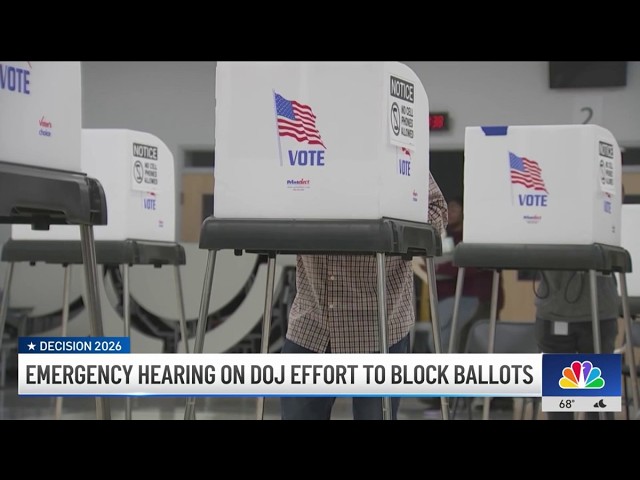 Emergency hearing held on DOJ effort to block ballots in California
Things we can learn from the video
Press to jump
- 0:17An attorney asks to segregate ballots; Judge Sanchez questions whether matching names reliably identifies voters.
- 1:07DOJ flags potential noncitizen voters; California officials say initial checks found many were born in the United States.
- 1:42Laurie Levenson describes federal intervention in an ongoing state election as highly unusual.
- 2:31Levenson says the government has not presented persuasive evidence.
- 4:04Levenson predicts a return to the lower court for factual development; no ruling has been issued.
A shared name is not necessarily the same voter. That problem comes into focus in NBCLA's report on an emergency federal appeals court hearing over the Trump administration's effort to separate disputed California ballots.
"My name is Gabriel Sanchez. I guarantee you there are many Gabriel Sanchezes in the county of Los Angeles," Judge Sanchez says as he questions the methodology behind the voter list.
The Justice Department is asking for ballots to be segregated. Its claim concerns roughly 20,000 potential noncitizen voters, but California officials say initial reviews found that many people on the list were born in the United States. The report describes a disputed list, not a finding that those voters are ineligible.
Loyola Law School professor Laurie Levenson puts the timing at the center of her analysis: voting is already underway. She describes federal intervention in an ongoing state election as highly unusual and calls the government's evidence unpersuasive.
Levenson expects the appeals panel may return the case to the lower court for further factual development. That is her assessment, not a decision: the case remains without a ruling.
The report drew more than 118,000 views before its first full day was over, far beyond NBCLA's usual start for a regular video. Its central question remains a practical one: whether the voter information is reliable enough to justify separating ballots already being cast.
Gabriel Patrick Sanchez has served as a federal appeals judge on the U.S. Court of Appeals for the Ninth Circuit since 2022.
More on Wikipedia ›A law professor at Loyola Law School in Los Angeles who teaches evidence, criminal law, criminal procedure and ethics. She also directs the school’s Center for Legal Advocacy.
More on Wikipedia ›Published on Trari
Where next?


 Is this your channel?For the channel's owners and team: a ready picture and text for your audience
Share the story with your audience. Everything is ready:
For an Instagram story or a WhatsApp status
For a community post or your channel's description
- Channel
- NBCLA
- Subscribers
- 426,000
- Channel views, last 7 days
- 2,967,355
- Channel views, pace per day
- 499,149 (on a normal day: 642,498)
- Video published
- October 26, 2026
- Video views so far
- 118,355 (less than a day online)
- Video views, pace per day
- 119,270
The numbers
The hearing report drew an unusually large early audience for an NBCLA regular video. Comments also arrived far faster than on a usual first day.
