
 United States
 United Kingdom
 Canada
 Australia
 New Zealand
 Ireland
Merz links EU budget veto to Ukraine aid, DW reports
Slovak and Czech leaders accuse Germany's chancellor of coercion, while MEP Riho Terras defends collective funding as essential to European security.
 DW News
Story of
Why this story? One of DW News's most watched videos since yesterday, with 149,853 views.
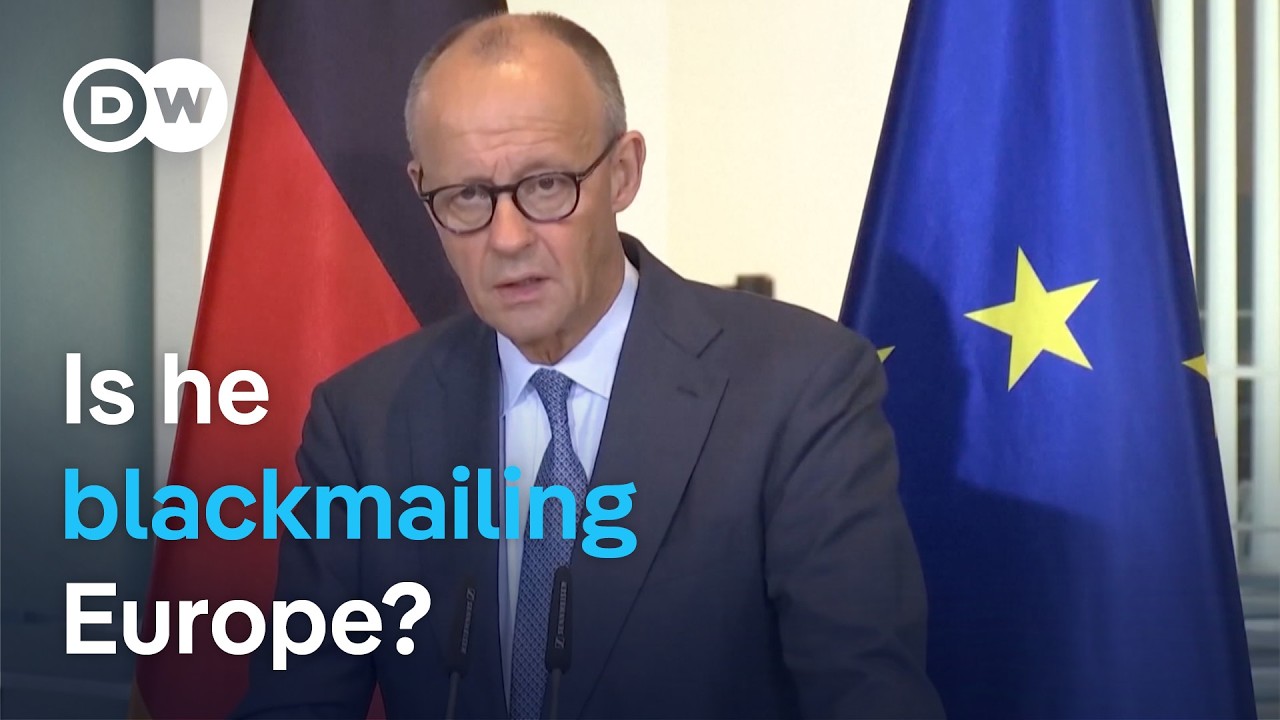 Germany’s Merz takes heat for EU-wide Ukraine financing demands | DW News
Things we can learn from the video
Press to jump
- 0:11Fico calls Merz's demand blackmail; Babiš argues that EU membership does not subordinate sovereign nations.
- 0:41Okwu outlines Ukraine's projected funding gap and Merz's proposed link to the next long-term EU budget.
- 1:36Merz says support for Ukraine is a shared EU responsibility, rather than a task for individual members.
- 2:11Magyar rejects linking the bloc's general budget to external aid.
- 9:44Terras defends collective support for Ukraine as necessary for European security.
Germany's next EU budget negotiation could become a test of whether every member state must help finance Ukraine. According to DW News, Chancellor Friedrich Merz is threatening to veto the bloc's next long-term budget unless support for Kyiv becomes a collective commitment.
The demand has drawn sharp objections from Slovakia and the Czech Republic. In clips carried by DW, Slovak Prime Minister Robert Fico calls it "typical blackmail," while Czech Prime Minister Andrej Babiš insists that EU members are sovereign nations, not subordinate to anyone.
Host Michael Okwu sets out the financial stakes: Ukraine faces a projected €70 billion funding gap, according to the report. Merz wants contributions addressed through negotiations over the EU's next seven-year budget. Those long-term spending frameworks require unanimous agreement among member states, giving a threatened veto practical weight.
Merz describes supporting Ukraine as "a common responsibility of the European Union." Hungarian Prime Minister Peter Magyar also objects to linking the general budget with external aid, though DW presents his response as more measured than those of Fico and Babiš.
DW chief political editor Michaela Küfner explains Berlin's push to secure a commitment from all members and examines Merz's domestic political position. The program then turns to Estonian MEP Riho Terras, a former defense chief, who rejects the blackmail characterization. His argument is that supporting Ukraine is necessary for Europe's own security, and that Europe has the capacity to provide that support.
Germany’s chancellor since May 2025 and leader of the Christian Democratic Union (CDU) since 2022.
More on Wikipedia ›Slovakia’s prime minister since 2023, with two earlier periods in office. He founded and leads the Direction – Social Democracy party.
More on Wikipedia ›The Czech Republic’s prime minister since December 2025, returning after serving from 2017 to 2021. He founded and leads the ANO 2011 party.
More on Wikipedia ›Hungary’s prime minister since May 2026 and president of the Tisza Party since 2024. He previously served in the European Parliament.
More on Wikipedia ›An Estonian member of the European Parliament since 2020. A former military officer, he commanded the Estonian Defence Forces from 2011 to 2018.
More on Wikipedia ›Published on Trari
Where next?


 Is this your channel?For the channel's owners and team: a ready picture and text for your audience
Share the story with your audience. Everything is ready:
For an Instagram story or a WhatsApp status
For a community post or your channel's description
- Channel
- DW News
- Subscribers
- 6,500,000 ▲ 10,000 this week
- Channel views, last 7 days
- 21,600,481
- Channel views, pace per day
- 5,101,165 (on a normal day: 2,613,389)
- Video published
- November 11, 2026
- Video views so far
- 149,853 (less than a day online)
- Video views, pace per day
- 197,741
The numbers
DW News's report drew about 150,000 views since yesterday, the largest audience among the channel's new uploads over that period.
