
 United States
 United Kingdom
 Canada
 Australia
 New Zealand
 Ireland
Satellite image blackouts leave the public blind, Ballinger argues
New York Times Opinion's report examines government pressure on commercial providers and the consequences for humanitarian workers and watchdogs.
 New York Times Opinion
Story of
Why this story? The video opened at a pace of 164,594 views a day, 11 times a normal first day on this channel (14,725).
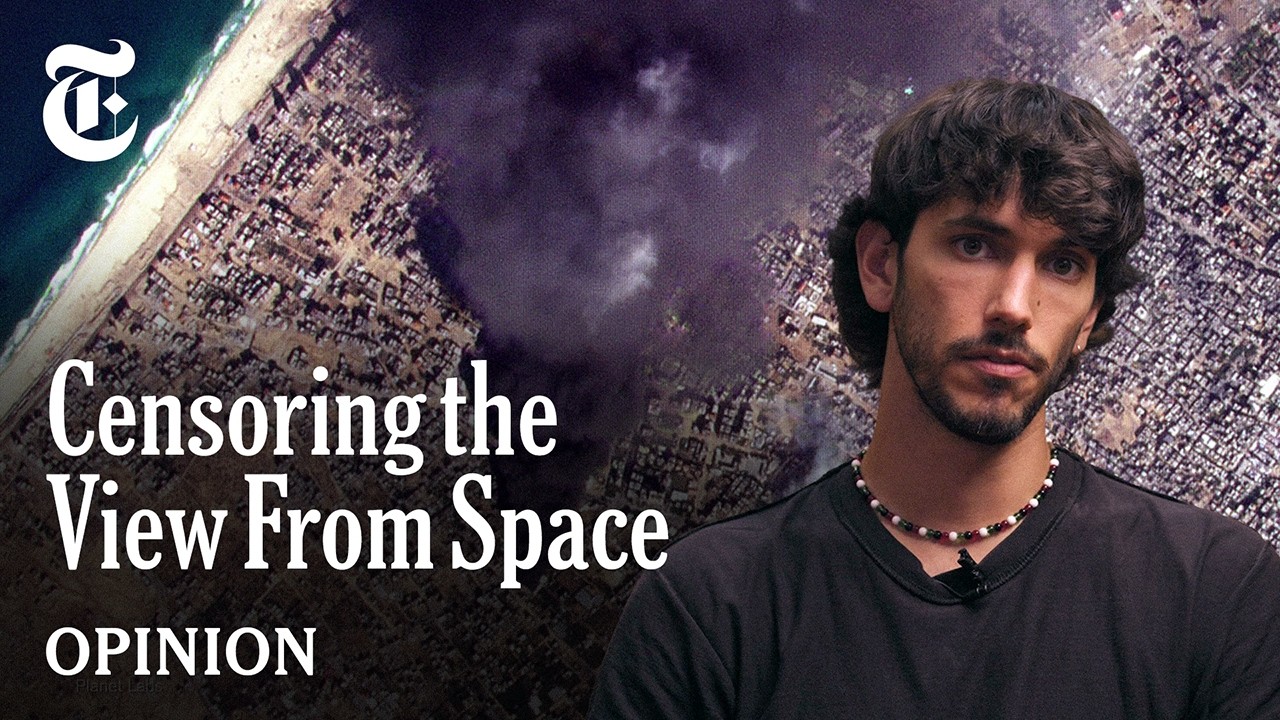 The View From Space the U.S. Government Doesn’t Want You to See | NYT Opinion
Things we can learn from the video
Press to jump
- 0:29Ballinger identifies satellite-imagery blackouts that he attributes to U.S. government pressure on commercial providers.
- 1:05Congressional hearing footage presents operational security as a reason for restricting commercial imagery.
- 1:29A Planet Labs email describes compliance with government requests to withhold images in designated areas.
- 3:10O'Connell argues that access to Chinese satellite providers can undermine the restrictions' intended effect.
- 4:34Humanitarian and environmental specialists explain how blocked imagery limits crisis information and independent scrutiny.
- 5:25Ballinger examines legislative moves to formalize restrictions and argues for uncensored public access.
New York Times Opinion puts a leaked satellite-company email at the center of a question about public accountability: who gets to see what happens on the ground?
In its new video essay, open-source researcher Ollie Ballinger describes restrictions on commercial satellite imagery across parts of the Middle East. He says U.S. government pressure is closing off images that journalists and researchers use to examine missile damage and events in conflict zones.
The report reached roughly 126,000 views in fourteen hours, already far beyond the channel's usual full-day audience for regular videos. Its comment count had also passed ten times the usual first-day level.
Ballinger's argument turns on the relationship between private satellite operators and a powerful customer. The video shows an email from Planet Labs describing voluntary compliance with U.S. government requests to withhold imagery indefinitely in designated areas. Archival congressional footage supplies the government's stated concern: protecting operational security.
But does restricting American providers actually prevent adversaries from obtaining pictures? Former Office of Space Commerce director Kevin O'Connell points to access through Chinese providers and asks: "Are you actually having the effect that you want to have?"
The consequences extend beyond military intelligence. Common Space co-founder Rhiannan Price describes missing information during humanitarian crises, while environmental investigator Mark Fahey explains the value of a view that can reveal activity otherwise hidden from scrutiny.
Ballinger closes by arguing for uncensored public access to images of Earth. An end card says the Department of Defense and National Reconnaissance Office declined to answer questions about the restrictions.
An American satellite-imaging company based in San Francisco that aims to photograph the whole Earth daily to track changes.
More on Wikipedia ›A U.S. Department of Defense intelligence agency that designs, builds, launches and operates government intelligence satellites, supplying satellite intelligence to other federal agencies.
More on Wikipedia ›Published on Trari
Where next?



 Is this your channel?For the channel's owners and team: a ready picture and text for your audience
Share the story with your audience. Everything is ready:
For an Instagram story or a WhatsApp status
For a community post or your channel's description
- Channel
- New York Times Opinion
- Subscribers
- 215,000 ▲ 4,000 this week
- Channel views, last 7 days
- 834,219
- Channel views, pace per day
- 137,444 (on a normal day: 109,584)
- Video published
- November 11, 2026
- Video views so far
- 125,786 (less than a day online)
- Video views, pace per day
- 164,594
The numbers
The satellite-imagery report passed the channel's usual first-day views well before a full day had elapsed. Comments also arrived in unusually large numbers.

💡 Test your knowledge
In which city is Ollie Ballinger's university, UCL?
Ballinger is identified in the video as a researcher and lecturer at University College London.