
 United States
 United Kingdom
 Canada
 Australia
 New Zealand
 Ireland
Mexico's sinkholes trace the crater of the dinosaur-killing asteroid
BBC Earth Science's Ancient Earth excerpt turns from a computer-generated catastrophe to geological clues hidden in the Yucatán jungle.
 BBC Earth Science
Story of
Why this story? The video is running at 287,673 views a day, 10 times its usual pace (28,514).
 The Hidden Evidence Of The Asteroid That Killed The Dinosaurs | BBC Earth Science
Things we can learn from the video
Press to jump
- 0:00Computer-generated imagery depicts the asteroid impact, followed by scientists explaining the scale of its destructive force.
- 1:37The film shifts to Mexico's Yucatán Peninsula, where jungle covers the ancient impact zone.
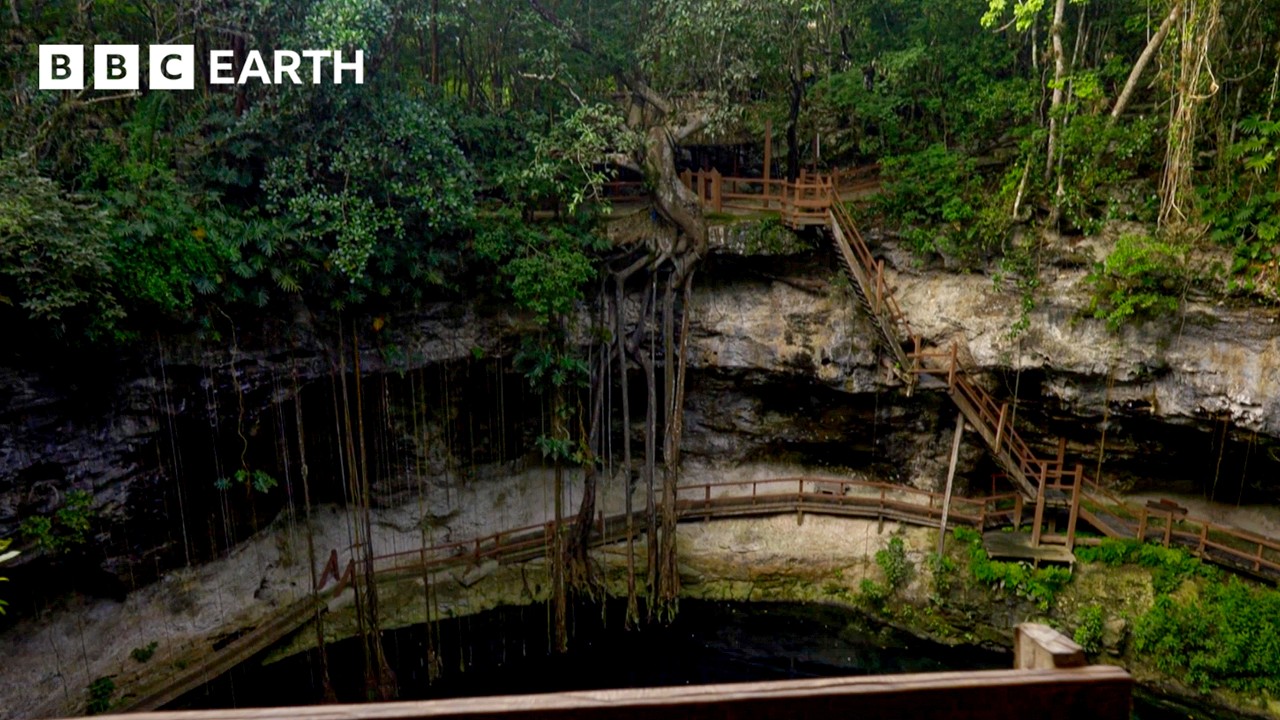
- 2:10Chris Lowery explains how erosion forms cenotes, the region's water-filled sinkholes.
- 3:00The promised clue appears: a semicircular ring of cenotes traces the ancient crater's inner rim.
Chris Lowery looks at a tablet covered in dots. Each marks a water-filled sinkhole in Mexico's Yucatán Peninsula, but together some of them reveal something much larger: the outline of an ancient impact crater.
That is the discovery at the heart of BBC Earth Science's "The Hidden Evidence Of The Asteroid That Killed The Dinosaurs | BBC Earth Science". Posted six days ago, the clip has added roughly 288,000 views in a day, about ten times its usual daily pace.
Taken from Ancient Earth (2023), it begins with computer-generated destruction: an asteroid the size of Mount Everest strikes Earth, sending a shockwave across prehistoric landscapes. NASA's Jessica Watkins supplies the understatement: "Not a great day to be a dinosaur."
Then the film trades the blast for jungle. Lowery, from the University of Texas at Austin, enters a cenote and explains how erosion creates these water-filled sinkholes. On the satellite map, he picks out the Ring of Cenotes, a semicircular arrangement corresponding closely to the inner rim of the Chicxulub crater. The landscape has become a way to read what lies beneath it.
The map is also where viewers want more time. Several comments ask how to distinguish the ring from the other clusters of dots, or why sinkholes should follow the crater's edge. Others point out the abrupt finish, just as Lowery compares the pattern to a bullseye. The excerpt reaches its central clue near the end, leaving the fuller geological explanation outside this clip.
Published on Trari
Where next?


What viewers say
The ring of cenotes tracing the crater's rim is such a beautiful piece of detective work — thousands of sinkholes quietly outlining a 66-million-year-old impact. Nature really does keep its own records.
@fortunefactsdailySee it on YouTubeI guess I need to see the whole thing. I didn't really see how to spot the clusters that form the circle of impact. I thought the clusters were going to be on the right side where there was a more dense band.
@GoggForGodSee it on YouTube"Almost like a bullseye of the impact crater..." Video ends???
@forestyforestSee it on YouTube
1 more comment
NGL, I saw the graphic of the asteroid impact, and my mind immediately goes back to Rogue One with the single reactor ignition from the Death Star! XD
@MD2389See it on YouTube
Public comments from the video's page on YouTube
 Is this your channel?For the channel's owners and team: a ready picture and text for your audience
Share the story with your audience. Everything is ready:
For an Instagram story or a WhatsApp status
For a community post or your channel's description
- Channel
- BBC Earth Science
- Subscribers
- 1,830,000
- Channel views, last 7 days
- 2,721,145
- Channel views, pace per day
- 411,649 (on a normal day: 488,147)
- Video published
- November 6, 2026
- Video views so far
- 459,058 (6 days online)
- Video views, pace per day
- 287,673 (on a normal day: 28,514)
The numbers
The asteroid excerpt's daily views have climbed sharply, even as BBC Earth Science's overall daily viewing sits below its usual level.

💡 Test your knowledge
In which country is the Chicxulub impact crater?
The crater lies beneath Mexico's Yucatán Peninsula and the adjoining sea.