
 United States
 United Kingdom
 Canada
 Australia
 New Zealand
 Ireland
Huang disclosures raise chip-policy questions on BBC's Asia Specific
Mariko Oi and Tim Culpan examine export checks and Washington influence in an unusually widely watched podcast episode.
 BBC World Service
Story of
Why this story? The video opened at a pace of 92,498 views a day, 12 times a normal first day on this channel (7,637).
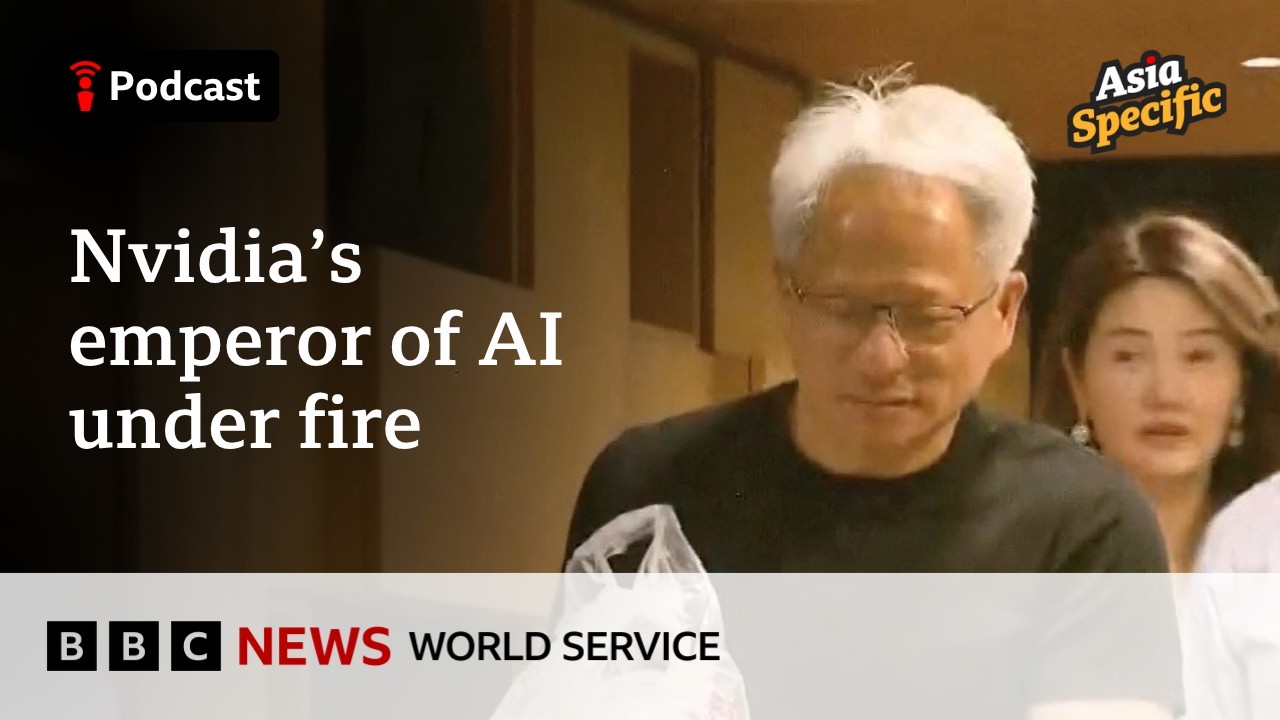 The power struggle behind the Jensen Huang scandal - Asia Specific podcast, BBC World Service
Things we can learn from the video
Press to jump
- 4:07Birtles outlines reporting alleging that restricted Nvidia AI chips were being funnelled to China.
- 8:04Culpan explains how Singapore-registered front companies can, in his account, circumvent export screenings.
- 11:49The panel considers whether Washington will tighten chip-export restrictions amid the controversy.
- 15:58Culpan argues that Nvidia's dependence on Huang leaves it exposed without a public succession plan.
Mariko Oi brings technology journalist Tim Culpan into a discussion that moves beyond Jensen Huang's personal scandal to a consequential question: who gets to shape the rules governing AI-chip sales to China?
The BBC World Service's Asia Specific episode examines whether the disclosures surrounding Nvidia's chief reflect a struggle over his influence in Washington. The programme reports that Huang has admitted infidelity, while Beijing has rejected espionage allegations linked to the controversy. Archival footage shows President Donald Trump defending Huang.
Editor Bill Birtles sets out reporting about alleged diversion of restricted Nvidia chips to China. Culpan explains how, in his account, Singapore-registered front companies can get around export screenings. That shifts the discussion from the restrictions on paper to the difficulty of checking where the hardware ultimately goes.
The episode drew roughly 92,000 views in its first day, around twelve times the channel's usual start for regular videos. Its comment section was also substantially busier than usual.
There is a corporate question alongside the geopolitical one. Culpan argues that Nvidia's dependence on Huang creates a vulnerability because it lacks a public succession plan. His description of Huang's keynote crowds as resembling a Taylor Swift concert gives a sense of how closely the company's identity is tied to its chief.
For Asia Specific itself, the recording marks a milestone: Oi welcomes Birtles onto a new set for the podcast's first anniversary and hundredth episode.
Taiwanese-American engineer and business executive who co-founded Nvidia and serves as its president and CEO.
More on Wikipedia ›American technology company co-founded by Jensen Huang in 1993. It develops graphics processors and hardware used in artificial intelligence and high-performance computing.
More on Wikipedia ›Published on Trari
Where next?


 Is this your channel?For the channel's owners and team: a ready picture and text for your audience
Share the story with your audience. Everything is ready:
For an Instagram story or a WhatsApp status
For a community post or your channel's description
- Channel
- BBC World Service
- Subscribers
- 2,270,000 ▲ 10,000 this week
- Channel views, last 7 days
- 4,319,996
- Channel views, pace per day
- 1,268,409 (on a normal day: 605,377)
- Video published
- November 11, 2026
- Video views so far
- 113,377 (less than a day online)
- Video views, pace per day
- 104,168
The numbers
The episode's first-day views and comments both rose far above BBC World Service's usual start for regular videos.
