
 United States
 United Kingdom
 Canada
 Australia
 New Zealand
 Ireland
Dr Ben Miles explores a thorium reactor's cheaper-than-coal ambition
His Copenhagen Atomics visit gets into the salt purification, stainless steel and layered design behind a proposed container-sized heat supplier.
 Dr Ben Miles
Story of
Why this story? One of the most watched videos since yesterday, with 313,828 views.
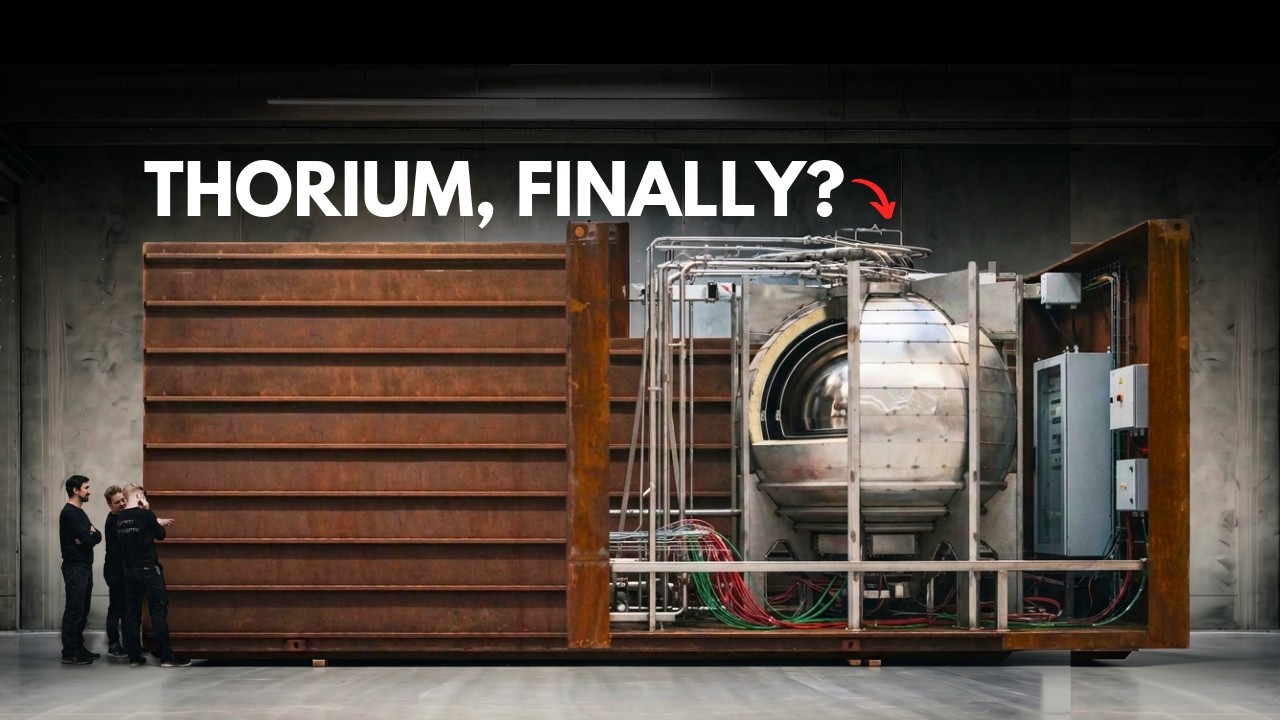 This Nuclear Reactor Runs on Thorium and Could Be Cheaper Than Coal?
Things we can learn from the video
Press to jump
- 1:52Thorium must absorb a neutron and transform into uranium-233 before it can supply fissile fuel.
- 6:01Pedersen explains how thorium salt, a fissile core and heavy-water layers share the reactor's neutron budget.
- 16:44Stubsgaard presents purified-salt test samples and explains the company's proposed solution to stainless-steel corrosion.
- 20:00Lithium isotope separation removes a neutron absorber while producing material useful for breeding fusion fuel.
- 25:51The company targets energy cheaper than fossil fuels; this is a cost goal, not a commercial result.
- 26:45Denmark's nuclear-generation ban takes the Balder test project to Switzerland's Paul Scherrer Institute.
An onion made of stainless steel is an unlikely place to look for cheaper energy. But inside Copenhagen Atomics' workshop, Dr Ben Miles finds a reactor prototype whose layers each have a job: breeding fuel, slowing neutrons and keeping very hot molten salt away from much cooler water.
His Danish lab visit has drawn about 314,000 views since yesterday. The question in the title, "This Nuclear Reactor Runs on Thorium and Could Be Cheaper Than Coal?", leads into something more concrete than a promise of abundant fuel: what would it actually take to build the machine?
Miles starts with the catch. Thorium isn't itself fissile, so it must absorb a neutron and pass through a sequence of transformations to become uranium-233, which can sustain fission. The design needs enough neutrons both to keep that reaction going and to make replacement fuel. Materials that absorb them can upset that delicate balance.
That is where ordinary stainless steel becomes interesting. Molten fluoride salts have historically corroded it, while specialist alloys bring costs and neutron losses of their own. CTO Aslak Stubsgaard shows test samples and explains the company's approach: remove moisture and oxide impurities from the salt so thoroughly that, he says, corrosion becomes insignificant.
Viewers are picking up on those engineering obstacles, particularly corrosion and lithium purification. Another thread follows a surprising connection: separating lithium isotopes for this fission design can also produce material useful for breeding tritium for fusion reactors. The onion, meanwhile, has inspired its own Shrek joke.
The cheaper-than-coal proposition remains the company's target, not a demonstrated commercial result. CEO Thomas Jam Pedersen explains that Copenhagen Atomics intends to sell heat rather than build entire electricity plants, supplying hot molten salt to customers' heat exchangers. Its maintenance plan includes draining the salt and replacing the internal steel core.
For the Danish company, the route to a working test reactor leads abroad. Miles closes the visit by explaining that Denmark's ban on domestic nuclear electricity generation has taken its Balder test project to Switzerland's Paul Scherrer Institute.
Published on Trari
Where next?



 Is this your channel?For the channel's owners and team: a ready picture and text for your audience
Share the story with your audience. Everything is ready:
For an Instagram story or a WhatsApp status
For a community post or your channel's description
- Channel
- Dr Ben Miles
- Subscribers
- 2,670,000 ▲ 10,000 this week
- Channel views, last 7 days
- 6,314,886
- Channel views, pace per day
- 420,407 (on a normal day: 1,441,198)
- Video published
- November 10, 2026
- Video views so far
- 313,828 (less than a day online)
- Video views, pace per day
- 457,175
The numbers
The lab visit drew roughly 314,000 views in its opening 12 hours. Here is how that audience sits alongside the channel's wider viewing.

💡 Test your knowledge
Which fissile isotope does the reactor design breed from thorium?
Miles explains that thorium-232 absorbs a neutron and transforms through protactinium-233 into uranium-233.