
 United States
 United Kingdom
 Canada
 Australia
 New Zealand
 Ireland
Practical Engineering tests what keeps windows warm and safe
Grady Hillhouse's heat experiments and hammer tests reveal why a transparent wall needs so much hidden engineering.
 Practical Engineering
Story of
Why this story? 936,510 views so far, and here is what is inside it.
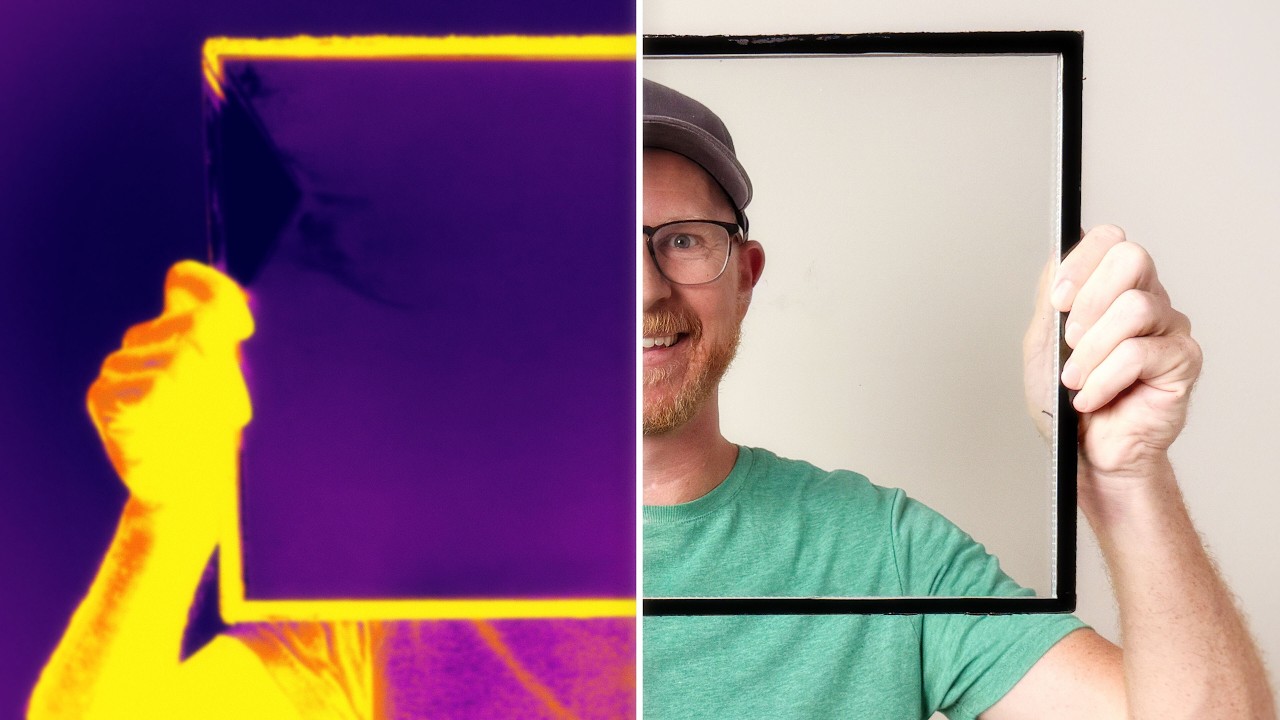 Windows Are Absurd
Things we can learn from the video
Press to jump
- 3:51A heated foam-box experiment compares heat retention with foam, single-pane glass and double-pane glass.
- 7:44Glass interacts differently with infrared radiation and visible light, allowing low-E coatings to improve thermal performance.
- 11:19Visible patterns help birds recognize glass as an obstacle rather than an open flight path.
- 14:40Structural silicone can help hold facade glass in place; Grady demonstrates its load-bearing role.
- 17:30Hammer tests reveal how ordinary annealed glass and tempered safety glass fracture differently.
- 21:05Laminated glass uses a plastic interlayer to retain shattered fragments and maintain a physical barrier.
The sealant around a glass facade can do more than keep rain out: it can help hold the glass in place. Grady Hillhouse puts that seemingly unlikely arrangement through a weight-bearing experiment in Practical Engineering's "Windows Are Absurd."
The title's complaint is really an engineering puzzle. Cutting a hole in a wall introduces weaknesses in insulation, security and structure, yet we still want the daylight and the view. Hillhouse explains the inventions that make that trade-off workable, from gas-filled gaps to glass designed to stay together after it breaks.
In his garage, an insulated foam box becomes a test chamber for comparing foam, single-pane glass and double-pane glass. The extra pane isn't simply another barrier: the space between panes helps resist heat transfer. He then turns to low-emissivity coatings, which control infrared radiation without giving up the window's usefulness as something we can see through.
Transparency has another cost. Birds can mistake reflections or a clear route through glass for somewhere they can fly. Hillhouse shows how visible marker patterns can interrupt that illusion, a practical detail viewers are discussing alongside the physics. One commenter also recognizes a pleasing reversal: after learning electricity through fluid analogies in college, they're watching him explain fluid flow through electrical ones.
The hammer tests make the safety distinctions especially tangible. Tempered glass is stronger than ordinary annealed glass, but once it fractures, it offers little resistance to entry. Laminated glass adds a tough plastic layer that retains broken fragments and preserves a barrier. Hillhouse demonstrates the difference by trying to get his hand through the shattered pane.
The episode has drawn roughly 940,000 views since publication and includes a sponsored fabrication-services segment after the main explanation. Its most useful distinction may be the simplest: stronger glass and glass that holds together after breaking solve different problems.
Published on Trari
Where next?


What viewers say
I spent all of college learning electricity with fluid analogies and here’s Grady teaching me fluid flow with electric analogies.
@JMay60206See it on YouTubeI did not know there was such an effective solution to bird strikes on glass, that made me genuinely happy to learn
@davidbowman2001See it on YouTubeThat's why I prefer Linux
@makecbaSee it on YouTube
6 more comments
Bold of you to assume I've never thrown a baseball through a brick wall
@WillowMoon777See it on YouTubeThank you for this window into engineering
@balaam_7087See it on YouTubeLet's not skip over a major part of the efficiency puzzle: Window frames and window boxes. This specific interface is often overlooked, yet can easily cause much of the unwanted heat transfer.
@DerBeowulfSee it on YouTubeIt's interesting that modern "curtain walls" are called that, because the same name is used to refer to the very thick outermost wall used to protect a fortress, which is almost exactly the opposite of a skyscraper's curtain wall.
@uroghai3439See it on YouTubeI didn't realize glass was such a complicated topic. This video made it clear to me there's a lot more to see.
@zythotvSee it on YouTubeThe mighty awning still lets light in but blocks the direct source.
@IWIN-NIMISee it on YouTube
Public comments from the video's page on YouTube
 Is this your channel?For the channel's owners and team: a ready picture and text for your audience
Share the story with your audience. Everything is ready:
For an Instagram story or a WhatsApp status
For a community post or your channel's description
- Channel
- Practical Engineering
- Subscribers
- 4,840,000
- Channel views, last 7 days
- 1,544,406
- Channel views, pace per day
- 131,648 (on a normal day: 184,779)
- Video published
- November 3, 2026
- Video views so far
- 936,510 (7 days online)
- Video views, pace per day
- 32,570 (on a normal day: 192,079)
The numbers
Here is how "Windows Are Absurd" has performed since publication, alongside Practical Engineering's wider channel activity.

💡 Test your knowledge
Which gas does Grady discuss using between panes in insulated windows?
Grady discusses argon, along with krypton, as a gas fill for insulated glass units.