
 United States
 United Kingdom
 Canada
 Australia
 New Zealand
 Ireland
Ukraine's drones can strike without Starlink, Philip Ingram says
The Sun's military analysis examines autonomous navigation and the shift towards striking weapons production and oil infrastructure inside Russia.
 The Sun
Story of
Why this story? The video opened at a pace of 563,041 views a day, 11 times a normal first day on this channel (53,151).
 How Ukraine bypassed Starlink red lines to strike inside Russia | Battle Plans Exposed
Next story: Nizhnekamsk refinery burns after Ukrainian drone strike, The Sun reports
Things we can learn from the video
Press to jump
- 0:00Ingram explains how Ukrainian long-range drones can operate without a Starlink connection.
- 1:12Pre-programmed terrain mapping and terminal optical matching provide navigation without continuous external data links.
- 2:13He argues that strikes on manufacturing and refining facilities aim to disrupt Russia's capacity to sustain the war.
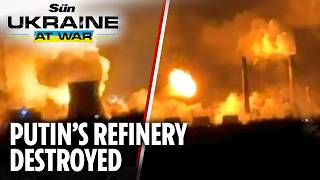
- 5:42Ingram reviews footage of large fires at the Lukoil refinery in Kstovo following a drone attack.
- 9:12His closing assessment is that Ukrainian drone innovation is restricting Russian frontline aviation operations.
A drone does not necessarily need a live satellite connection to reach its target. That is the distinction former intelligence officer Philip Ingram draws in The Sun's Battle Plans Exposed, explaining how Ukrainian long-range aircraft can operate without relying on Starlink.
His account centres on pre-programmed terrain mapping and optical matching near the destination. Rather than depending on continuous instructions from outside, he explains, these systems use information carried onboard to navigate. The title's promise of bypassing Starlink restrictions is therefore about operating independently of the network, not gaining access to it.
The analysis has drawn around 370,000 views in its first 11 hours. Its estimated first-day audience is more than ten times the usual opening for The Sun's regular videos.
Ingram uses a wall map to connect the technology to a broader strategy: attacking the facilities that manufacture weapons and process fuel, rather than concentrating solely on equipment at the front. He argues that homegrown autonomous systems give Ukraine greater freedom over strikes inside Russia.
Where The Sun's earlier reports showed fires at industrial sites, this episode concentrates on how such attacks are possible and what they are intended to disrupt. Footage includes a refinery fire in Kstovo and an attack on a Russian Mi-8 helicopter at a forward staging area. Ingram closes by arguing that Ukrainian drone innovation is restricting where Russian frontline aviation can operate.
Published on Trari
Where next?


What do you think?
Want to know when somebody answers you?
 Is this your channel?For the channel's owners and team: a ready picture and text for your audience
Share the story with your audience. Everything is ready:
For an Instagram story or a WhatsApp status
For a community post or your channel's description
- Channel
- The Sun
- Subscribers
- 6,560,000 ▲ 10,000 this week
- Channel views, last 7 days
- 8,610,208
- Channel views, pace per day
- 1,070,063 (on a normal day: 1,353,453)
- Video published
- November 15, 2026
- Video views so far
- 370,389 (less than a day online)
- Video views, pace per day
- 563,041
The numbers
The analysis is reaching a much larger opening audience than The Sun's usual regular upload. The first-day projection is an estimate, not a completed day's view count.
