
 United States
 United Kingdom
 Canada
 Australia
 New Zealand
 Ireland
Ismar Volić questions the math behind America's election winners
His TEDxBrownU talk uses a crowded Massachusetts primary to explain why the most votes need not mean majority support.
 TEDx Talks
Story of
Why this story? The video opened at a pace of 44,159 views a day, 405 times a normal first day on this channel (109).
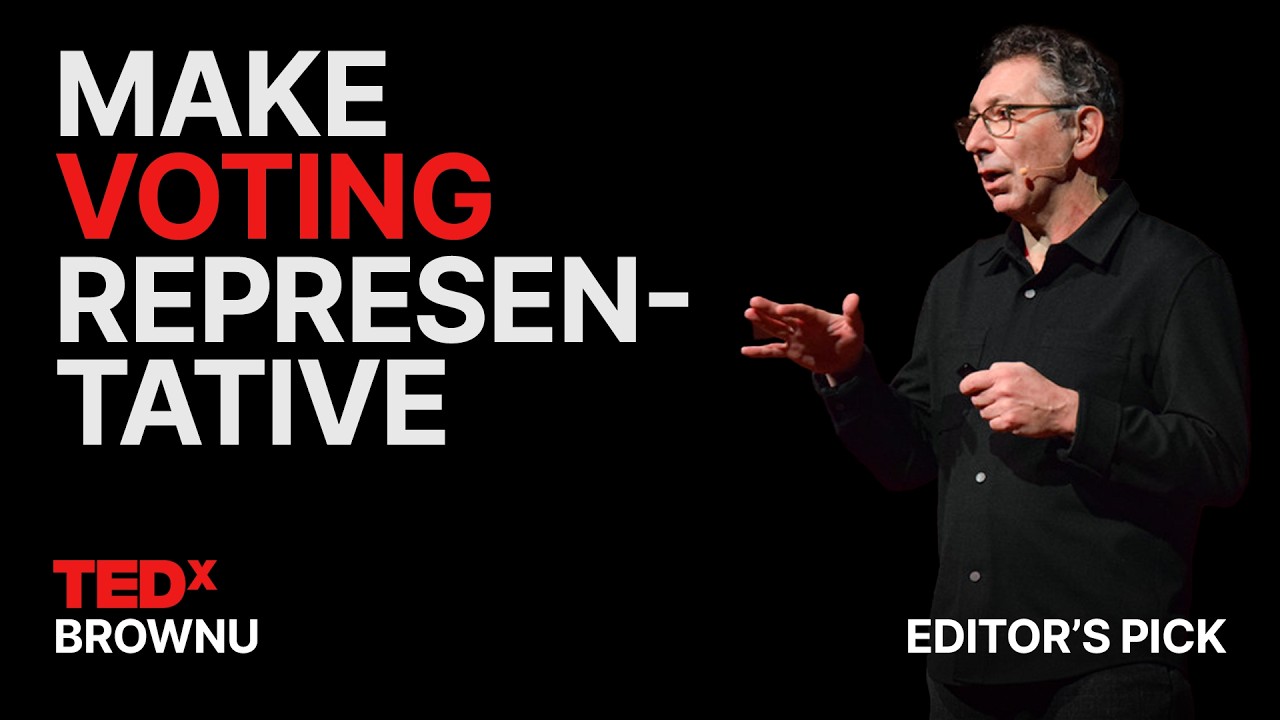 The flawed math that shapes American democracy | Ismar Volić | TEDxBrownU
Things we can learn from the video
Press to jump
- 3:00Volić connects the Declaration of Independence's reasoning to the mathematical proof tradition associated with Euclid.
- 6:06A Massachusetts primary illustrates how plurality voting can produce a winner without majority support.
- 8:26He explains how gerrymandering can make congressional district outcomes highly predictable.
- 9:50He proposes ranked-choice voting and multi-member districts with proportional representation as alternatives.
- 10:53He argues that expanding the House to around 700 members would improve the population-to-representative ratio.
A candidate can finish first while most voters choose someone else. For mathematician Ismar Volić, that is not a footnote to election coverage: it is a reason to examine the rules that turn ballots into power.
His TEDxBrownU talk has drawn about 33,000 views in fourteen hours, an unusually brisk start for a regular upload on TEDx Talks. Recorded in Providence in March, it moves from the arithmetic of picking a winner to the geometry of drawing districts.
Volić, a mathematics professor at Wellesley College and author of Making Democracy Count, makes plurality voting concrete with a Massachusetts congressional Democratic primary. The winner received less than a quarter of the vote. Finishing ahead of each individual opponent, he explains, is different from securing the support of most voters.
He then turns to gerrymandering: how district boundaries can shape election outcomes before anyone casts a ballot. His proposed alternatives include ranked-choice voting and multi-member districts with proportional representation, which he presents as ways to reduce vote-splitting and make representation better reflect voters' choices. He also argues for a larger House of Representatives.
The talk offers a different approach from Tamara Cofman Wittes's recent TEDx Talks upload about slowing down political life. Where Wittes focused on citizens' habits, Volić examines the machinery they operate within. His closing instruction is direct: "Demand an explanation. Demand better math."
Published on Trari
Where next?


 Is this your channel?For the channel's owners and team: a ready picture and text for your audience
Share the story with your audience. Everything is ready:
For an Instagram story or a WhatsApp status
For a community post or your channel's description
- Channel
- TEDx Talks
- Subscribers
- 44,700,000
- Channel views, last 7 days
- 12,226,572
- Channel views, pace per day
- 2,270,033 (on a normal day: 1,704,326)
- Video published
- November 1, 2026
- Video views so far
- 33,069 (less than a day online)
- Video views, pace per day
- 44,159
The numbers
Volić's talk is running far ahead of the channel's usual first-day pace for regular videos.

💡 Test your knowledge
Which ancient mathematician does Volić connect to the proof tradition behind America's founding arguments?
Volić links the Declaration of Independence's structure to mathematical proof logic influenced by Euclid.