
 United States
 United Kingdom
 Canada
 Australia
 New Zealand
 Ireland
John Kiriakou explains Netanyahu's caretaker advantage
The Briefing Room's election edition argues that a parliamentary setback need not remove Israel's prime minister if his opponents cannot build a coalition.
 John Kiriakou
Story of
Why this story? 873,509 views so far, and here is what is inside it.
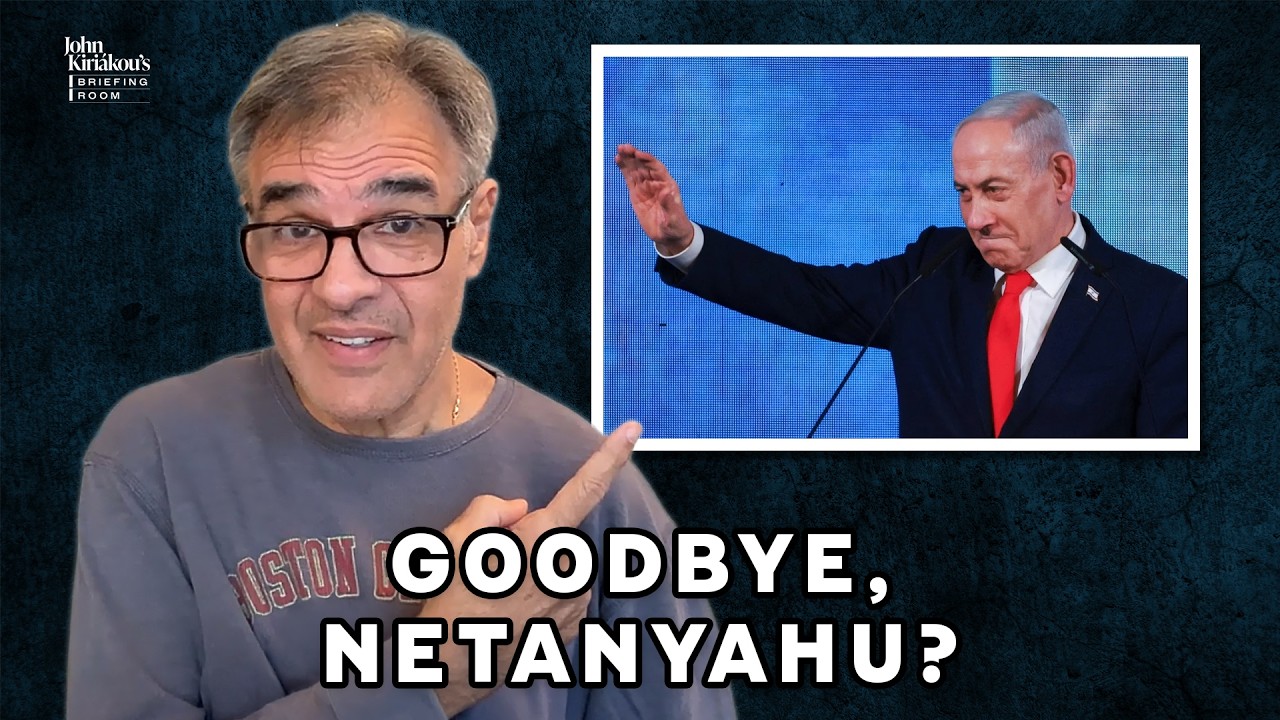 Netanyahu Loses Big Time. Will It Matter? Israel Election Results Arrive
Things we can learn from the video
Press to jump
- 1:53Haaretz's exit-poll graphic puts neither main bloc at a majority without support from Arab parties.
- 2:32Kiriakou argues coalition deadlock could keep Netanyahu in office as caretaker prime minister.
- 7:52He examines Arab voter turnout and why he considers an Eisenkot coalition with Arab parties unlikely.
- 11:00Lula's Brazilian election victory prompts Kiriakou to acknowledge that his own expectations were wrong.
- 18:13He reads Trump and Vance's campaign stops in reliably Republican states as a sign of concern.
- 27:20His US forecast gives Democrats the Senate and Republicans the House.
Neither bloc has a majority. That is the problem at the heart of John Kiriakou's election edition of The Briefing Room: the projections he presents leave Benjamin Netanyahu weakened, but his opponents without enough seats to govern alone.
A Haaretz clip featuring reporter David Issacharoff sets out the parliamentary arithmetic. Gadi Eisenkot's bloc is ahead of Netanyahu's, while Arab parties hold seats that could determine whether an alternative government is possible.
Kiriakou's answer to the title's question, "Will It Matter?", is that a change in seats does not necessarily produce a change in leadership. Netanyahu remains caretaker prime minister until a new government can be formed. Kiriakou argues that Eisenkot's reluctance to build a coalition with Arab parties could prolong that position, despite their strong electoral showing.
"He just has to make sure that nobody else wins," Kiriakou says. It is the distinction driving this opening section: winning enough support to replace a government is a different task from leaving its leader without a majority.
The episode then widens into an international election roundup. Kiriakou acknowledges that Lula's victory in Brazil surprised him, before examining American early-voting figures and Donald Trump and JD Vance's campaign itineraries. He interprets their concentration on reliably Republican states as evidence of concern, then forecasts a Democratic Senate win and Republican control of the House. Those are his predictions, not election results.
The broadcast includes a paid gold-investment advertisement. For readers coming specifically for the Netanyahu analysis, the coalition discussion occupies the opening section, before the move to Brazil at eleven minutes.
Leader of Israel's Yashar party and a former military chief of staff. He led the party in the 2026 election as the main challenger to Prime Minister Benjamin Netanyahu.
More on Wikipedia ›Brazil's president since 2023 and a member of the Workers' Party. Luiz Inácio Lula da Silva also held the presidency from 2003 to 2011.
More on Wikipedia ›Published on Trari
Where next?


 Is this your channel?For the channel's owners and team: a ready picture and text for your audience
Share the story with your audience. Everything is ready:
For an Instagram story or a WhatsApp status
For a community post or your channel's description
- Channel
- John Kiriakou
- Subscribers
- 390,000 ▲ 22,000 this week
- Channel views, last 7 days
- 2,774,536
- Channel views, pace per day
- 299,516 (on a normal day: 304,469)
- Video published
- October 29, 2026
- Video views so far
- 873,509 (4 days online)
- Video views, pace per day
- 46,271 (on a normal day: 254,009)
The numbers
This episode's views are not an unusual result for John Kiriakou. The story here is his explanation of how an electoral setback can coexist with continued control of government.

💡 Test your knowledge
How many seats are there in Israel's Knesset?
The Knesset has 120 seats, making 61 the threshold for a parliamentary majority.