
 United States
 United Kingdom
 Canada
 Australia
 New Zealand
 Ireland
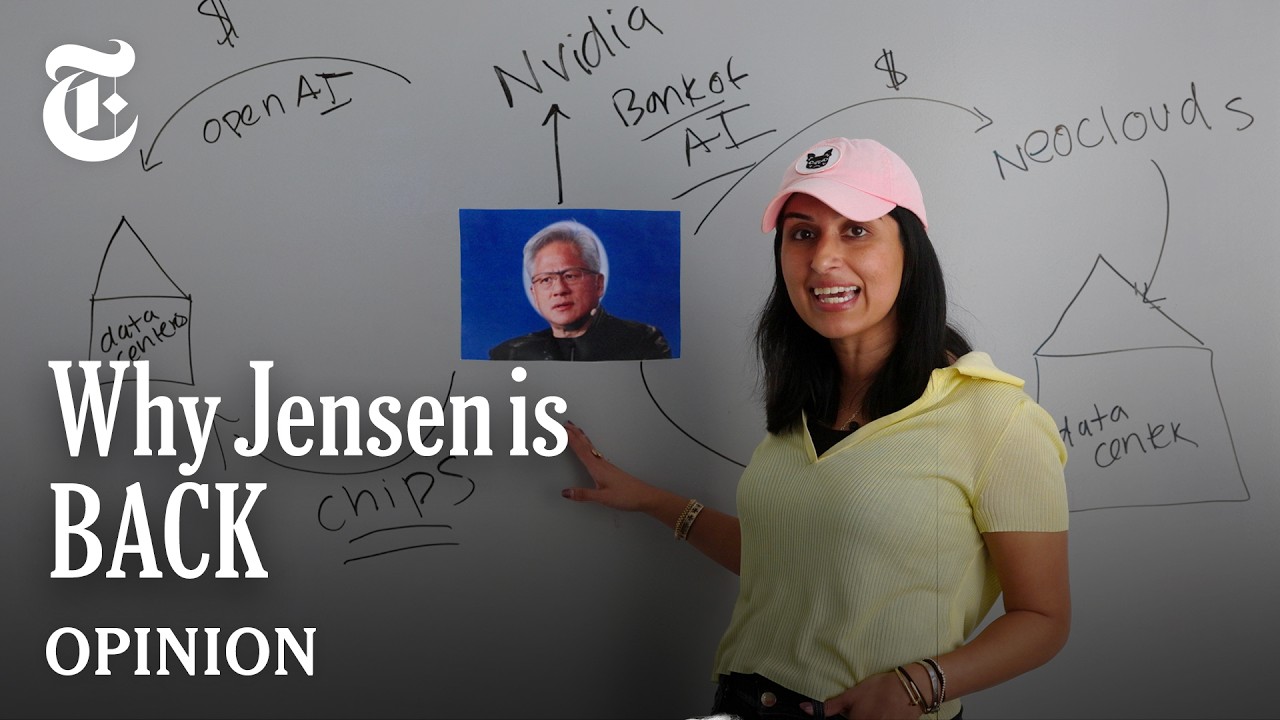
Natasha Sarin puts Nvidia's "bank of AI" on a whiteboard
The New York Times Opinion video drew an estimated 158,000 first-day views with a look at how the chip designer helps finance its own customers.
 Why the U.S. Can’t Afford to Let Nvidia Fail
Up nextTrari.com home page ›



 New York Times Opinion
Story of
Why this story? The video opened at a pace of 157,941 views a day, 12 times a normal first day on this channel (13,126).
When an AI developer needs more computing power, it can rent it from a data center. But who helps that data center take on the cost? In Natasha Sarin's telling, it can be the same company that supplies the chips: Nvidia.
In "Why the U.S. Can't Afford to Let Nvidia Fail", the economist uses Jensen Huang's return as CEO to explain why she thinks so much rides on him. At the whiteboard, she traces the deal from developers such as OpenAI to companies that run data centers. Nvidia can take a stake in those companies and promise to take over contracts if needed, Sarin says. With cloud providers such as CoreWeave, that means Nvidia can help back a business that buys its hardware. "That makes Nvidia almost like the bank of AI," she says.
The video drew nearly ten times as many first-day comments as a regular New York Times Opinion upload. A recurring question went right back to the distinction Sarin raises at the start: even if Nvidia is hard to replace, does that mean Huang is too?
Nvidia is a U.S. technology company that designs graphics processors used in AI and other high-performance computing.
More on Wikipedia ›Jensen Huang is an electrical engineer who co-founded Nvidia and serves as its president and CEO.
More on Wikipedia ›OpenAI is a San Francisco company that develops generative AI models, including the GPT family of large language models.
More on Wikipedia ›CoreWeave is a U.S. cloud computing company that runs data centers equipped with graphics processors for AI workloads.
More on Wikipedia ›Published on Trari.com
Go back to Trari.com home page
Where next?
Things we can learn from the video
Press to jump
- 0:18Sarin counters former Goldman Sachs CEO Lloyd Blankfein's skepticism about indispensable executives by making an exception for Huang.
- 1:42AI developers rent computing power, and Nvidia can back data center deals with equity stakes and contract guarantees.
- 3:07Sarin argues that exclusive chip upgrade agreements help Nvidia hold on to its customers.
- 3:49Nvidia acts like a bank, Sarin says, because it provides financing as well as hardware.
- 4:12CoreWeave illustrates the financial risk Sarin sees when Nvidia helps finance companies that buy its chips.
- 4:44Sarin uses Nvidia's stock movements to argue that the broader economy has already made a big bet on Huang.
What viewers say
Leadership under someone besides Jensen does not guarantee failure.
@UncleEntropySee it on YouTubeIf Huang was a good CEO, he built a business model that transcends the need for one particular person. Business model does not equal CEO.
@cbuddeSee it on YouTube
Public comments from the video's page on YouTube
Want to know when somebody answers you?
 For the channel's owners and team
Share the story with your audience
A ready picture for an Instagram story or a WhatsApp status.
Ready text for a community post
- Channel
- New York Times Opinion
- Subscribers
- 225,000 ▲ 6,000 this week
- Channel views, last 7 days
- 1,711,535
- Channel views, pace per day
- 825,509 (on a normal day: 151,442)
- Video published
- November 23, 2026
- Video views so far
- 192,091 (2 days online)
- Video views, pace per day
- 152,038
The numbers
Sarin's video started well ahead of the channel's usual pace for a regular upload. New York Times Opinion's daily views across all its videos also ran at more than five times their usual level.

💡 Test your knowledge
Which company makes ChatGPT?
OpenAI developed and launched ChatGPT.