
 United States
 United Kingdom
 Canada
 Australia
 New Zealand
 Ireland
Economics Explained asks who gains when India's workers train robots
The factory footage pays workers more for a shift, but the essay asks what happens if it helps bring manufacturing back to richer countries.
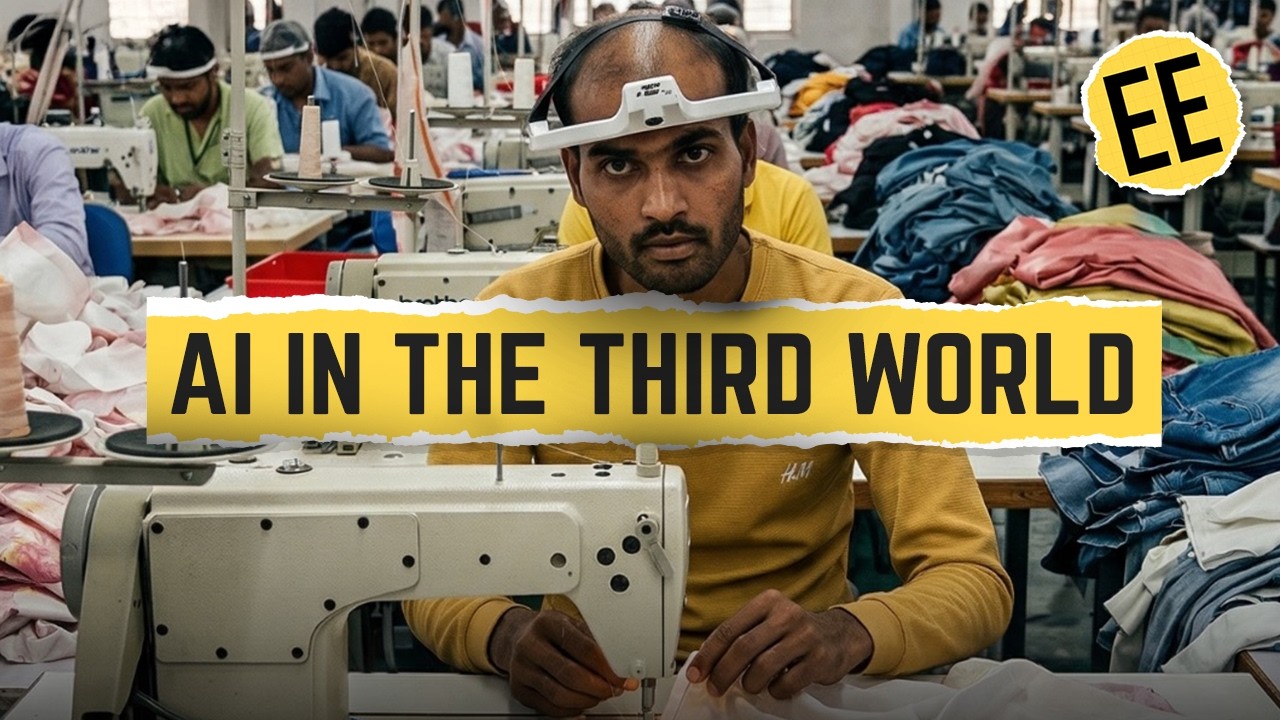 AI Is Speedrunning India's Economic Demise
Up nextTrari.com home page ›



 Economics Explained
Story of
Why this story? 1,586,222 views so far, and here is what is inside it.
A head camera turns an ordinary factory shift into a training film. The intended audience, as the narrator puts it in Economics Explained's "AI Is Speedrunning India's Economic Demise," is robots. The video includes a sponsored segment from 80,000 Hours.
For the workers in India, the immediate decision makes sense: the essay says a recorded session pays more than a regular factory shift. But the narrator doesn't expect the first robots trained on that footage to take those workers' jobs. The economics point somewhere else. A robot has an easier time paying for itself in a country where wages are high than in one where human labor is already inexpensive.
That's how the essay gets from a head camera to the much bigger claim in its title. If companies can automate enough of the work to bring production home, India and Bangladesh could lose some of the export manufacturing jobs that have helped other countries industrialize. The threat Economics Explained sees isn't just a robot taking someone's place on the factory floor. It's a factory that never opens there at all.
The comments focus on who does the work and who gets paid. Some viewers point to self-checkout as an example of a job shifted to the customer rather than done by a machine. Others ask who will buy what automated factories make if fewer people are earning wages. Economics Explained adds one more wrinkle near the end: some seemingly autonomous systems still have people operating them from far away.
Published on Trari.com
Go back to Trari.com home page
Where next?
Things we can learn from the video
Press to jump
- 0:00Factory workers in India wear head cameras to capture everyday tasks from their own perspective for robot training.
- 3:33Recorded sessions can pay workers more than regular factory shifts, giving them a reason to sign up.
- 6:08The essay explains why companies might automate a task to cut wages even without a big productivity gain.
- 9:00Robots are easier to justify in high-wage countries, where replacing a worker saves more money.
- 11:44If automation brings factories back to richer countries, India and Bangladesh could lose a route to industrial growth.
- 14:33Some ostensibly automated systems still rely on people operating them remotely.
A professional in this field? Want to write about Money & self-improvement on Trari? Tell us ›
What viewers say
Self-checkout isn't automation, it's having the customer do the job.
@BlackJar72See it on YouTubeI don't understand. if AI and mchines replace all the jobs, who is going to pay for all of those AI tokens and machines?
@supul32See it on YouTubeThese AIs are going to be really good at generating videos of work being done 😌
@EnkaybeeSee it on YouTube
1 more comment
That is so demoralizing. Imagine having to wear that to basically train your replacement.
@Thunder-h3hSee it on YouTube
Public comments from the video's page on YouTube
Want to know when somebody answers you?
 For the channel's owners and team
Share the story with your audience
A ready picture for an Instagram story or a WhatsApp status.
Ready text for a community post
- Channel
- Economics Explained
- Subscribers
- 2,900,000 ▲ 10,000 this week
- Channel views, last 7 days
- 2,798,463
- Channel views, pace per day
- 221,848 (on a normal day: 169,946)
- Video published
- November 25, 2026
- Video views so far
- 1,586,222 (3 days online)
- Video views, pace per day
- 135,468 (on a normal day: 1,079,985)
The numbers
The essay drew about 1.6 million views in its first three days.

💡 Test your knowledge
What is it called when a company brings production back to its home country?
Reshoring means moving production that had gone abroad back to the company's home country.