
 United States
 United Kingdom
 Canada
 Australia
 New Zealand
 Ireland
Arab parties' coalition leverage comes with conditions, BBC reports
The Global News Podcast examines what Arab-led parties would bring to an Eisenkot government, and why parliamentary arithmetic alone cannot secure their support.
 BBC News
Story of
Why this story? One of BBC News's most watched videos since yesterday, with 222,296 views.
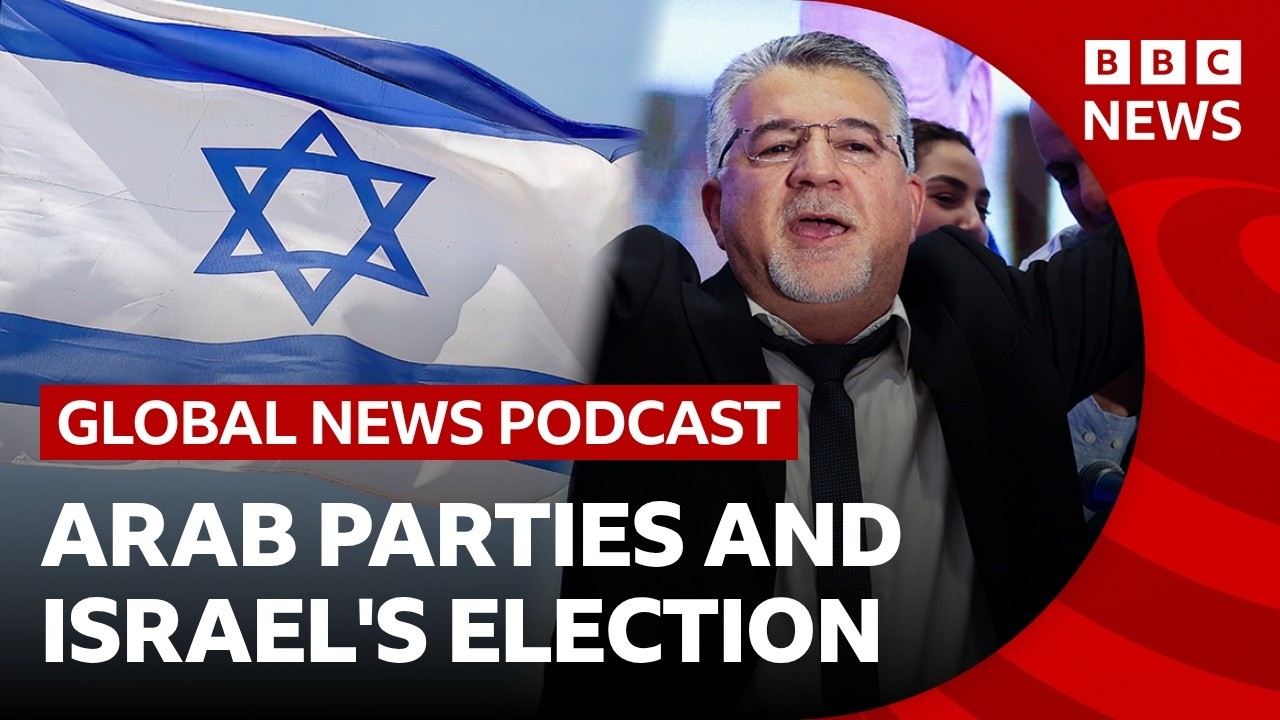 How Arab parties could decide Israel's election and Netanyahu's fate | Global News Podcast
Things we can learn from the video
Press to jump
- 0:46The BBC reports that Netanyahu's bloc fell short of the parliamentary majority needed to govern.
- 2:05Balad's Dr Maha Sabbah says cooperation cannot be unconditional or come at the expense of Arab parties' principles.
- 3:09James Landale explains why opposition divisions and tensions following October 7 complicate an Arab-Jewish governing arrangement.
- 6:14Issam Ikramawi links increased Arab turnout to crime, crackdowns, house demolitions and political exclusion.
- 7:52Ikramawi distinguishes the Joint List from Mansour Abbas's Ra'am and their approaches to coalition support.
Cooperation with Gadi Eisenkot cannot come at the expense of Arab parties' principles, Balad politician Dr Maha Sabbah tells BBC News. Her intervention puts conditions, rather than simply seat totals, at the centre of the question of who could form Israel's next government.
The Global News Podcast episode adds a party representative's position and an explanation of increased Arab turnout to the post-election debate. According to the BBC's account, Benjamin Netanyahu's bloc leads but lacks a parliamentary majority, while Eisenkot would need Arab-party support to assemble one.
In Tel Aviv, demonstrators call for a joint Arab-Jewish government. But diplomatic correspondent James Landale distinguishes that demand from the negotiations needed to deliver it. Opposition parties have indicated a willingness to talk, he reports, while divisions among them and tensions following October 7 remain substantial obstacles.
"The bar is high, but it's not impossible," Landale says.
BBC Arabic journalist Issam Ikramawi explains that the Arab-led parties are not a single political force with an identical approach to government. He contrasts the Joint List with Mansour Abbas's Ra'am, whose strategy has included participation in a governing coalition.
Ikramawi also connects increased turnout to concerns about rising crime, crackdowns, house demolitions and political exclusion. Those concerns help explain why voters mobilised, in his account, without settling which partnership their representatives would accept.
The episode drew about 222,000 views since yesterday. Its central distinction is between having the seats to make a government possible and agreeing on the terms under which to support it.
Leader of Israel's Yashar party and a former military chief. He was Benjamin Netanyahu's main challenger in the 2026 parliamentary election.
More on Wikipedia ›A Palestinian nationalist party in Israel led by Sami Abu Shehadeh. It joined Hadash and Ta'al in August 2026 to re-establish the Joint List alliance.
More on Wikipedia ›An alliance of Arab-majority parties in Israel, re-established in 2026 by Hadash, Balad and Ta'al. Its platform is left-wing, progressive and anti-Zionist.
More on Wikipedia ›An Arab-Israeli politician who leads Ra'am and represents it in Israel's parliament. In 2021, he joined an Israeli governing coalition.
More on Wikipedia ›An Islamist, conservative political party in Israel, also called the United Arab List. Led by Mansour Abbas, it joined a governing coalition in 2021.
More on Wikipedia ›Published on Trari
Where next?



 Is this your channel?For the channel's owners and team: a ready picture and text for your audience
Share the story with your audience. Everything is ready:
For an Instagram story or a WhatsApp status
For a community post or your channel's description
- Channel
- BBC News
- Subscribers
- 20,200,000
- Channel views, last 7 days
- 36,111,174
- Channel views, pace per day
- 8,449,586 (on a normal day: 4,859,374)
- Video published
- October 29, 2026
- Video views so far
- 286,161 (2 days online)
- Video views, pace per day
- 222,335
The numbers
This was BBC News's most watched upload from the past two days by views gained since yesterday.
