
 United States
 United Kingdom
 Canada
 Australia
 New Zealand
 Ireland
Fujifilm expands magnetic tape production for AI-era data storage
A Japanese report separates the practical case for offline archives from the nostalgia bringing music cassettes back into cafés.
 Japan
Why this story? One of ANNnewsCH's most watched videos since yesterday, with 201,630 views.
ANNnewsCH: The news channel of ANN, a Japanese news network led by TV Asahi. 5.1M subscribers and 6.4B views.
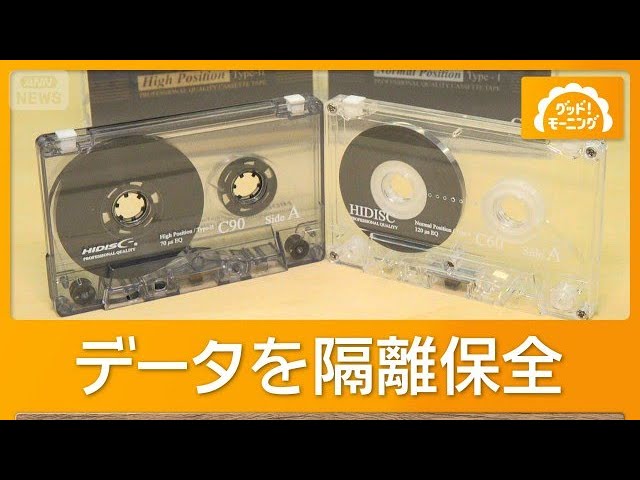 「磁気テープ」再注目 生成AIの普及でデータ量莫大に 情報流出リスク低く需要高まる【もっと知りたい!】【グッド!モーニング】(2026年11月13日)
Next story: Arlington guard's medal unusual for junior troops, Japanese report says
Things we can learn from the video
Press to jump
- 0:21Customers at Shibuya's CASSE café describe the appeal of cassette sound and mechanical player buttons.
- 1:08Fujifilm plans a ¥10 billion investment in Odawara to increase data-storage tape production capacity fivefold.
- 1:39Risako Wakatsuki links expansion to AI-driven data growth and anticipates additional demand for protection against unauthorized access.
- 2:04The report explains higher recording densities, offline storage and tapes' lack of electricity consumption while stored.
- 3:45Cassette specialist Akira Ebata demonstrates recording equipment and the large tape reels known as pancakes.
- 4:26Ebata explains how adjusting analog recording levels prevents distortion and helps achieve the sound customers want.
Fujifilm plans to increase its data-storage tape production capacity fivefold, putting a technology associated with cassette players to work on a very different problem: preserving the enormous volumes of information generated in the AI era.
Japan's All-Nippon News Network, through TV Asahi's ANNnewsCH channel, reports that the company will invest about ¥10 billion at its manufacturing site in Odawara, southwest of Tokyo. The report describes it as Fujifilm's first major investment of this kind in two decades.
Company representative Risako Wakatsuki says growing demand linked to generative AI prompted the expansion. She also expects greater interest in tape as protection against unauthorized access: cartridges can be physically disconnected from networks and stored offline, reducing their exposure to cyberattacks. While sitting in storage, the tapes themselves require no electricity.
The underlying recording principle is familiar, but these are digital data cartridges, not analog music cassettes. The report explains how increasingly fine magnetic particles, arranged densely and evenly on the tape surface, have enabled much larger storage capacities. Wakatsuki identifies long-term storage of large quantities of data as the main advantage.
Alongside that industrial story, the program visits CASSE, a cassette café in Tokyo's Shibuya district. Customers handle players and enjoy their mechanical buttons, while staff member Ami Takahashi says younger visitors find the retro sound fresh. That revival has a different driver from the demand for digital archives, a distinction viewers also raise in the comments.
In Mito, northeast of Tokyo, the report meets Akira Ebata, who has spent 45 years making music cassettes. He maintains aging machinery, demonstrates the large reels of tape known as pancakes and adjusts recording levels to prevent distortion while matching customers' preferred sound.
Production at his operation has risen from its low point, the report says. Ebata intends to keep making cassettes for as long as his company produces them: for him, tape is not a rediscovered technology but a life's work.
A Japanese multinational company based in Tokyo, with businesses spanning photography, optics, office and medical electronics, biotechnology and chemicals.
More on Wikipedia ›Published on Trari
Where next?



What do you think?
Want to know when somebody answers you?
- Channel
- ANNnewsCH
- Subscribers
- 5,100,000
- Channel views, last 7 days
- 17,372,200
- Video published
- November 13, 2026
- Video views so far
- 208,428 (less than a day online)
- Video views, pace per day
- 201,688
The numbers
The report drew about 202,000 views since yesterday, making it the most-watched new video in Japan's leading-news-channel selection.

💡 Test your knowledge
Where is the Fujifilm manufacturing site receiving the investment described in this report?
The report places the production expansion at Fujifilm's site in Odawara, Kanagawa Prefecture.