
 United States
 United Kingdom
 Canada
 Australia
 New Zealand
 Ireland
Netanyahu 'almost begging' for unity deal, ABC analyst says
Haaretz analyst Dahlia Scheindlin examines Eisenkot's coalition options, arguing that excluding Arab-Israeli parties is a political choice rather than a legal requirement.
 ABC News (Australia)
Story of
Why this story? One of ABC News (Australia)'s most watched videos since yesterday, with 161,171 views.
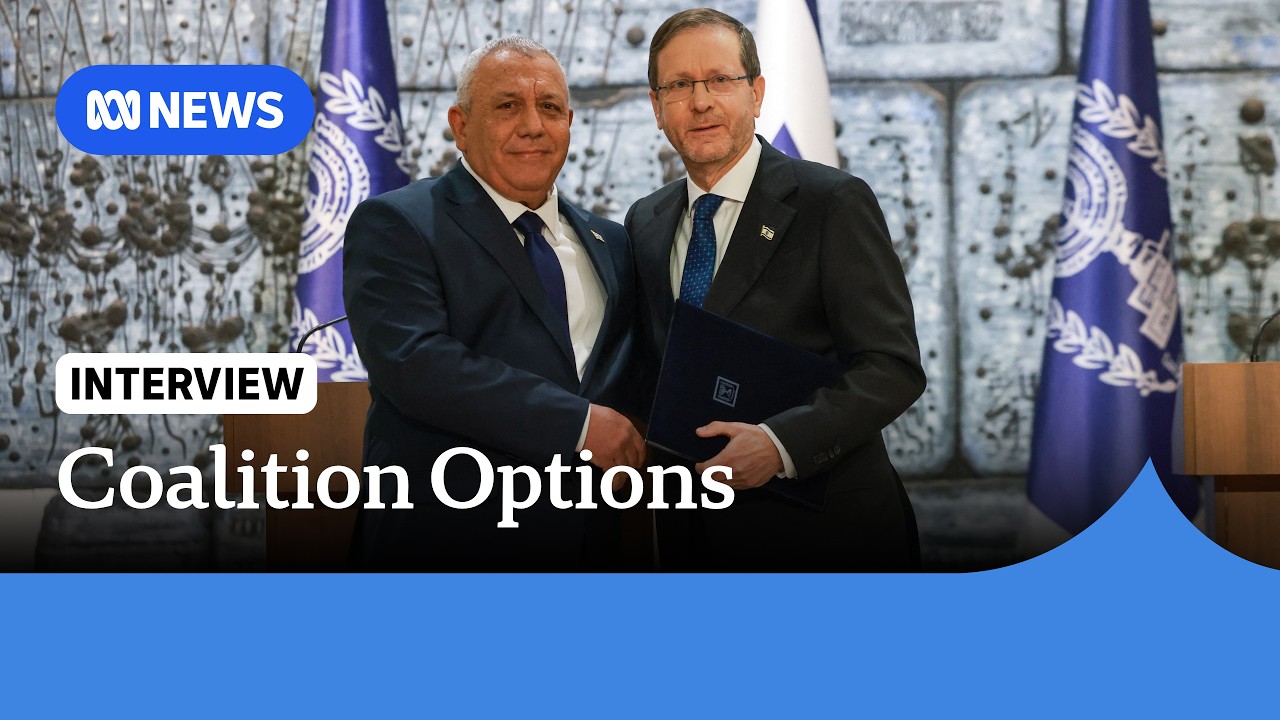 Netanyahu ‘almost begging’ Eisenkot to share power in new Israeli government: analyst | ABC NEWS
Things we can learn from the video
Press to jump
- 0:00ABC reports that Herzog has given Eisenkot the mandate to assemble a governing coalition.
- 1:23Scheindlin says ultra-Orthodox negotiations are under way and argues that excluding Arab parties is a political constraint.
- 3:55Scheindlin describes Netanyahu's push for unity and the obstacles to a power-sharing agreement.
- 5:40Possible outcomes include a minority government or failed negotiations; Scheindlin declines to assign firm odds.
Benjamin Netanyahu is pressing Gadi Eisenkot for a power-sharing government, Haaretz analyst Dahlia Scheindlin tells ABC News, describing him as repeatedly asking for unity and "almost begging for it".
The interview follows President Isaac Herzog's decision to give Eisenkot the mandate to assemble a government after Israel's deadlocked election. According to ABC's report, Eisenkot's centre-right Yashar party won fewer seats than Netanyahu's Likud, but he has been tasked with finding enough partners for a parliamentary majority.
Scheindlin says negotiations with ultra-Orthodox parties are already under way. Other possible routes include Arab-Israeli parties or defectors from Netanyahu's bloc, leaving Eisenkot with several combinations to explore rather than a single straightforward agreement.
Her central argument concerns which partners should be considered. "The sensitivity around the Arab parties is a self-imposed constraint that has no basis in Israeli law," she says. She points to previous experience of an Arab-Israeli party participating in government as a reason to keep that option open.
A unity deal with Netanyahu would bring a different obstacle: opposition resistance to allowing him to serve as prime minister, Scheindlin says. Netanyahu's enthusiasm for an agreement does not establish that Eisenkot or his prospective partners would accept one.
The segment drew about 161,000 views since yesterday. It ends without a confident prediction: Scheindlin sets out possibilities including a minority government or the collapse of negotiations. "To say it's 50-50 would be overstating the case. We just don't know."
An Israeli general and politician who leads the Yashar party. He headed Israel’s military from 2015 to 2019 and served as a minister in the unity government from 2023 to 2024.
More on Wikipedia ›An American-Israeli political consultant, pollster and journalist who writes regularly for Haaretz.
More on Wikipedia ›An Israeli politician who has been Israel’s president since 2021.
More on Wikipedia ›A major Israeli right-wing to far-right political party, founded in 1973 through an alliance of several right-wing parties.
More on Wikipedia ›Published on Trari
Where next?


 Is this your channel?For the channel's owners and team: a ready picture and text for your audience
Share the story with your audience. Everything is ready:
For an Instagram story or a WhatsApp status
For a community post or your channel's description
- Channel
- ABC News (Australia)
- Subscribers
- 2,640,000
- Channel views, last 7 days
- 13,398,225
- Channel views, pace per day
- 1,316,066 (on a normal day: 1,464,937)
- Video published
- November 10, 2026
- Video views so far
- 170,101 (less than a day online)
- Video views, pace per day
- 161,171
The numbers
The coalition interview was ABC News Australia's most-watched new video since yesterday.

💡 Test your knowledge
Who gave Eisenkot the mandate to try to form a government?
ABC's report says Israeli President Isaac Herzog gave Eisenkot the mandate.