
 United States
 United Kingdom
 Canada
 Australia
 New Zealand
 Ireland
Alsleben urges German spending cuts instead of shelving tax relief
The INSM director criticizes the 2027 budget compromise over electricity taxes, inflation-driven tax burdens and rising debt.
 GermanyStory of
Why this story? One of WELT Nachrichtensender's most watched videos since yesterday, with 142,124 views.
WELT Nachrichtensender: The German news channel WELT, formerly N24, owned by the media group Axel Springer. 2.5M subscribers and 5.9B views.
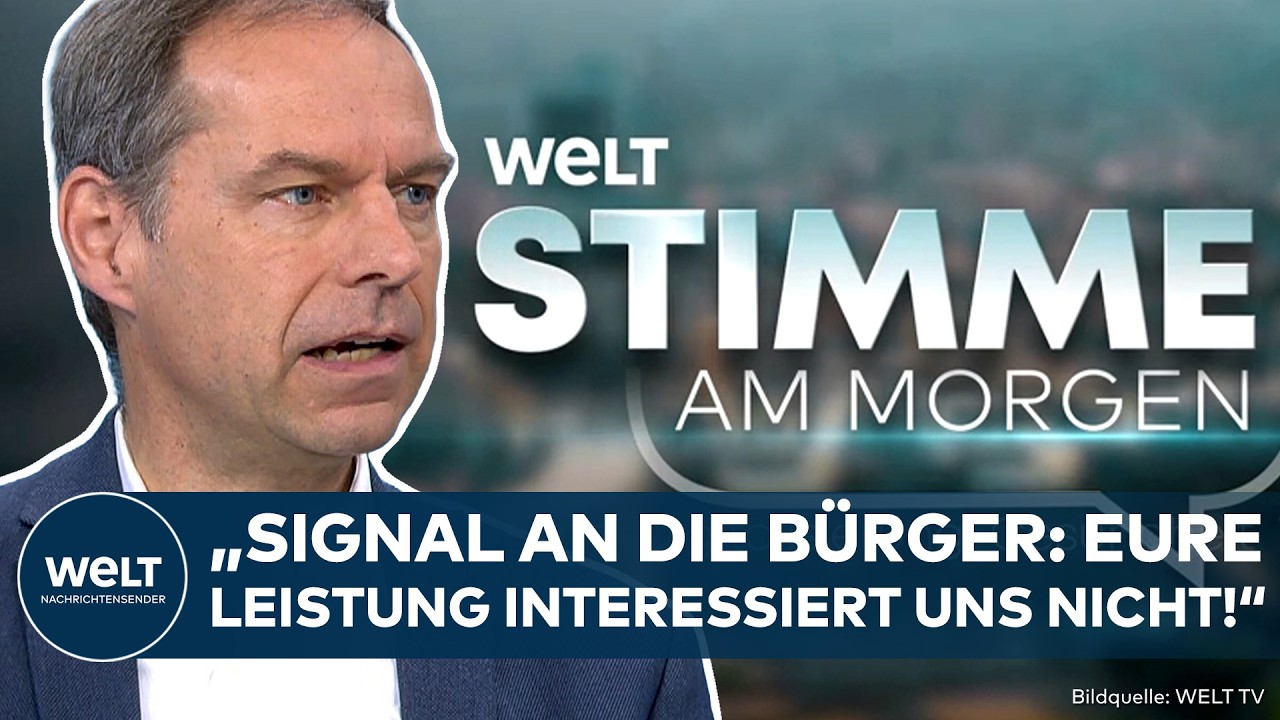 HAUSHALT: "Armutszeugnis!" Experte rechnet ab! Koalition verpasst Arbeitern eine derbe Klatsche
Next story: Navidi sees an anti-AI message in US midterm results
Things we can learn from the video
Press to jump
- 0:24Alsleben argues that the budget compromise adds burdens instead of delivering promised relief to households and businesses.
- 1:51He identifies subsidies and the Mütterrente pension measure as places where the government could reduce spending.
- 2:51He criticizes the proposed German sugar-tax design in comparison with Britain's model.
- 3:48He condemns the possible failure to offset inflation-driven increases in workers' income-tax burdens.
- 5:49He warns that rising debt will increase interest costs without delivering enough investment for the future.
- 6:36He calls for structural savings in ministries, agencies and civil-service staffing rather than further burdens on working people.
Promised tax relief should not give way to higher burdens on people who work, Thorsten Alsleben argues in a sharply critical interview about Germany's 2027 federal budget compromise.
Speaking on Germany's WELT Nachrichtensender, Alsleben, managing director of the Initiative Neue Soziale Marktwirtschaft (INSM), says the government should cut subsidies and administrative spending rather than abandon relief for households and businesses. INSM is a free-market advocacy organization founded by the employers' association Gesamtmetall, a background that helps explain his emphasis on smaller government and business competitiveness.
Two tax questions anchor his criticism. The interview describes a promised general electricity-tax reduction as missing from the compromise, while compensation for inflation-driven income-tax increases remains uncertain. That second issue, known in Germany as "kalte Progression," arises when nominal pay increases push workers into higher tax burdens without improving their purchasing power. Alsleben calls the failure to offset it a damning indictment of policymakers.
Asked where savings could come from, he points to direct subsidies and criticizes the proposed Mütterrente pension measure, which credits mothers for time spent raising children. He puts its cost at five billion euros. He also argues for structural savings across ministries, public agencies and civil-service posts.
The discussion extends to a proposed sugar tax, whose German design he considers worse than the British model, and the Federal Employment Agency's finances. Alsleben says budget requirements associated with agency chief Andrea Nahles are not being met.
His broader warning is that borrowing and future interest bills are increasing without enough genuine investment in the country's future. One presenter reinforces that argument by describing Germany's difficulty as a spending problem rather than a revenue problem.
These are the interview's economic judgments, not a final parliamentary outcome. Asked whether lawmakers might substantially revise the compromise in the budget committee before its adoption, Alsleben expresses little confidence that they will.
A German think tank and lobby group founded in 2000 by the employers’ organization Gesamtmetall. It promotes free-market reforms, entrepreneurship, individual responsibility and competitiveness.
More on Wikipedia ›A German federal agency overseen by the Federal Ministry for Labour and Social Affairs. Its director is Andrea Nahles.
More on Wikipedia ›A former German politician who has led the Federal Employment Agency since 2022.
More on Wikipedia ›Published on Trari
Where next?


What do you think?
- Channel
- WELT Nachrichtensender
- Subscribers
- 2,500,000 ▲ 10,000 this week
- Channel views, last 7 days
- 25,828,258
- Channel views, pace per day
- 1,447,221 (on a normal day: 4,099,663)
- Video published
- November 12, 2026
- Video views so far
- 142,124 (less than a day online)
- Video views, pace per day
- 165,195
The numbers
The budget interview drew about 142,000 views since yesterday, placing it among Germany's most-watched new news videos.

💡 Test your knowledge
What does "kalte Progression" refer to in this budget discussion?
Nominal pay rises can increase workers' tax burdens even when inflation leaves their purchasing power unchanged.