
 United States
 United Kingdom
 Canada
 Australia
 New Zealand
 Ireland
Japan's food tax cut divides ruling party and worries small farmers
Former prime minister Shigeru Ishiba questions the funding, while tax-exempt growers fear a measure meant to help shoppers could reduce their income.
 JapanStory of
Why this story? One of TBS NEWS DIG Powered by JNN's most watched videos since yesterday, with 142,657 views.
TBS NEWS DIG Powered by JNN: The news channel of JNN, a Japanese news network led by TBS. 3.4M subscribers and 5.8B views.
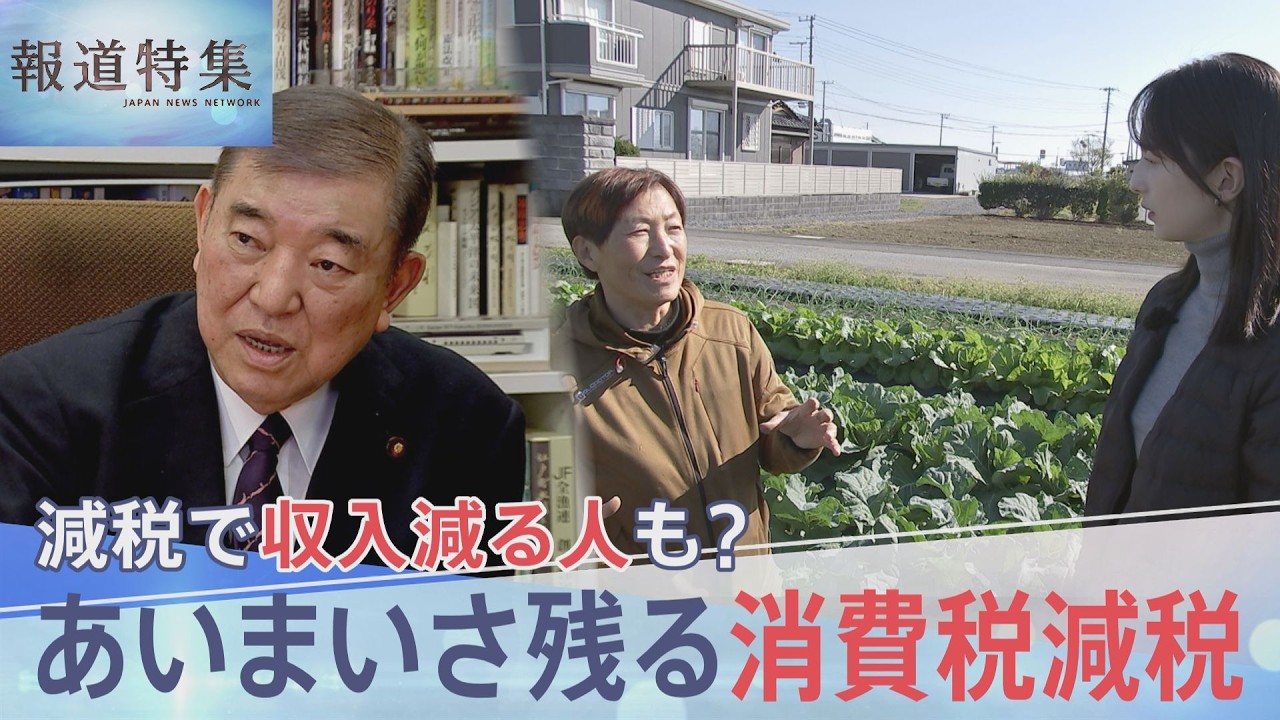 高市総理の悲願「消費税減税」で波乱 石破前総理が“造反”の本音語る「賛成した方が楽」 減税で収入減る人も? 【報道特集】|TBS NEWS DIG
Next story: Zelenskyy says formal Donbas-NATO offer would need public discussion
Things we can learn from the video
Press to jump
- 0:23The proposed food consumption tax cut would reduce the rate from 8% to 1% for two years.
- 3:32Four LDP lawmakers leave the lower-house vote and receive party reprimands, the report says.
- 4:22Ishiba explains his opposition: the government has not identified replacement revenue for the tax cut.
- 8:11Tax-exempt farmers explain why a lower food tax could reduce their income while production costs remain high.
- 17:28The report examines how the government would fund the tax cut and support payments.
- 20:34Professor Sato argues that demand-stimulating tax cuts during inflation could backfire and worsen fiscal concerns.
A cheaper grocery bill could come at a cost to some of the farmers supplying the food. That is one concern in Japan's debate over Prime Minister Sanae Takaichi's proposed consumption tax cut, which has also drawn dissent from her predecessor within the ruling Liberal Democratic Party.
Japan's TBS NEWS DIG Powered by JNN reports that the bill has passed the House of Representatives despite unresolved questions about funding and compensation for those who could lose out. It would lower the consumption tax on food from 8% to 1% for two years. The feature follows scrutiny in the upper house, where Takaichi describes the cut as a long-held ambition.
Former prime minister Shigeru Ishiba, former economy minister Yuko Obuchi and two other LDP lawmakers left the chamber for the lower-house vote and received party reprimands, according to the report. Ishiba says his objection is that replacement revenue has not been identified. Supporting the measure would be easier, he explains, but he will not endorse something he cannot accept. Obuchi argues that party members need not all respond with agreement.
The report then visits Kazo, in Saitama Prefecture, where vegetable farmer Hisae Unuma describes rising material costs and another threat to her take-home income. As a tax-exempt business, she does not remit consumption tax on her sales. The report explains that reducing the tax component of what she receives could therefore leave her with less income. Rice farmer Hideo Hachisuka also voices concern about reduced receipts alongside weak rice prices.
The fiscal question extends beyond the food tax cut. The report puts the combined cost of the cut and a support-payment scheme at roughly 10 trillion yen, examining parliamentary questions to Finance Minister Satsuki Katayama and the government's plans to find savings.
Hitotsubashi University professor Motohiro Sato questions whether spending reform can reliably provide the money. He argues that stimulating demand through tax cuts during inflation could be counterproductive, and that the government should explain funding for its wider defense and investment commitments at the same time.
The studio discussion returns to the growers: their potential losses are already a concern, while the arrangements for making them whole remain unclear.
Japan’s prime minister and leader of the Liberal Democratic Party since October 2025. She is the first woman to hold either post.
More on Wikipedia ›A major conservative and nationalist party that has governed Japan almost continuously since 1955. It is led by Sanae Takaichi.
More on Wikipedia ›Japan’s prime minister and Liberal Democratic Party leader from 2024 to 2025. He remains a member of the House of Representatives.
More on Wikipedia ›A Liberal Democratic Party member of Japan’s House of Representatives. She briefly served as economy, trade and industry minister under Shinzo Abe before resigning.
More on Wikipedia ›Japan’s finance minister since October 2025 and the first woman in the role. She is a Liberal Democratic Party politician serving in the House of Councillors.
More on Wikipedia ›Published on Trari
Where next?


What do you think?
Want to know when somebody answers you?
- Channel
- TBS NEWS DIG Powered by JNN
- Subscribers
- 3,430,000
- Channel views, last 7 days
- 40,226,545
- Channel views, pace per day
- 2,262,125 (on a normal day: 6,171,224)
- Video published
- November 14, 2026
- Video views so far
- 142,657 (less than a day online)
- Video views, pace per day
- 168,460
The numbers
The report drew about 143,000 views since yesterday, placing it among Japan's most-watched new news videos.

💡 Test your knowledge
What is the name of Japan's upper house of parliament?
Japan's parliament, the National Diet, consists of the House of Representatives and the House of Councillors.