
 United States
 United Kingdom
 Canada
 Australia
 New Zealand
 Ireland
Serbia's student victors put reform before EU talks, professor says
Euronews asks who will govern after the student-led victory, with Bojan Vranić explaining why the campaign did not revolve around a single leader.
 euronews
Story of
Why this story? The video opened at a pace of 79,268 views a day, 47 times a normal first day on this channel (1,686).
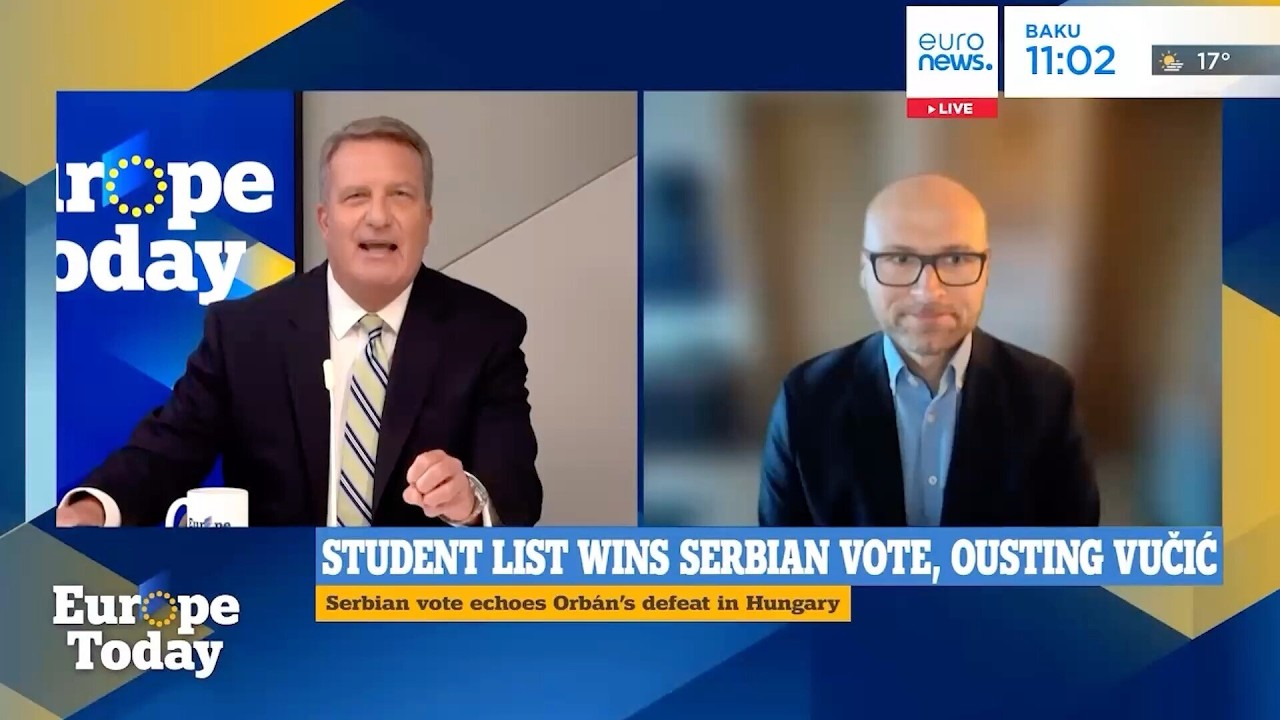 Serbia’s students change the political game, says political expert
Things we can learn from the video
Press to jump
- 0:15Vranić says decentralized campaigning challenged both the ruling establishment and the existing parliamentary opposition.
- 1:51A prime minister is not yet identifiable; campaign figures served as shields against media pressure.
- 2:44He describes a platform of improvements without sudden radical changes, appealing to voters who value continuity.
- 3:52Internal reform comes before EU negotiations, with no immediate integration breakthrough expected.
- 4:33The coalition's diverse factions make major foreign-policy shifts toward Russia, China and Kosovo unlikely, Vranić says.
The public faces of Serbia's student campaign served as shields against media pressure, not necessarily as prime ministers in waiting. That is how University of Belgrade political science professor Bojan Vranić explains the movement's leadership approach in an interview with Euronews' Europe Today.
The presenter's question is practical: with the student list projected to hold a parliamentary majority, who will actually run the government? Vranić says it is too early to name a prime minister. He describes a decentralized campaign whose victory challenged not only the ruling establishment but also the existing parliamentary opposition.
The interview drew nearly 74,000 views in its first 20 hours, far beyond the channel's usual first-day audience for regular videos. Its substance moves quickly from how the students won to what they intend to change.
Vranić argues that the newcomers are prepared to govern, but that their platform offers improvements rather than an abrupt break with everything that came before. He connects that approach to conservative voters who want continuity alongside reform.
That caution extends abroad. Despite European Council President António Costa's message of support for reforms, Vranić does not expect an immediate breakthrough in European integration. He says the movement wants to strengthen institutions at home before negotiating with the EU as an equal partner. Nor does he anticipate major changes toward Russia, China or Kosovo: the coalition contains different factions, limiting how far it can move together.
A landlocked country in Southeastern and Central Europe with about 6.5 million people. Its capital and largest city is Belgrade.
More on Wikipedia ›President of the European Council since 2024. The Portuguese politician previously served as Portugal's prime minister from 2015 to 2024.
More on Wikipedia ›Published on Trari
Where next?



 Is this your channel?For the channel's owners and team: a ready picture and text for your audience
Share the story with your audience. Everything is ready:
For an Instagram story or a WhatsApp status
For a community post or your channel's description
- Channel
- euronews
- Subscribers
- 2,590,000 ▲ 10,000 this week
- Channel views, last 7 days
- 7,110,029
- Channel views, pace per day
- 635,154 (on a normal day: 793,308)
- Video published
- October 26, 2026
- Video views so far
- 73,693 (less than a day online)
- Video views, pace per day
- 79,268
The numbers
The Serbia interview drew an unusually large early audience for a regular Euronews upload. Here is how its start compares with the channel's usual first day.

💡 Test your knowledge
In which country is the University of Belgrade?
Belgrade is Serbia's capital and home to the university where Bojan Vranić teaches.