
 United States
 United Kingdom
 Canada
 Australia
 New Zealand
 Ireland
CBC examines backup rules behind Spain's fatal train collision
Andrew Chang's analysis adds an engineering perspective on the signaling failure, the clearance to resume speed and dispatchers' training.
 CBC News
Story of
Why this story? One of CBC News's most watched videos since yesterday, with 103,908 views.
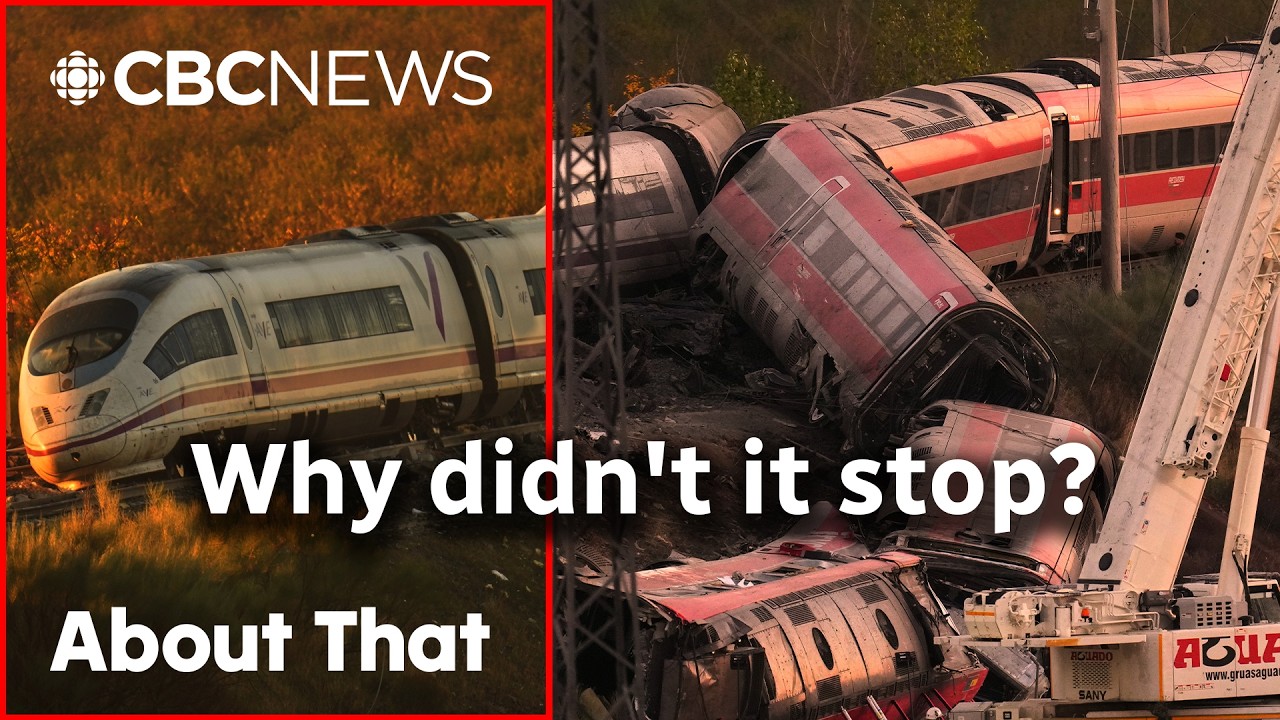 Did human error cause Spain's deadly high-speed train crash? | About That
Things we can learn from the video
Press to jump
- 1:18Chang reconstructs the positions of the Iryo and trailing Renfe trains near Urda.
- 2:24According to CBC, an LZB glitch halted the trains and forced reliance on manual signaling.
- 3:17Chang examines authorization for the trailing train to resume normal speed under BSL backup rules.
- 6:30Radio audio features in CBC's explanation of why the lead train remained stranded.
- 8:05Zarembski argues that dispatchers were not sufficiently trained to respond when the primary system failed.
The safety system failed. What happened after that is the central question in CBC News' analysis of the high-speed train collision near Urda, Spain, which the broadcaster reports killed at least 69 people.
In About That, Andrew Chang reconstructs the sequence using dispatcher recordings and explanations from railway engineering specialists. Beyond the collision itself, the report examines the backup procedures intended to keep trains moving safely when their primary protection fails.
According to CBC's account, a glitch in the LZB train-control system halted an Iryo train and a trailing Renfe train on the same line. Operations then depended on manual signaling. Chang examines the dispatcher's authorization for the trailing train to resume normal speed under the BSL backup rules, while the train ahead remained stranded with difficulties resetting its LZB system.
Radio exchanges between the Renfe driver and the Adif control center in Atocha form a key part of the explanation. Adif manages railway infrastructure, including tracks and signaling, rather than operating the passenger services.
"This is a two-part event, clearly," says Allan Zarembski, a University of Delaware railroad engineering specialist. He identifies both the primary system failure and a human element in what followed. Later, he argues that dispatchers were insufficiently trained for a failure of the main system.
The analysis has drawn about 104,000 views since yesterday. Its distinctive contribution is the examination of that fallback: not simply why a train stopped, but why the procedures used afterward did not keep the approaching train safely separated, according to the specialists interviewed.
A private high-speed rail operator in Spain, operating under the brand name Iryo.
More on Wikipedia ›Spain's state-owned national railway company, responsible for train services rather than the infrastructure managed by Adif.
More on Wikipedia ›Spain's state-owned manager of most railway infrastructure, including tracks, signaling and stations.
More on Wikipedia ›Published on Trari
Where next?



 Is this your channel?For the channel's owners and team: a ready picture and text for your audience
Share the story with your audience. Everything is ready:
For an Instagram story or a WhatsApp status
For a community post or your channel's description
- Channel
- CBC News
- Subscribers
- 4,780,000
- Channel views, last 7 days
- 13,299,689
- Channel views, pace per day
- 2,083,476 (on a normal day: 2,259,985)
- Video published
- October 30, 2026
- Video views so far
- 103,908 (less than a day online)
- Video views, pace per day
- 261,848
The numbers
CBC's About That analysis was its most watched new video since yesterday.
