
 United States
 United Kingdom
 Canada
 Australia
 New Zealand
 Ireland
BBC panel puts everyday costs at centre of AI's political reckoning
Rumman Chowdhury, Tabitha Goldstaub and Lara Lewington examine whether tougher scrutiny will redirect AI towards problems the public actually wants solved.
 BBC News
Story of
Why this story? One of BBC News's most watched videos since yesterday, with 160,214 views.
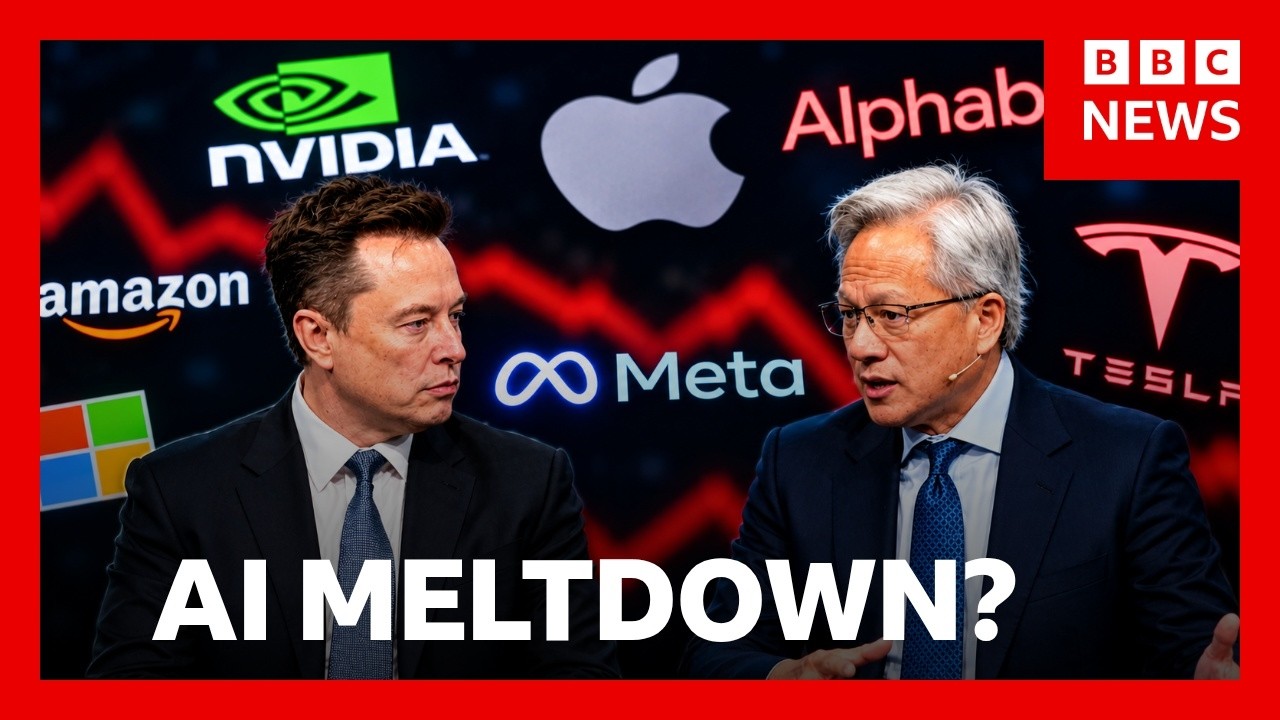 Is the AI party over after a week from hell? | BBC News
Next story: US flight halt: Sarah Smith relays officials' safety reassurance
Things we can learn from the video
Press to jump
- 2:00Chowdhury expects AI oversight to focus more on consumer protection and everyday algorithmic decisions.
- 2:44Trump's veto power could constrain federal legislation; Chowdhury points to states pursuing their own oversight bills.
- 4:17Goldstaub argues that people want help with everyday economic concerns, not a race towards artificial general intelligence.
- 5:20Lewington identifies resource consumption and local data centres as increasingly tangible sources of public anger.
- 7:07Fraser questions Britain's reliance on voluntary company testing as the panel considers the need for legislation.
- 13:48The closing discussion asks whether AI's hype is ending or giving way to more responsible governance.
Electricity use, local data centres and household economic worries, rather than distant visions of superintelligence, should shape AI's next political chapter. That is the argument running through BBC News's Artificial Intelligence Decoded discussion, presented by Christian Fraser.
The programme, which has drawn roughly 160,000 views since yesterday, examines the consequences of Democratic victories in both houses of Congress, according to the BBC's account of the US midterms. Its question is not simply whether the investment boom is faltering, but what greater political scrutiny could change.
Rumman Chowdhury, chief executive of Humane Intelligence, expects attention to move from frontier models towards consumer protection and the algorithms already affecting everyday life. Fraser raises an important constraint: Donald Trump retains presidential veto power. Chowdhury points to US states pursuing oversight through their own legislation.
Tech entrepreneur Tabitha Goldstaub argues that the industry's ambitions have become disconnected from public priorities. "The thing that people never asked for was a race for artificial general intelligence," she says. BBC technology journalist Lara Lewington identifies resource consumption and local data centres as concrete sources of public concern.
The discussion also reaches Britain, where Fraser questions an AI testing system that relies on companies participating voluntarily. Goldstaub argues for legislation rather than treating stronger governance as an obstacle to progress. Her answer to the title's suggestion that the AI party might be over is a different interpretation: "this is not a pause. This is a quality check, a governance check. This is actually a really good moment."
The US elections held on November 3, 2026, midway through Donald Trump's second term. Democrats won majorities in both the Senate and the House of Representatives.
More on Wikipedia ›Published on Trari
A professional in this field? Want to write about Tech on Trari? Tell us ›
Where next?


What do you think?
Want to know when somebody answers you?
 Is this your channel?For the channel's owners and team: a ready picture and text for your audience
Share the story with your audience. Everything is ready:
For an Instagram story or a WhatsApp status
For a community post or your channel's description
- Channel
- BBC News
- Subscribers
- 20,300,000 ▲ 100,000 this week
- Channel views, last 7 days
- 41,075,335
- Channel views, pace per day
- 3,834,565 (on a normal day: 5,980,419)
- Video published
- November 14, 2026
- Video views so far
- 160,214 (less than a day online)
- Video views, pace per day
- 209,808
The numbers
The BBC discussion drew about 160,000 views since yesterday.

💡 Test your knowledge
Which company developed ChatGPT?
OpenAI developed ChatGPT and publicly launched it in November 2022.