
 United States
 United Kingdom
 Canada
 Australia
 New Zealand
 Ireland
Pakistan's solar boom leaves a costly question for its grid
BBC News follows households and factories choosing their own power, then asks who pays to maintain the network they use less.
 BBC News
Story of
Why this story? One of BBC News's most watched videos since yesterday, with 282,571 views.
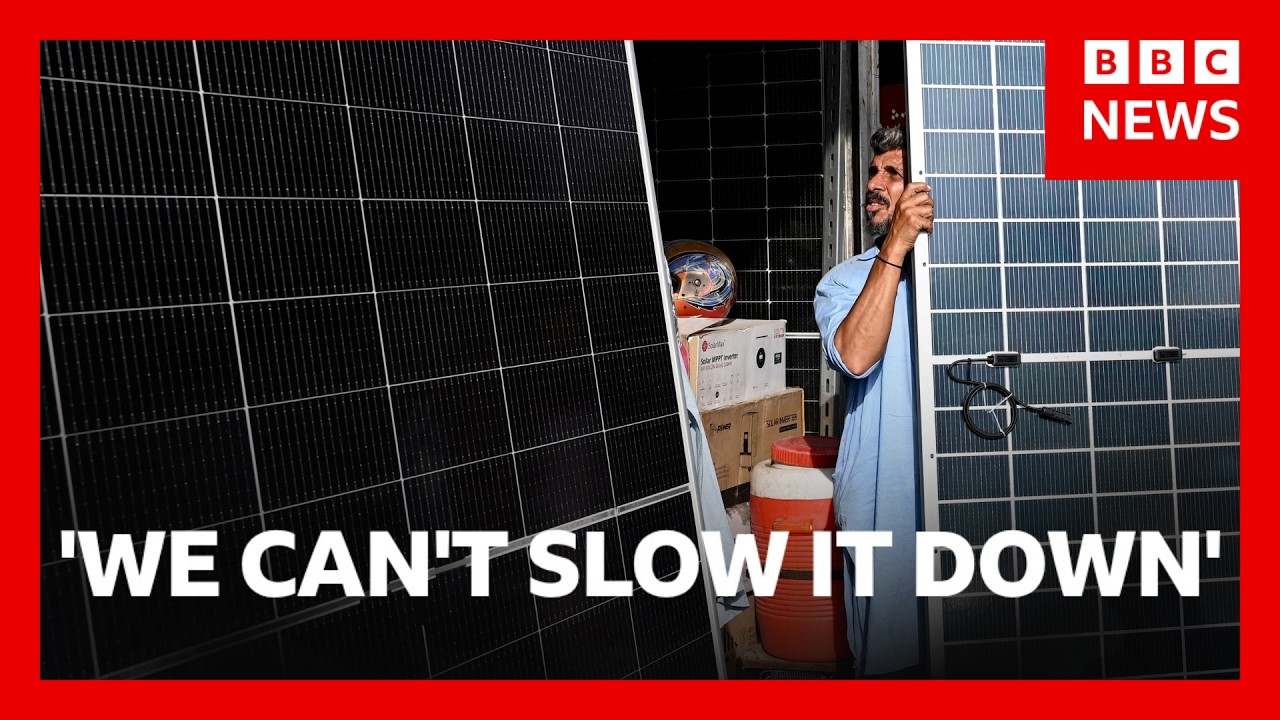 Is Pakistan at risk of fumbling its solar energy revolution? | BBC News
Next story: US flight halt: Sarah Smith relays officials' safety reassurance
Things we can learn from the video
Press to jump
- 0:50In rural Punjab, Faisal Shahzad explains why high electricity bills led him to solar power.
- 2:42Kohinoor Textile Mills combines a large solar array with battery storage to support factory operations.
- 3:57Reduced grid use can leave fewer customers paying fixed network costs, raising prices and encouraging further departures.
- 5:07Muhammad Hassan Dajana warns that mounting losses could turn power companies into an expensive burden.
- 5:56Energy Minister Awais Ahmad Leghari says grid plans accommodate solar growth and denies trying to slow it.
Faisal Shahzad wants solar panels over every room of his house. In rural Punjab, he tells BBC correspondent Carrie Davies that generating his own electricity offers an escape from punishing bills. His ambition captures the appeal of a transition being driven by Pakistan's residents and businesses rather than its government, according to the report.
The same calculation extends to industry. At Kohinoor Textile Mills, chief executive Taufique Saigol shows how a large solar installation and battery storage support factory operations. For a country heavily dependent on imported fuel, the BBC explains, producing more electricity at home offers greater energy independence.
But the report's central question arrives on a city rooftop: what happens to the national grid when more customers buy less of its electricity?
Maintaining the network still costs money. As those fixed costs fall on fewer paying customers, prices can rise, encouraging still more people to switch to solar. Davies describes the risk as a "utility death spiral". Muhammad Hassan Dajana, of Renewables First, warns that the worst outcome would leave power companies accumulating losses and becoming an expensive burden.
Energy Minister Awais Ahmad Leghari rejects the idea that solar growth threatens the grid's survival. He says its expansion is already incorporated into plans to adapt pricing and technology, and insists the government is not trying to restrain it.
"We can't slow it down. It's not in our control, and we haven't ever exercised any control to slow down," he tells Davies.
Pakistan’s federal energy minister since March 2024, serving in Prime Minister Shehbaz Sharif’s cabinet. He previously served as power minister from 2017 to 2018.
More on Wikipedia ›Published on Trari
Where next?


What do you think?
Want to know when somebody answers you?
 Is this your channel?For the channel's owners and team: a ready picture and text for your audience
Share the story with your audience. Everything is ready:
For an Instagram story or a WhatsApp status
For a community post or your channel's description
- Channel
- BBC News
- Subscribers
- 20,300,000 ▲ 100,000 this week
- Channel views, last 7 days
- 41,075,335
- Channel views, pace per day
- 3,834,565 (on a normal day: 5,980,419)
- Video published
- November 14, 2026
- Video views so far
- 282,571 (less than a day online)
- Video views, pace per day
- 314,111
The numbers
The BBC report has drawn roughly 283,000 views since yesterday.

💡 Test your knowledge
Which city is Pakistan's capital?
Islamabad is Pakistan's capital, while Karachi is its largest city.